





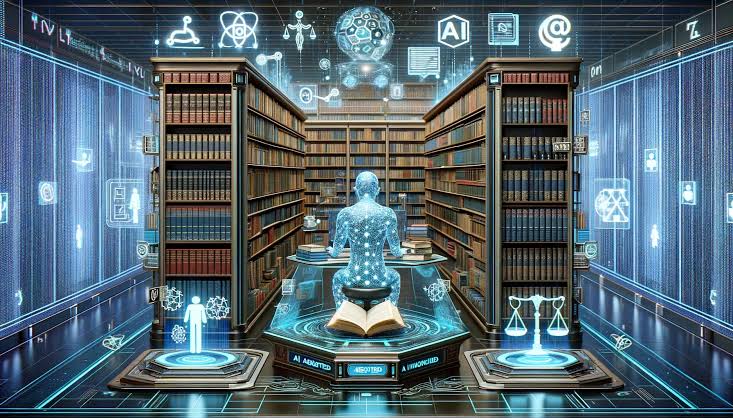
Artificial Intelligence, more commonly known as AI, has been around since the 1950s; however, there was a considerable increase in the use of AI when companies like OpenAI built generative AIs, one of the most famous being ChatGPT. This AI surge has been ongoing since 2020 to the present day (2026), with people today heavily dependent on AI, even for basic tasks. Today, 37% of the population start their research using generative AI rather than Google, as it is quicker and requires less effort. Due to this heavy reliance on AI, a major crisis has also been unfolding in the world of literature. Many people are now using AI to write articles, poetry, and, at times, even full-blown novels. A lot of these people don’t just use AI tools to help; they have AI generate the entire content of their creative writing, which completely removes the “creative” part of their work.
At surface level, the use of AI in literature may not seem damaging, but if we look more closely, it seems like the slow death of authentic storytelling. An analysis of Upwork data found that after the launch of ChatGPT, between November 2022 to February 2024, freelance writing jobs suffered the worst declines, which was a staggering 33% drop. Moreover, a Brookings Institution analysis showed that freelancers who were a part of text-heavy services like proofreading or editing saw an approximate 2% decline in new contracts monthly, with 5% decrease in total earnings on the platforms. These are not just some simple statistics; these are real people losing their livelihood right now because of the rise of generative AI.
Another significant pitfall of AI-generated text is plagiarism and a lack of originality. AI models are trained on billions of books, articles, blogs, and creative writings. These AIs can then unintentionally plagiarise texts or produce something that closely resembles the work of another writer, even when it is “generating a new text” based on patterns. Most of these authors never even consented to their work being ‘fed’ to these AI tools, and none of them were ever paid for it, raising further ethical concerns. In December 2023, The New York Times sued OpenAI and Microsoft, alleging that millions of its copyrighted articles were used without permission to train large language models across a dataset equivalent to a Microsoft Word document of over 3.7 billion pages. This shows that the AI industry is built on stolen works of other authors and takes what actually belongs to others.
Literature has always been a way for humans to document their experiences. Through stories, people talk about their feelings, about love, about grief, about injustice, and much more. The stories that stay with people long after are the ones that carry a weight of real consciousness behind them. Artificial Intelligence, no matter how hard it tries, can never replicate those emotions. An AI cannot grieve, it cannot be awed, it cannot sit in front of a screen at 2 am and think about moral uncertainty. All the AI can do is predict words and patterns extracted from the work of people who felt those things. According to Edelman’s 2025 research, AI-generated content is less trusted than human-written content. Readers can always sense the difference in content, even when they cannot always articulate it. This shows how
AI-written pieces of literature lack genuine viewpoints and completely fail to capture the emotions that literature is built on.
Now the question that this article poses is “What will Authorship mean in the future” or “Who owns the story,” and the answer is simple: authorship will mean what it has always meant. A human being, drawing on lived experiences and taking creative freedom as well as moral responsibility for what they put out in this world. The rise of AI in writing is not inevitable progress but a choice being made by technology companies, publishers, platforms, and writers. They choose to prioritise speed and cost over creativity, originality, and the livelihoods of real people. A story that is written by a machine does not belong to anyone because no one made it, and if the literary world is built on such stories, that world would be equally hollow.
Amzing💓
AI can help writers, but it should never take away the value of original human expression
Amazing artical
Incredible amazing story