





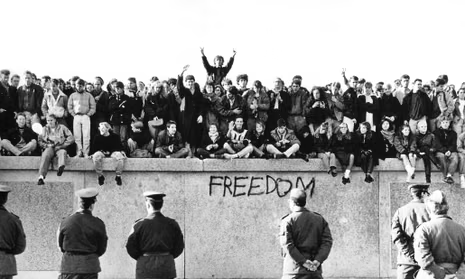
A watershed moment in history that contributed to the weakening of the Soviet Union and the Cold War barriers, through the exodus of East Germans and their subsequent rebellion against the communist regime, was the fall of the Berlin Wall. The Wall had greater implications than a physical division of the capital city. Its influence reached around the globe through the economic, political, and social consequences of the Wall that East Germans faced. That monumental collapse manifested itself as the recurring pioneer of global democratisation and freedom from oppressive practices; however, contemporary politics and the present unipolar system are turning back to the pre-war conditions through Western hegemony and capitalistic extremism.
After WW2, the Allied powers — the USA, UK, and France — and the USSR brought it upon themselves to rid Germany of Nazism and divided the country into four segments and two major zones, East and West Germany, both with contradictory ideological regimes. The USSR controlled the entire Eastern part, while the Allied powers distributed the West amongst themselves. Berlin, although entirely integrated into the USSR’s territory, was further split due to its logistical importance as the capital.
The German Democratic Republic of the East anchored itself as a Soviet satellite with communism and a state-controlled market. Subsequently, it faced elevated inflation and poverty. The Soviet regime exercised strict surveillance via its secret service, the Stasi. On the contrary, the Federal Republic of Germany of the West benefited from a capitalist policy and the USA’s financial aid in the Marshall Plan to rebuild the devastated remains of WW2 and the ongoing ruptures of the Cold War. This gap in the quality of life led to massive migrations from the east to the west, triggering the GDR to build a 155 km-long, concrete wall with fortified fences. The wall separated families, hindered job routes, represented the Cold War, and isolated the people of East Berlin into a state of coercion.
Decades later, in 1989, a domino effect occurred. A governmental press conference arranged to convey easier travel rules to the citizens of the GDR misfired and accidentally promulgated the citizens’ passage into the West. Bearing a burden of isolation no more, the people mobilised immediately and tore down the wall with hammers, overwhelming the security guards at checkpoints. Neighbouring communist regimes like Czechoslovakia, Romania, and Hungary became sanctuaries for the refugees and ultimately faced civil rebellion against the governments as well. One by one, democracy paved its way around states and became one of the deciding factors for the weakening of the soviet union, and its opponent — the United States of America — emerging as the unipolar power directing the course of the international state system. Within 2 years, Europe rapidly democratised and inspired a kindred transition in many Asian, African, and Latin American countries. Meanwhile, the United States of America championed itself as the leader of the ‘free world.’
Following this episode, the term ‘Pax Americana’ took form. It literally means ‘American peace,’ as this was the country that the rest of the world looked forward to for being accountable for maintaining law and order and supremacy of the principles of national sovereignty. Or so we thought. Since 1989, this unipolar leader has launched major military interventions and bombed at least 10 countries. It launched three full-scale wars under four presidents. These operations were always justified with a humanitarian concern of ‘promoting democracy’ or ‘countering terrorism.’
As per an analysis by Brown University Watson Institute of International and Public Affairs, US-led wars since 2001 have directly caused the deaths of about 940,000 people across Afghanistan, Pakistan, Iraq, Syria, Yemen, and other conflict zones. This number does not include indirect deaths caused by a lack of access to food and healthcare, war-related diseases, and funding of wars in other countries. The USA’s longest conflict, the war on terror in Afghanistan, aimed to dismantle Al-Qaeda and remove the Taliban from power. It resulted in the Taliban regaining control over Afghanistan. The Iraq war to find weapons of mass destruction (WMDs) instigated violence and a power vacuum there. Subsequent interventions in Libya, Syria, and now escalating tensions in Iran are doing the same, creating instability in the region and weakening global rule-based orders and democratic structures.
Soviet communism in East Germany used psychological intimidation, tapped wires, hidden cameras, etc., to surveil its people. Communism’s incapacitation in the post-fall of the Berlin Wall order temporarily empowered the privacy rights of individuals, but modern technology has succumbed to collecting data on its users as well for targeted marketing, paradoxically ridding people under capitalist regimes of their privacy.
A wall’s fall may have prompted a better, more peaceful, and just world, but only temporarily. The current system of invasions and subjugations is a mistake compared to the historic moment meant to promote global emancipation. Liberation, either at a state or an individual level, is the crux of mankind’s evolution towards civilisation, but the fall of the Berlin Wall failed to deliver it. The destruction has not solidified yet, and institutional orders can still be restored through lawful practices of states and corporations and intergovernmental organisations, ensuring accountability. Thereafter, we can have a milestone that will revolutionise universal stability.