





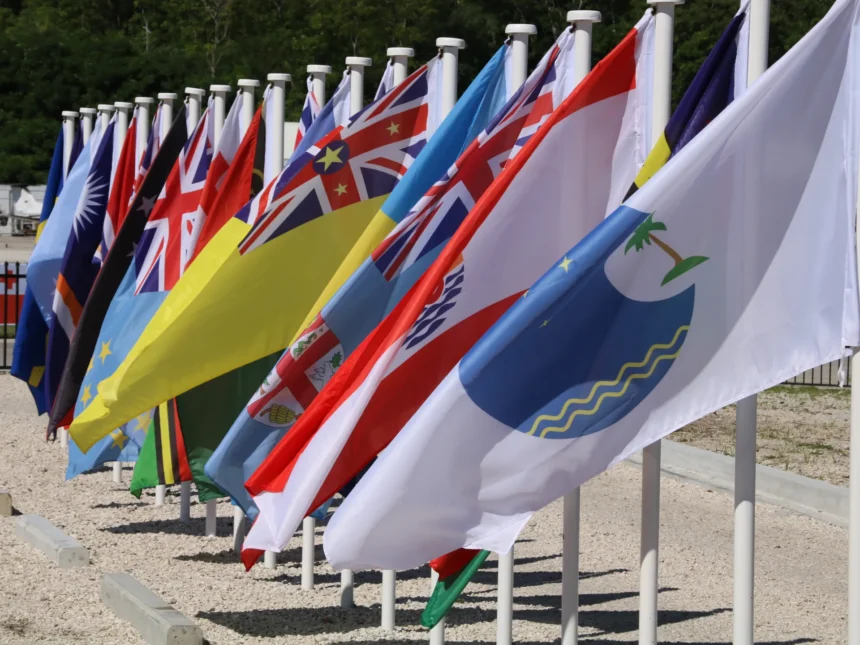
The Pacific island are a group of islands in the Pacific Ocean. They are grouped into three ethno-geographic categories: Melanesia, Micronesia, and Polynesia. Comprising tiny land areas and populations, the Pacific Island Countries (PICs) were often overlooked in policy discussions surrounding the Pacific region and regarded as mere pawns of greater powers. However, the last decade has seen a rise in their geopolitical stature as they have become a focal point for competition between major powers like the US, China, Australia, and Japan, each seeking to expand their influence over the region. As the PICs control a large part of the Pacific Ocean, gaining influence over them means controlling trade and naval movements in the region. They can also accommodate military bases belonging to either superpower, thereby providing it with a strategic advantage. Besides that, they are rich in tuna, seabed minerals, and other energy sources worth billions. Then there comes the question of the diplomatic recognition of Taiwan, as both China and Taiwan strive to gain the favour of these states in this matter. (Lowy Institute, 2024).
Role in US-China rivalry
The US and its allies, particularly Australia, New Zealand, and the United Kingdom, have traditionally regarded the 14 PICs as close partners. Recently, Beijing has used the promise of investments and trade to improve diplomatic relations with these countries. As a result, in 2019, the Solomon Islands and Kiribati cut ties with Taiwan and recognised China instead, which was considered a significant diplomatic victory for China (The Guardian, 2019). Since 2009, China has emerged as the largest lender and top trading partner to Pacific Island nations, second only to the Asian Development Bank. Chinese Foreign Minister Wang Yi visited eight Pacific Island nations in 2022, marking a significant diplomatic development. In response, the US has stepped up its diplomatic and security presence in the region and provided economic incentives to the island states. The US opened an embassy in the Solomon Islands capital, Honiara, in February after a 30-year absence and signed a new security deal with Papua New Guinea during the Secretary of State’s visit in May 2023. (CSIS, 2025).
Global spotlight
Not only the US and China, but also other countries are hustling to deepen their relations with Pacific countries amid their growing economic and strategic importance. In 2014, Indian PM Modi announced a $1 billion climate adaptation fund for the region, and India gives $200,000 in aid annually to each Pacific nation. In November 2014, Modi flew to Fiji for India’s first summit with the 14 Pacific Island nations. Modi promised that New Delhi would be a “close partner of the Pacific Islands”. A second summit followed in 2015, in the Indian city of Jaipur, before the recent third summit in Port Moresby (Lowy Institute, 2024). Some view India’s actions as efforts to counter Chinese influence. However, India has recently emerged as a major regional power, and its actions may be part of a strategy to increase its diplomatic footprint in the region. India is not the only one; other powers are trying to carve out a multipolar power dynamic in the region by vowing to support it through loans, grants, climate cooperation, and green technologies. South Korea has been trying to carve out its position in the region and emerge as a strong middle power. In May 2023, South Korea’s President Yoon Suk Yeol hosted the first-ever Korea-Pacific Islands summit in Seoul, inviting about 12 leaders from the region to discuss maritime cooperation, climate change, and energy security, among other issues. Representatives from Arab League countries as well as Pacific Island nations met and agreed in June to strengthen cooperation in environmental protection, investment and other sectors as part of the Riyadh Declaration issued in Saudi Arabia. (The Guardian, 2025).
Turning vulnerability into strategy
How are the Pacific nations reacting to all this attention and being at the centre of the geopolitical stage? According to analysts, their main priority remains their national and economic interests rather than regional power plays. However, recent developments suggest that the Pacific leaders have mastered the art of extracting benefits from the power struggle in the region as superpowers vie for their support and, in return, bestow favours upon these countries to retain their alliances. As they are small and vulnerable, It remains the PIC’s policy to not engage directly in conflicts, especially military altercations between the superpowers, but their ability to align with the US or China on different issues has given them considerable bargaining power and secured beneficial concessions regarding trade benefits and major climate change-related policy decisions, as it is a matter of great significance for them (Australian Outlook, 2024).
In the words of the president of the seventy-sixth UN General Assembly session, Abdullah Shahi , “Although Island nations are vulnerable, they are not powerless.” Through strategic policymaking, the PICs have transformed their image from mere pawns to that of custodians of the largest ocean in the world and prominent advocates for climate action and resilience. Now it’s time to evaluate how long the rhetoric of being “friends to all, enemies to none” will benefit them without requiring them to choose sides.