





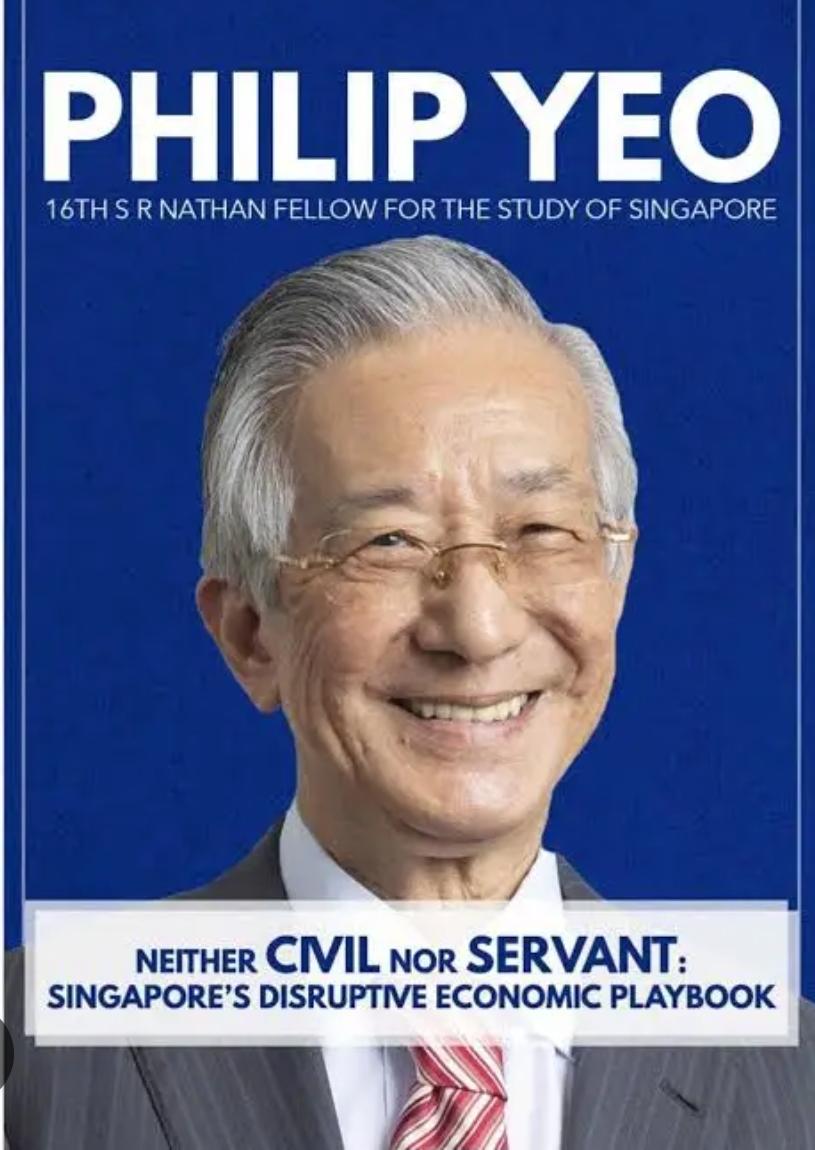
He smuggled an ashtray into a meeting. It led to a $2 billion deal for Singapore.
In the 1980s, no ministry in Singapore was allowed to own a computer.
Only the Ministry of Finance had that privilege.
Philip Yeo was running logistics at MINDEF. He needed one. Badly. His team was drowning in manual processes while the rest of the world was going digital.
So he bought an IBM machine.
And on every single official document, he called it an “intermediate business machine.”
He scrubbed the word “computer” from every form, every requisition, every approval sheet. Nobody questioned it. Nobody flagged it. The machine arrived, his engineers got to work… and that quiet act of defiance became the foundation for MINDEF’s entire systems engineering unit.
Which later became the backbone of Singapore’s national computerisation programme.
Let me say that again.
The reason Singapore became one of the most digitally advanced governments in the world… started with one guy who refused to accept a stupid rule, and renamed a computer so nobody would notice.
That was Philip Yeo.
Not a politician. Not a billionaire founder. A civil servant. Though if you called him that to his face, he’d correct you immediately.
“𝑫𝒐𝒏’𝒕 𝒆𝒗𝒆𝒓 𝒄𝒂𝒍𝒍 𝒎𝒆 𝒂 𝒄𝒊𝒗𝒊𝒍 𝒔𝒆𝒓𝒗𝒂𝒏𝒕.”
He meant it. The man preferred cartoons over written reports. Three-minute conversations over thirty-page proposals. He once walked into his boss Goh Keng Swee’s office, got approval in under five minutes, walked out, and started building. No committee. No deck. No “let’s circle back.”
He was told to buy 2 Hawkeye planes for the military.
He came back with 4.
One crashed on arrival.
When asked if he got into trouble, his response was simple: “I had no personal gain or benefit. What’s there to scold?”
Here’s the thing about Philip Yeo that most people miss.
It’s not that he was “bold.” Plenty of people are bold. Bold is easy when nothing’s at stake.
Philip Yeo was bold when everything was at stake… and none of it was for himself.
When he took over the Economic Development Board in 1986, Singapore was crawling out of its first deep recession since independence. The agency was sluggish. Comfortable. Bureaucratic. Yeo showed up and immediately doubled the number of overseas offices from 18 to 37. Added 38 investment promotion officers. If meetings ran past 15 minutes, he cancelled them.
He didn’t ask for permission to restructure. He just did it. And when people pushed back, he had one answer:
“If I fail, fire me. But don’t get in my way.”
But the story that gets me… the one I keep thinking about… is the ashtray.
Philip Yeo was in a meeting trying to convince Mobil’s CEO to invest in Jurong Island. This was the big pitch. Billions of dollars on the line. The future of Singapore’s petrochemical industry sitting in one room.
Halfway through, Yeo noticed the CEO getting restless. Fidgety. Distracted. The man needed a cigarette but couldn’t find an ashtray. The room was a non-smoking zone.
Most people would have ignored it. Stayed professional. Kept presenting the slides.
Philip Yeo quietly left the room, went to the bar, “borrowed” an ashtray, and snuck it back onto the table.
The CEO lit up.
Relaxed.
Kept listening.
That meeting led to a US$2 billion investment in Singapore.
Two billion dollars.
Because one man paid attention to what the other person actually needed… instead of performing what professionalism was supposed to look like.
And that was the pattern. Over and over again.
When the rest of Asia was chasing cheap manufacturing in the early 90s, Yeo looked at Singapore and said: we’re going to become a world-class hub for biomedical science.
People thought he’d lost it. No biotech infrastructure. No pharmaceutical presence. No deep research culture. Just a small island with an outsized appetite. He built Biopolis anyway… seven buildings, world-class labs, state-of-the-art facilities.
Before he had the scientists to fill them.
Then he flew to Stanford. To MIT. To Harvard. Not with a PowerPoint deck. With a question.
“Why not Singapore?”
He offered research freedom, fast-track funding, and labs that were ready yesterday. The world’s best researchers started showing up. Nobel laureates came. Novartis set up their Asia-Pacific HQ here. GlaxoSmithKline followed.
A-STAR, the research agency he chaired, became the nucleus of Singapore’s innovation ecosystem. Over 50 biomedical research institutes now sit inside Biopolis. An entire generation of local scientists got their start through scholarship programmes he personally pushed through.
Richard Sykes, the former chairman of GlaxoSmithKline, said it best: “You can have a visionary like Lee Kuan Yew. But somebody has to put it into practice. Philip puts things into practice.”
But here’s what I actually want to talk about.
Not Philip Yeo’s achievements. You can Google those.
I want to talk about the version of ourselves we keep burying at work. At home. In our own heads.
𝐁𝐞𝐜𝐚𝐮𝐬𝐞 𝐦𝐨𝐬𝐭 𝐨𝐟 𝐮𝐬 𝐡𝐚𝐯𝐞 𝐡𝐚𝐝 𝐚 𝐏𝐡𝐢𝐥𝐢𝐩 𝐘𝐞𝐨 𝐦𝐨𝐦𝐞𝐧𝐭.
A moment where we saw something broken, knew exactly how to fix it… and said nothing. Sent the email to ourselves instead of to the team. Rewrote the proposal to be “safer.” Waited for someone more senior to say it first.
We don’t rename the computer. We don’t sneak the ashtray. We don’t fly to MIT with nothing but a question.
We wait.
We hedge.
We protect.
Philip Yeo once warned about something he called “eunuch disease.” It’s when leaders surround themselves with so many layers of staffers and reports that they become completely disconnected from reality. “If I’m the emperor,” he said, “I would want to see the generals myself.”
And I think most of us aren’t suffering from a lack of ideas.
We’re suffering from eunuch disease.
Too many layers between what we think and what we do. Too many filters between what we believe and what we say.
So here’s what I’d challenge you to do. Not tomorrow. Not next quarter. This week.
Send the message you’ve been drafting in your head for months. The one to your boss, your client, your partner… the one you keep editing down until there’s nothing left. Send the real version.
Stop building the deck. Start building the thing. Philip Yeo didn’t pitch Biopolis to death in a boardroom. He laid the foundation before anyone gave him the green light. You don’t need a perfect plan. You need a first move.
Name your computer. We all have something we’re disguising because the real version feels too risky, too direct, too “not how things are done.” Call it what it is. Out loud. To someone who matters.
Pay attention to the ashtray. The next time you’re trying to convince someone of something… stop presenting and start noticing. What do they actually need right now? Not what your agenda says. What their body language says. Sometimes the $2 billion moment isn’t in your slides. It’s in the thing you almost didn’t bother to do.
Kill one layer. Just one. The next time you feel the urge to “run it by” someone, ask yourself honestly… am I seeking input or seeking permission? If it’s permission, skip it. Move. Trust that your intentions are clean enough to survive the scrutiny.
Philip Yeo’s biography, Neither Civil Nor Servant, sold over 25,000 copies and sat on the Straits Times bestseller list for 52 straight weeks.
For a book about a government official.
Because deep down, everyone wants permission to be the person who gets things done… instead of the person who asks if it’s okay to start. Philip Yeo never asked. And maybe that’s the real lesson.
You don’t need anyone’s permission to be useful.
You don’t need a title to make things happen.
You don’t need the perfect moment to begin.
You just need to stop calling the computer an intermediate business machine.
And call it what it is.