





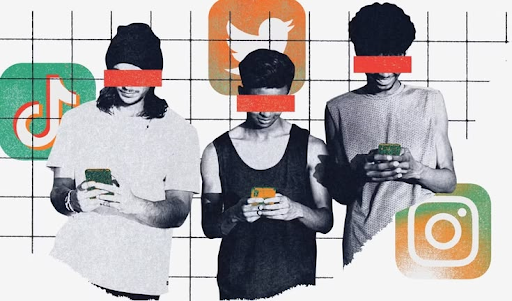
The battlefield has evolved: from swords to guns, and now from guns to algorithms. In the 21st Century, social media has become the new front in geopolitical warfare. Control over these platforms has become critical for national security, economic competition, and most importantly, the power to wear the crown of global sovereignty.
The rapid fire begins with the dissemination of information. For governments, especially those involved in conflicts or facing internal instability, managing their international image is a strategic and integral priority. Their political agendas depend on the world being convinced of their strength and moral authority to avoid legal charges in criminal courts, but even more importantly, to avoid global humiliation. With the rise of social media, this power has been dispersed, meaning ordinary civilians have access to shaping the country’s image and narrative. This introduces a new player in modern warfare: the ordinary individual who can interfere with geopolitical relations with the click of a button.
This power is amplified by the International Criminal Court’s acceptance of digital evidence. In Ukraine, people have been documenting their experiences of the Russian conflict, broadcasting across different social media platforms. These pieces of evidence have contributed to the ICC issuing a warrant against Russian President Vladimir Putin for war crimes. Here, the algorithm became the witness.
The same dynamic can also be seen in Palestine, where social media dismantled official narratives by circulating unfiltered footage of atrocities. Videos and images that appeared on millions of for-you-pages exposed the scale of violence against Palestinian civilians. The strength of this reporting is reflected in the response: 129 Palestinian journalists were killed by Israel, “more than in any other year since the Committee to Protect Journalists (CPJ) began collecting data more than three decades ago.” When states target journalists, they are attempting to silence the very people who threaten to ruin their global narrative.

However, whilst social media does welcome the advantage of truthful reporting, it also opens the door for disinformation. China weaponised deepfakes to discredit the French Rafale fighter jets used by India to sell their own J-35 fighters employed by Pakistan, according to the US Commission. In the Israel-Iran conflict, deepfakes were generated portraying “massive explosions in Tel Aviv, successful missile attacks on U.S. warships, Israelis bemoaning their losses, and other images purporting to show how Iran is delivering pain to its enemies”. Another example includes Israel producing fake videos of Palestinian medic Razan al-Najjar, killed during 2018 Palestinian protests against Israel’s occupation. The video depicted the 21-year-old declaring “she was acting as a human shield for Hamas”. The prominent use of AI and social media in various conflicts shows how quickly this is becoming an entrenched part of modern warfare.
Governments are also actively using social media platforms to rapidly alert and inform civilians. This has become a vital warfare strategy to avoid casualties and ensure national security. The Ukrainian Main Directorate of Intelligence established Telegram as a way to inform citizens and maintain transparency. The Ukrainian military groups also utilised the same app to broadcast their activity and keep civilians informed. The impact was such that “after February 24, 2022, 63.3% of Ukrainians started reading Telegram channels to receive news, while only 35.9% did so before the full-scale invasion”. This striking approximate 28% increase proves the increasing importance of social media in national emergencies such as warfare.
Yet, the one who grasps the ultimate power is the one who owns the platforms. This is because control over digital platforms means control over the visibility and emotional impact of information itself.
The fight for such power was illustrated by the US’s tussle against China in 2024 when they claimed the owners were feeding political agendas influenced by the Chinese government. The prolonged series of legal battles and temporary TikTok ban imposed by the American government signals a deep-seated fear of the algorithm being exploited by enemy nations to threaten national security. What makes this fear more drastic is that social media platforms are engineered to maximise engagement and so within seconds any message, whether true or false, can be sent to millions.
It is precisely this unprecedented influence over public opinion that explains why the US government jumped at the chance to financially control TikTok. American investors include billionaires such as Michael Dell and Rupert Murdoch who are closely affiliated with the American President himself, Donald Trump. Trump himself being at the forefront of these negotiations demonstrates the growing politicisation of social media platforms in modern geopolitical relations.
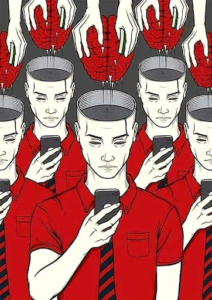
However, the benefits are not solely political; they are also economically advantageous. Aligning with TikTok’s new investor network allows affiliated political figures to indirectly profit from the platform’s revenue streams, further entrenching their influence within both domestic politics and wider geopolitical economic competition. This becomes even more apparent when considering that figures such as Rupert Murdoch, whose media empire is widely associated with right‑wing political interests, stand to profit from TikTok.
Overall, in this new era of algorithmic warfare, anyone who holds the camera and controls the social media platforms is the new combatant. Indeed, the very architecture of conflict is being rewritten, forcing states to confront evolved geopolitical obstacles emerging in the digital sphere.