





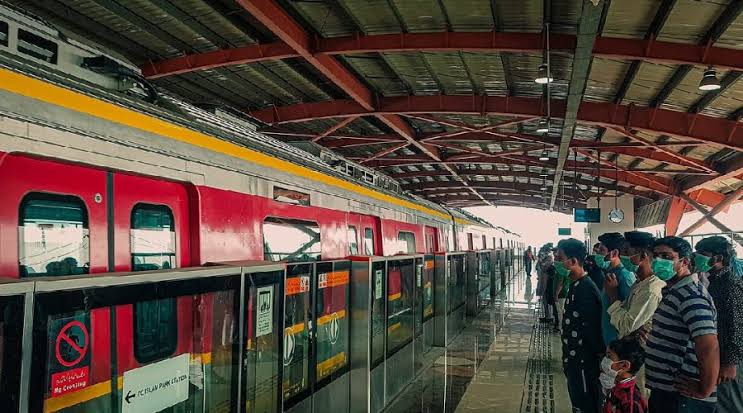
It was the start of May. After finishing my finals, I decided to go on a trip that was long overdue. “The orange train”, advertised as a great public facility, secure and convenient, but here’s the truth about it.
Dear reader, we are collectively so unaware of the distressing turmoil that some of us go through on a regular basis. As someone so disconnected from the differences in social class and not wanting to experience the transition in between, this time around I decided to give it a go. It was a fine summer Sunday. Now you would expect it to be rather calm compared to the rest of the days, but that was not the case. Walking in the odour of roasted corn and masala, being prepared by the vendor on a nearby cart, was what welcomed us. The announcements followed, and yes, they were entirely free, but they had more cons than pros. Walking up the unexpectedly clean escalators, we reached the area where the train had to arrive. Now imagine yourself in the shoes of a twenty-something female in this country, and experience this horror with me, if you may.
The doors to the train opened after a couple of minutes of waiting, and a gust of wind washed over me, and then we began our trip from Ali Town Terminal, crossing Chuburji, reaching Dera Gujran, and all the way back. A couple of hours if calculated. But for me, it was a couple of hours. The scent of sweat and cheap perfume mixed with a hint of overbearing masculinity. The seats are designed so that, instead of facing each other in parallel, they are set in rows, each on both sides of the train, with the handles in between.
And that is when the experiment began. I positioned myself so I was looking out the window, but from the corner of my eye I could sense it: the stares burning at the back of my forehead. Within minutes, these eyes would settle. Not the usual glances a regular commuter would make. And not out of curiosity either, which commonly occurs in public places. But instead, one that would linger, a look that returned, carrying a threat with it each time. Entirely oblivious to the difference between observing someone and staring at them to the point it made the other person uncomfortable.
The security of this country, as we know, is so efficient that a mere complaint takes three to five business days to be heard; so again, it was of no use. And when it happens so many times in the span of ten minutes, it starts to get concerning. At first, I thought I was imagining it, but then, when I looked around, it was happening to almost every other woman there. Some stared back while the others shrugged their shoulders and continued to look away, fully aware that confrontation in this country always leads to conflict. The issue here is not looking; it is the entitlement. The assumption that the mere presence of a female around you grants you permission for shameless visual scrutiny.
And this dynamic turns an ordinary commute into a constant practice of vigilance, keeping you on guard and not relaxing for even a second. Women naturally are experts in reading rooms; they track the repeated glances, the discomforting gestures and can easily recognise the difference between accidental glances and a deliberate fixation. This is a skill rather than a gift. And since it happens everywhere we go, it has become a survival instinct. We blatantly claim that women should reclaim public spaces and make the most of them. But how are you supposed to do it when you want to escape the very second you enter? When you step out of the house, your personal space is violated, forcing you to reconsider your decision entirely. A man might never understand the mental exhaustion a woman has to face just from these regular interactions. And this investigation is not entirely about the orange train, as it serves merely as a moving mirror.
And it cannot be called an achievement, endorsing inclusivity, until people learn how to behave once on board and women can travel safely, without fearing for their lives.
Remarkable 👏🏻👏🏻👏🏻