





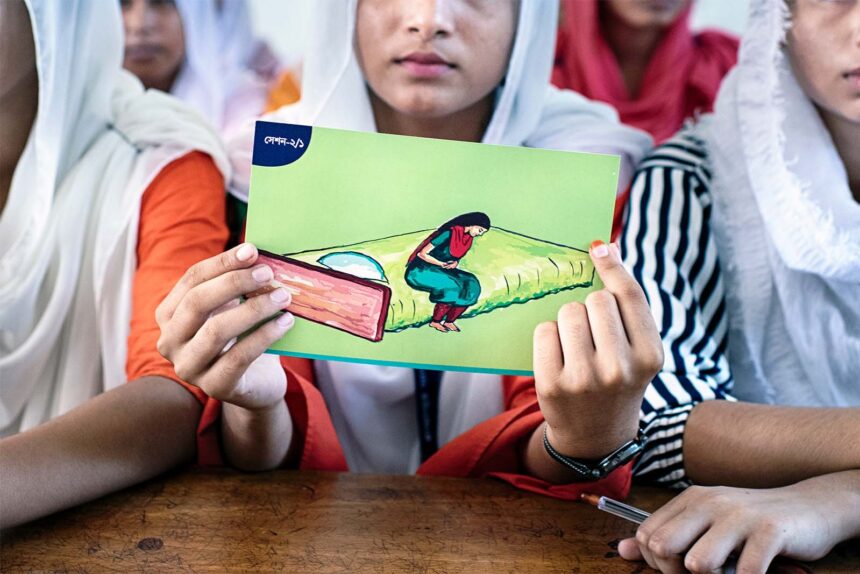
When we regard health as something that matters above all, are there systematic exceptions bound to our concept of health? Do we think of the well-being of the uterus like we think of, let’s say, the well-being of our blood pressure, or that of our blood glucose levels?
Menstruation is a regular, healthy biological process the female body undergoes monthly. To enlighten those unaware of what actually happens: it is the regular shedding of the uterine lining that occurs roughly every 28 days as part of the reproductive cycle – a period. It is NOT an anomaly but a sign of health, vitality, and the very sustenance of human life. Yet, society has twisted this completely natural bodily function into a source of shame, making a significant deal out of a normal process for no logical reason. What worsens it is our refusal to even speak its name out loud.
This regular process commonly brings along “premenstrual symptoms,” which include mood swings, irritability, anxiety, prolonged periods of sadness, fatigue, random joint or muscle aches, headaches, sleep disorders, constipation or diarrhoea, and even appetite changes. These symptoms usually begin to occur a week or two prior to the period.
The mere act of wrapping something so normal in shame, something almost half the world’s population regularly goes through, is not a singular problem. This practice paves the way for countless others. The stigma around menstruation actively hinders awareness and education concerning it. Pakistani girls frequently reach menarche without any prior knowledge of what is happening to their bodies. And if, God forbid, their mothers are not around while they do, the fear and confusion they undergo after realising they randomly started to bleed are more suffocating than they are credited to be. I have personally come across several girls thinking they had caught a disease or that they were about to die!
Once a mother – ill-informed herself – discovers her daughter has got her period, her immediate instinct is rarely to educate her daughter. Instead, it is to silence her and tell her to make sure no male family member finds out. Before the child even understands the biology of what is happening to her body, this culture of secrecy is imposed upon her. Mothers, grandmothers, and often elder sisters are all involved in this mission to shield fathers and brothers from this reality at all costs, ensuring the young girls’ pads are properly wrapped in multiple layers of camouflage before she discards them.
This enforced secret directly influences physical health and hygiene because deeply ingrained myths compromise basic hygiene. Many elderly women strictly forbid girls from showering for the first few days of their period, or even for its entire duration. Mothers often warn their girls to not be in contact with water at all, as it could invite diseases or cause problems with pregnancy in the future.
There is a piercing irony in the way these taboos are embedded within many traditional households. In many Islamic households, girls are taught that while they are exempted from offering the five obligatory prayers or fasting (which they actually are), they are entirely barred from any form of recitation, praying or preaching otherwise (which has no religious backing). It often takes women a lifetime to realise the flaws in these man-made concepts. But with this set of instructions comes the irony. The irony is to instruct the girls to act “normal” and fake their prayers and fasts while they menstruate just so the male members of the family do not find anything unusual. What is unusual is the act itself. Why? Absolutely illogical shame tied to the female body.
As a result, the classroom becomes the first major target of this cycle of shame. Girls begin to miss school. They miss school because of the pain and discomfort menstruation brings and because of the unreasonable fear of blood stains. They miss school because they are fed with the need to hide themselves out of embarrassment; they are so often made to believe that they have been inflicted with something abnormal that they choose to stay back.
This anxiety is compounded by the inconvenient logistics of the school environment itself. A girl cannot simply walk to the washroom to change a sanitary product when doing so demands almost smuggling it past fellows and teachers in a culture that will morally fail you if you try being “bold”. In fear of being seen with a stain, many choose to not leave their chairs, refusing to stand up, participate in class, or engage in extracurricular activities. This withdrawal is not always met with empathy. Teachers, often victims of the same systematic ignorance, themselves lack the training to understand or support their students. Glued to the belief that they must hide themselves, these young girls retreat from their education, choosing the comfort of being absent over the daily daunting public exposure.
The curriculum breaks no silence upon this matter. There is little to no integration of any age-appropriate reproductive health education into the curriculum for either girls or boys. In the National Curriculum Framework of Pakistan, the mention of sexual health or menstruation health management is nowhere to be found. “Physical Education, Health and Sports in Education” is the only health education mentioned in the National Educational Policy. The more this conversation should be normalised, the fewer are the steps taken by the policymakers to dismantle the paralysing stigma that breeds this ingrained bullying and isolation.
When education budgets or curriculum reforms are debated on by policymakers, textbooks and laptops and teacher training become a part, but we rarely hear talks about the provision of sanitary pads or clean toilets. They rarely, if ever, talk about staff and student training on menstrual health and hygiene. There are barely any awareness programmes arranged by schools to educate the parents and ease the life of the young girls wrapped in confusion and shame.
Even in this age, so many daughters do not know how to stick a pad to their undergarments just because they were never educated to do so, just because mothers still teach their daughters to use only random scraps of clothes. Once they have been used up completely, nothing prevents the stains. Another reason many girls miss school. Once they do, they slowly fall behind in courses because this is not a once-in-a-year occurrence; it is a cycle that occurs every month. They may miss crucial sessions, leading to widened learning gaps and stress from constantly trying to catch up.
According to the little research that is done, the national education data states that thousands of government schools lack the most basic amenities: functioning toilets, running water, and boundary walls. For a menstruating girl, a school without a private toilet is not just an inconvenience but a hostile environment. There is no availability of pads or undergarments to help girls who unexpectedly menstruate in school or for those of them getting their period for the first time. Upon reaching out, the first thing many female teachers will do is to ask you to lower your voice in case anybody overhears.
To think of it, the provision of sanitary goods in school dispensaries is as crucial as it is to have chalk and textbooks. To educate children about menstruation is as important as it is to enlighten them about their cultural and religious values. It is a basic bodily function and not a taboo topic fit only for hushed conversations in a corner.