





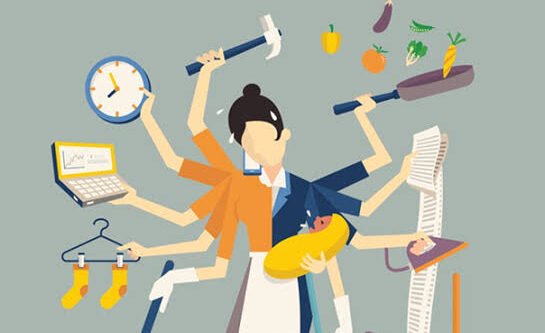
While there’s no denying that patriarchy persists all over the world, the overwhelming presence of it in South Asia is nearly unrivaled. It creeps into our daily lives so naturally that we don’t even realize something is wrong; from the way women eat last despite cooking the meal, to the way sons are never required to fend for themselves, it has influenced practically every part of our culture.
Since childhood, we saw our mothers and aunts spending celebrations crammed into the kitchen cooking, and saw the men of our families in the next room — eating the food the women cooked, on the plates the women washed, and in the room the women cleaned. A community with such rigid gender roles trickles down its values each generation, leaving little room for anomalies. When every woman is expected to take on the whole brunt of housework, being less than perfect in any one area of it is simply not an option. While a man who can’t cook can easily get through life, get married, and start a family, such a life becomes nearly impossible for a woman with the same issue.
After generations upon generations of seeing women tend to all domestic work, men start to believe that women have a biological advantage that allows them to miraculously gain all life skills by their teen years. While the teen daughter is forced to learn to cook, clean, and babysit, the adult son is still having his food served on a hot plate to him by his mother, because “boys are bad at this kind of stuff”.
Kids start falling into the gender roles their environment pushes them into from a very young age — so young, in fact, that their perceived interest in certain things appears completely natural. You can see this starting from the toys parents buy their sons versus the ones they buy their daughters, as exposure to certain ideas through toys allows kids to be more comfortable in similar situations in adulthood. Many girls grow up making pretend food in toy kitchens and dressing their babydolls; subsequently, they often end up with an interest in cooking later on in life. Boys, on the other hand, are turned away from play of this kind, usually by their parents who deem it too feminine. A toy kitchen is no more feminine than it is masculine, yet decades of believing domestic work to be a woman’s job has caused society to perceive it as such.
A man who can cook is a self-proclaimed chef; a woman who can cook is just a woman. When a man is good with kids, it’s “he’ll be such a great father”; when he isn’t, it’s “men aren’t good at dealing with children”. But a woman who isn’t good with children has no choice but to learn, for inevitably she will be given the task of childcare — whether they’re her siblings, her cousins, or her future kids. The word babysitting itself doesn’t apply to a woman watching over children, as it’s assumed to be the natural duty of a woman to give in to her ‘motherly instincts’; the word only ever applies to a man, even if it’s his own children he’s caring for.
Women are quite literally not allowed to be bad at domestic work — not without severely damaging future marriage prospects and ruining family reputation — but they’re not allowed to be bad at anything else either. A man totals his car, and he’s a bad driver; a woman gets rear-ended, and suddenly all women are bad drivers. Men are allowed to make mistakes and have it be a personal fault, but a woman can’t make a mistake without bringing half of the population down with her.
It’s absolutely true that men and women have biological differences, but none of those differences will be in favour of either gender when it comes to domestic work. The lack of a Y chromosome isn’t making women any better at ironing their clothes than men, the same way the increased testosterone in men isn’t making them any worse at mopping the floor.