





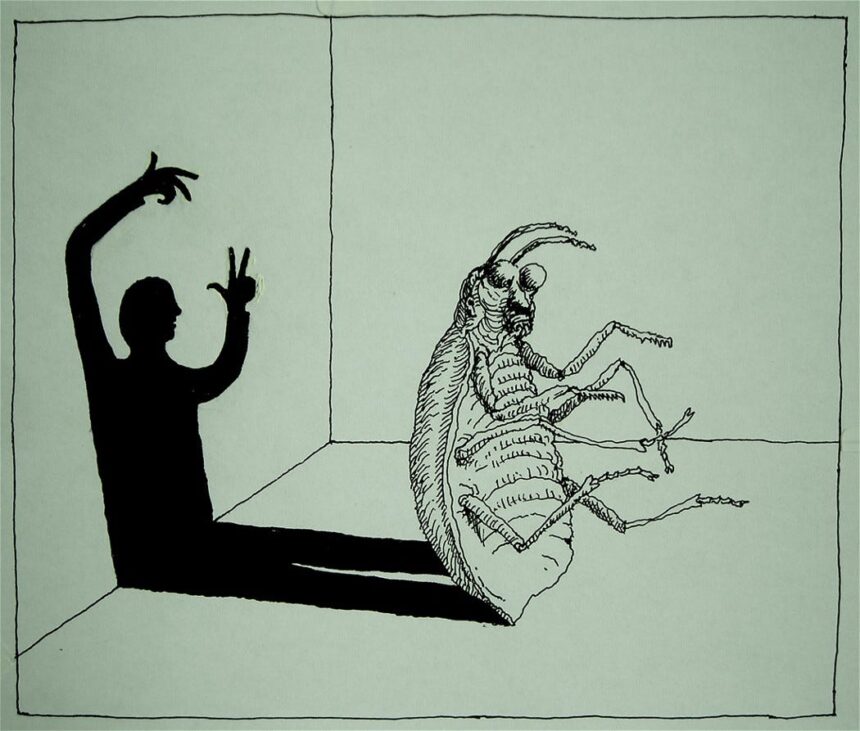
When one thinks of cockroaches, three labels come to mind: disgusting, reviled and hidden. Rarely do they appear as anything other than symbols of decay and rejection – the creatures meant to be erased from sight. Franz Kafka also portrayed this insect in a similar unsettling way – powerless, voiceless, excluded and ultimately expendable.
In Kafka’s Metamorphosis, Gregor Samsa wakes up one morning and finds himself turned into an insect. Though the transformation is beyond understanding, it is not the real tragedy. Some tragedies are wrapped in the multiple layers of painful truths that society refuses to show evidently.
The moment Gregor transformed into a despicable giant creature, he was subjected to dehumanisation. His sudden change strips him of dignity while pushing him into isolated corners. He faced such derogatory behaviour coming not only from society, but also from his own family, who devalued him due to his inability to live up to their expectations.
He did not resist. He accepted the labels given to him. He embraced the derogatory identity imposed on him by societal standards. He became alienated, dejected and excluded. Eventually, weakened, neglected and emotionally and socially abandoned, Gregor was condemned to death.
In Metamorphosis, Kafka’s protagonist was not a revolutionary figure. He chose to stay invisible, voiceless and conformist. He preferred silence over speech. He opted for exclusion instead of liberation from expectations and standards.
More than a century later, Kafka’s Gregor Samsa has stood as literature’s most powerful symbol of exclusion defined by a cockroach. However, the 21st century challenges the mentality related to cockroaches. It is no longer seen as an insect hidden in the cracks and roaming purposelessly. Once portrayed as compliant, it is now turning into a rebellious creature. Have you thought about what would happen if all the cockroaches refused to stay invisible and organised themselves into a powerful agency? What if all the cockroaches come together? What if the creature entered public life and demanded recognition?
At first, it seems impossible. But this idea has already been materialised by the Cockroach Janta Party (CJP), emerging as a provocative reversal of Kafka’s metaphor. The viral movement started when the Chief Justice of India compared unemployed youth to “parasites and cockroaches” drifting towards social media and digital activism.
Here lies the major difference. Instead of accepting these labels, these cockroaches are resisting and peacefully swarming the streets. Unlike Gregor Samsa, they reject alienation and dehumanisation. They speak, use political agency and challenge existing hierarchies. According to CJP founder Abhijeet Dipke, “For government, we may be mere insects, but we are alive and capable of fighting for our rights.”
What started as a joke on social media has now become a revolution around political satire. The rising popularity of the party also shows that youth and marginalised communities neglected by governments and excluded from elite institutions are now refusing to give in to despair and demanding their rights. Besides being a symbol of political awakening, the CJP also represents generational fatigue as young people are tired of pretending everything is fine. They are frustrated by poor political representation, inflationary pressures, pervasive unemployment and uncertain job markets.
In Pakistan, the situation of youth is also bleak. They are also facing a plethora of issues in social, economic and political domains. The young people are trapped in existentialism, trying to find meaning through opportunities that are reserved for elites. Hierarchies are entrenched. Political representation is centralised. Mainstream institutions are exclusive. Now, a question comes to mind: Will Pakistani youth raise their voices against injustices, or will they compliantly embrace their pathetic situations?
In the long term, the future of CJP turning into a formal political party remains unclear, but one thing is certain. The significant shift is here to stay. The rebellious cockroaches do not efface Kafka; they complement him. Metamorphosis candidly explains how a person can experience alienation when society treats him as less than a human. The emergence of CJP exhibits an evolutionary process defined by political awakening. Kafka’s magnum opus may end tragically, but its echoes still resonate in the modern world marked by rebellion.