





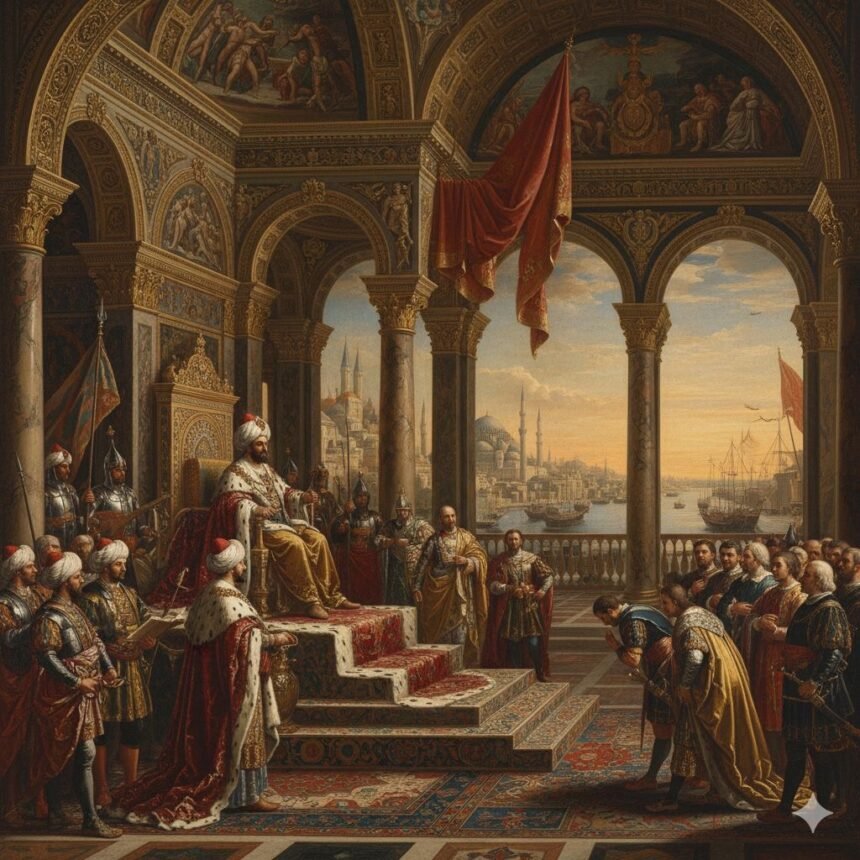
Before the invention of fibre-optic cables that relay billions of messages per second, the key issue that determined the fate of empires was simply one of speed: How fast can information travel?
Battles, treaties, and monarchs are traditional ways to frame history. Yet behind every victory was a quieter struggle — the race to be the first to deliver news. Orders went out and armies marched. Records were kept, ensuring taxes were collected. A report arrived on time and rebellious factions were suppressed. As every empire conquered new territory, it also conquered the flow of information.
The internet has revolutionised communication, but it addresses a challenge that societies have grappled with for centuries.
Ancient rulers governed lands so vast they could never inspect their entire territory in person. The Roman Empire spanned three continents. The Abbasid Caliphate linked cities across desert and sea. The Mongol Empire stretched thousands of kilometres across Eurasia. Physical distance was not merely a logistical hindrance; it was a central political dilemma.
What was the use of the wisest decree an emperor could issue if it arrived months too late?
Early Information Networks: From Persia to Rome
Few caught on to this reality until the Persian Achaemenid Empire established one of the most advanced communication networks in history around the fifth century BCE: the Royal Road. Connecting the imperial capital with remote provinces via a network of relay stations across 2,700 kilometres, it allowed fresh horses and riders at every stop to transmit messages at astonishing speeds for the era.
Herodotus expressed deep admiration for this system, noting that messengers travelled undeterred by snow, rain, heat, or darkness — an observation that inspired the informal motto of the United States Postal Service more than two millennia later.
The Romans subsequently refined the concept.
They constructed their extensive road network not only for marching legions, but also as an information thoroughfare. Official messengers rode the cursus publicus — a state-funded network of posts, horses, and facilities maintained under the authority of the emperor. Governors’ reports were relayed to Rome, population censuses were compiled for taxation, and military intelligence was gathered from distant frontiers.
Delay was conquered through infrastructure.
Couriers, Runners, and Maritime Routes
In other parts of the world, empires developed equally ingenious solutions. Across imperial China, dynasties established vast networks of couriers to connect provincial capitals with the imperial court. Later, Genghis Khan and his successors in the Mongol Empire created the Yam system — a relay network spanning Eurasia. Travelers with official credentials could obtain fresh mounts, rations, and lodging, allowing state intelligence to move across vast distances.
The Mongols recognised a truth vital to any government today: information is worthless if it arrives too late.
Not all messages were carried on horseback. Coastal empires transported official correspondence by sea alongside merchants and pilgrims, while river networks served as primary communication channels long before they were used for heavy freight. In mountainous terrain inaccessible to cavalry, relay runners filled the gap. Though the Incas possessed neither horses nor the wheel, their trained relay runners — the chasquis — transmitted messages across the Andes with remarkable efficiency.
The medium changed, but the objective remained constant.
Bureaucracy and Knowledge as Control
Gathering information was as crucial as disseminating it.
Empires relied on complex bureaucracies to understand the societies they ruled. Population counts were taken via censuses, wealth was recorded on tax registers, and agricultural yields were estimated using land surveys. Religious institutions maintained registers of births, marriages, and deaths, while local administrators produced endless reports covering harvests, infrastructure, trade, crime, and civil disputes.
While such documentation might seem mundane to modern readers, ancient rulers viewed these records as indispensable instruments of authority — knowledge translated directly into power.
The British Empire provided a clear illustration of this approach. Across its colonial territories, officials conducted extensive mapping, censuses, gazetteer compilation, ethnographic research, and administrative reporting on an unprecedented scale. Information became a primary instrument of governance in British India: communities were categorised, languages catalogued, agricultural production surveyed, and infrastructure systematically documented.
However, collecting information was never a neutral process. Empires determined what was worthy of record and what was ignored, directly shaping public policy, legal frameworks, military recruitment, and taxation. Information reflected existing power structures — power decided which data mattered.
Vulnerabilities: Delays, Corruption, and Rumour
Naturally, speed remained a persistent vulnerability.
A revolt could brew for weeks before an imperial capital was notified. Communication delays could serve as cover for provincial corruption, and adverse weather regularly sank vessels carrying critical dispatches. Messengers were vulnerable to capture, bribery, or assassination, and entire military campaigns were lost when vital messages failed to reach their destinations.
Inefficient communication and informational breakdowns contributed directly to the decline of numerous states.
Furthermore, social media was far from the first medium to struggle with misinformation. Rumours often travelled faster through marketplaces than official proclamations, spreading alongside commercial goods, while pilgrims carried exaggerated tales across borders. Political factions routinely weaponised rumours, leaving monarchs struggling to distinguish reliable intelligence from noise.
The challenge facing twenty-first-century governments — distinguishing truth from background noise — is as old as the written word.
From Imperial Archives to Fibre Optics
The digital age has not created information management; it has expanded its scale.
Fibre-optic cables have compressed what once took months into seconds. Government announcements reach millions instantly, satellite imagery has replaced months of physical reconnaissance, and financial markets react before official statements conclude. Yet the fundamental questions remain unchanged: Who controls information? How fast does it move? Can it be trusted?
While states no longer rely on horseback couriers, they continue to compete over data infrastructure, intelligence gathering, and communication networks. Caravan routes have been replaced by submarine cables, imperial archives by data centres, and physical fortresses by cybersecurity protocols.
Technology has transformed the tools, but the underlying contest remains the same.
History frequently celebrates emperors for their military conquests while overlooking the administrative systems that sustained them. The decisive forces behind enduring empires were rarely just armies; they were the roads, couriers, maps, censuses, archives, and bureaucracies that made governance possible.
An empire cannot rule what it does not know. Long before data became a modern commodity, history had already demonstrated that simple truth.