





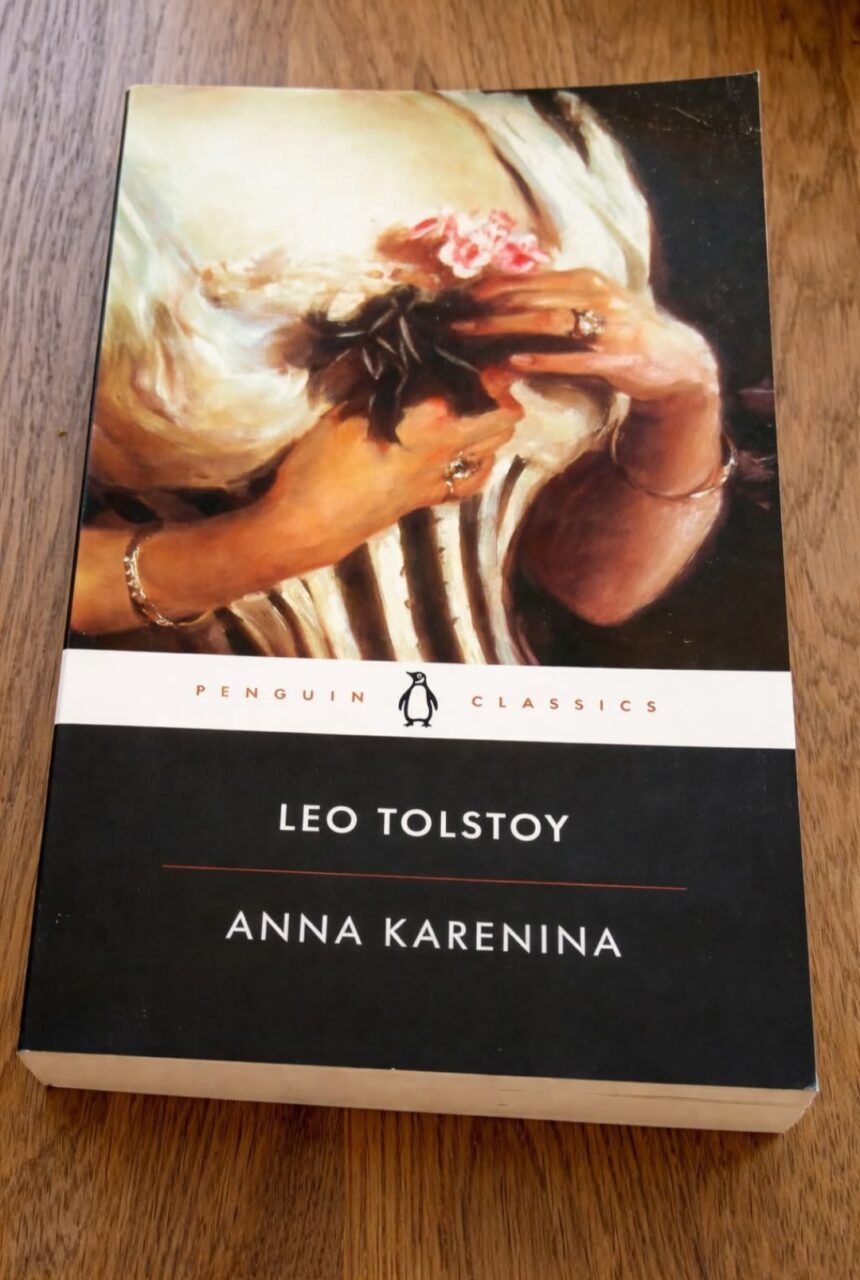
Tolstoy opens this novel with one of the most famous sentences in all of literature.
“All happy families are alike; each unhappy family is unhappy in its own way.”
He delivers it with the calm authority of a man who has thought about human beings for a very long time and arrived at something true. And then, before you have finished turning it over in your mind, he pulls you into a world so vast and so alive that you forget you are reading.
You simply begin to live inside it.
Anna Karenina is not the woman you expect her to be. She arrives in Moscow on a train, beautiful and warm and luminous, sent by her husband to help salvage her brother’s failing marriage. She is charming without effort. Kind without performance. The kind of woman who makes every room feel more alive simply by being in it.
Then she meets Vronsky.
And everything she had carefully, obediently, dutifully constructed begins its slow and gorgeous collapse.
Count Alexei Vronsky is young, handsome, and possessed of the particular dangerous quality of a man who always gets what he wants and has never had reason to develop any discipline about his wanting. He sees Anna across a crowded platform and decides, with the uncomplicated certainty of someone who has never been refused, that he will have her.
She resists. Then she doesn’t. And the moment she stops resisting is the most electrifying moment in the novel, because you feel simultaneously thrilled for her and terrified on her behalf. Tolstoy writes it with a restraint that somehow makes it more devastating than any explicit scene could manage.
She gives up everything. Her husband. Her son. Her reputation. Her place in a society that had adored her.
And Vronsky, who wanted her with such absolute consuming conviction, turns out not to know what to do with her once he has her.
Here is where the novel turns.
Here is where Tolstoy does something that nobody who has only heard about this book is prepared for.
He makes you realise, slowly and with the precision of a surgeon, that the real tragedy of Anna Karenina is not that she loved the wrong man. It is that she loved the right man at the wrong depth. Vronsky is not a villain. He is not cold or deliberately cruel. He is ordinary. He has ordinary restlessness and ordinary limitations and an ordinary inability to sustain the altitude of feeling that Anna needs to feel alive.
He wanted the flame. He did not understand that you cannot hold a flame and expect it not to burn you.
Jealousy moves into their relationship like a third occupant. Anna begins watching his face for signs of cooling with an obsessive attention that she cannot stop and cannot hide. She knows she is doing it. She knows it is driving him away. She cannot stop. And the knowledge that she cannot stop becomes its own private hell.
Now. The controversy. And it is real.
Tolstoy, after finishing this novel, turned deeply religious and essentially disowned it. He came to see Anna’s story as divine punishment for adultery. He chose his epigraph deliberately. Vengeance is mine and I will repay. He wanted readers to see Anna’s destruction as God’s verdict on her choices.
His wife Sofia disagreed. Loudly and in her diary, which is one of the great unsung literary documents of the nineteenth century. Sofia Tolstoy spent decades copying her husband’s manuscripts by hand, raising their thirteen children, managing their estate, and watching Leo receive universal adoration while dismissing the very books she had helped him produce. She wrote about Anna with a sympathy that her husband had deliberately tried to remove from the text. She saw what he was trying to do with the ending and she found it dishonest.
She was right.
Because the novel itself refuses Tolstoy’s moral verdict. It is too inside Anna’s experience, too full of her warmth and her intelligence and her very legitimate grief, to function as a cautionary tale. You do not finish this book thinking Anna deserved what happened to her. You finish it thinking about every woman who ever wanted more than the world decided she was entitled to want and was punished for the wanting rather than the transgression.
And then there is Levin.
Konstantin Levin runs parallel to Anna’s story the entire novel, and the contrast is Tolstoy’s real argument. Levin is awkward and earnest and perpetually arguing with himself about the meaning of existence. He loves Kitty Shcherbatskaya with the overwhelming slightly clumsy sincerity of a man who has never learned to want things casually. He fumbles his proposal. He retreats to his estate. He farms and thinks and slowly, unglamorously, finds something Anna is searching for and cannot reach.
Not passion. Not the consuming fire.
Something steadier. Something that can actually hold a life.
The contrast is uncomfortable because Tolstoy is not saying passion is wrong and domesticity is right. He is saying something more nuanced and more painful than that. He is saying that a life built entirely on the intensity of romantic feeling, with nothing else beneath it, cannot hold its own weight indefinitely.
Anna needed Vronsky to be everything. No person can be everything. And the moment he failed to be everything, she had nothing left to stand on.
The train appears at the beginning of the novel. A worker is crushed on the tracks and Anna witnesses it and Vronsky’s mother calls it a bad omen. You note it and move on. You forget it. Tolstoy banks on you forgetting it.
And then it comes back.
By the time it does, you have been inside Anna’s consciousness so completely, so uncomfortably close to her thoughts, that what happens does not feel like plot. It feels like inevitability. It feels like watching someone you know make a decision you cannot stop.
Tolstoy was uncomfortable with how much sympathy readers felt for Anna. He kept trying to tip the scales against her. He kept failing. Because whatever he intended, what he actually created was a woman so fully and so honestly rendered that she escaped his moral framework entirely and became simply, irreducibly, terrifyingly real.
Sofia understood that from the beginning.
It took the rest of the world considerably longer.