





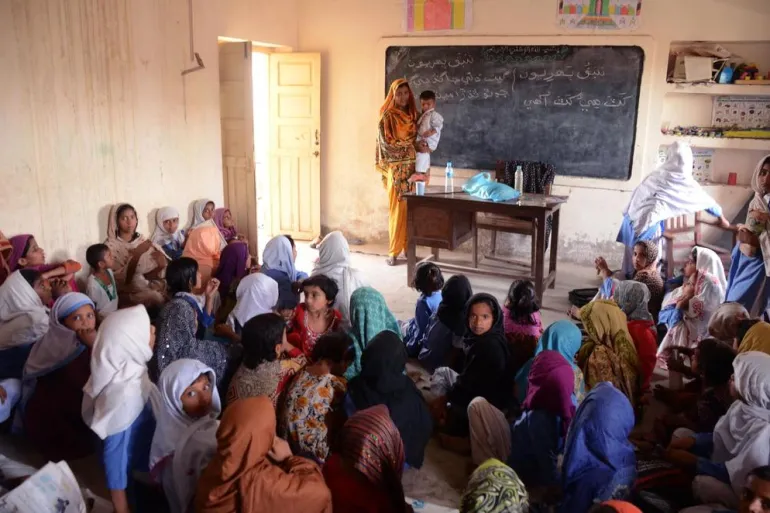
Pakistan has been under a national education emergency since 2024. The number of out-of-school children is in millions, with the literacy rate standing at the lowest in South Asia. On the surface, the government is taking action to counter this, but it is ineffective in making any remarkable progress. If the state expects to overcome this obstacle, it must remodel its policies and finances comprehensively.
In Pakistan, a ‘literate’ person is someone of age 10 or above who can read and understand a simple sentence. As of 2026, the national literacy rate (for the population aged 10+) is 63%, notable progress from 2018-2019, when it was 60%. This statistic changes and shows widespread disparities when it comes to gender, age, residency, and provincial background. Women, residents of rural areas, and Balochistan are the most highly affected by illiteracy. In terms of age, adults above the age of 50 have historically been the group most compromised, with literacy in youth standing at 77%. However, a new dilemma concerning children has arisen. ‘Youth’ is the age group from 15 to 29, and ‘children’ is the age group under 18. A government-backed report has shown that 77% of children aged 10 are unable to read and comprehend simple texts, making them illiterate. On top of that, the number of out-of-school children (OOSC) has hit 25.1 million, according to a report from the Pakistan Institute of Education (2024-2026).
The provincial breakdown of OOSC shows:
| province | OOSC (millions) | % of OOSC according to school-age group |
| Punjab | 9.7 | 21% |
| Sindh | 7.4 | 44% |
| KPK | 4.5 | 34% |
| Balochistan | 3.5 | 69% |
Constitutionally, the government is responsible for free and compulsory education for children aged 5-16, as per Article 25A. This subject was entrusted to provincial governments after the 18th amendment, but the administrative imperative still stands. Ideally, the financial priority in such a crisis should be education, with 4-5% of the GDP being allocated to it. On the contrary, we have seen a declining trend in budgetary allocation for education since 2019, with all being less than 2%, showing a national flaw to uphold its commitment towards its children. Aside from chronic underfunding, the exacerbation of ghost schools — a new phenomenon showing the existence of schools only on paper for receiving funds and salary for staff — lack of consistency in adopting educational policies, and nonuniformity in different schooling systems (public, private, and madrassas) and negligence towards social issues like gender disparity, child labour, and early marriages combine to form a new low for educational prosperity in Pakistan.
In May 2024, PM Shahbaz Sharif declared a nationwide education emergency to target the OOSC and improve the education sector in the country. This commitment was reiterated in September 2024. And in a sense of urgency, people were led to believe that initiatives like a high-level task force, detailed policies and frameworks, and a proposal to increase the budgetary allocation by an additional 0.5% annually would actually bear some fruit. Despite these efforts, overall public spending on education — across federal and provincial governments — dropped to just 0.8 per cent of GDP in FY 2024-25, according to the latest Pakistan Economic Survey 2024-25. In monetary terms, education-related expenditure during the first three quarters (July 2024–March 2025) fell by nearly 29–30 per cent, and HEC’s development budget dropped more than 35 per cent. None of these figures promises the federation’s dedication to growth.
Provincial governments also took numerous steps to tackle the issue at hand. The Punjab government made the strongest efforts by intensifying its Public Schools Reorganisation Programme, outsourcing its under-performing schools to private partners, and endowing funds for scholarships, but according to the latest 2025 survey, its OOSC ratio is static, showing no progress. Sindh and KPK showed a 3% decrease in their OOSC, and in Balochistan, the number of OOSC dropped by 14%. The largest reduction in any province. However, on a per-person basis, this only covers 2-3% of the school-going population, and no province has contributed to a major shift in the national crisis; the overall assessment remains underwhelming.
The 18th constitutional amendment delegated almost 17 subjects to the provinces by putting them in the residuary powers of the provincial governments. Their share of the national resources also rose from 43 to 59% to manage the additional responsibilities under the 7th NFC award. The education sector was one of those 17 subjects, and the goal of devolving them was to strengthen governance. Provinces could also tailor policies according to the specific challenges faced in the regions. But the persistence of this systemic failure stems from the federation’s inadequate financial distribution and the NFC award’s population-heavy formula, which puts low population provinces like Balochistan at a significant disadvantage, despite it having the lowest literacy rate in the country.
For a nation already facing the blow of poverty, a staggering 43%, children are the most viable asset for economic growth. Investing in their education today will lead to a skilled workforce and free-thinking leaders capable of shaping Pakistan into a thriving state tomorrow. The transmission of educational autonomy to federating units was a step in the right direction, but the government will have to redirect its funds and implementation capacities towards schooling with the utmost dedication to get out of this crisis and stabilise its literacy.