





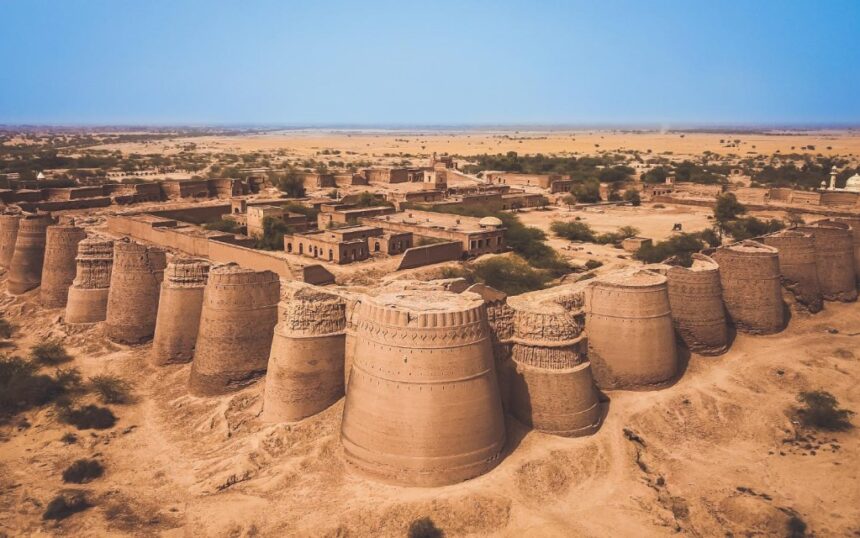
Cholistan was never a void. It is the afterimage of a living system, a residual imprint of past circulation. The vast stretches of sand of the Cholistan desert are often mistaken for emptiness. Often mistaken for a land isolated and silent due to its absent history. Yet, this perception collapses when we scrutinise what appears today as a barren desert. This barren desert was once a zone of uninhibited dynamism, harbouring constant movement as a corridor that connected regions and sustained settlements. Cholistan was active, constantly transmuting, with its machinery of change undergoing change as well.
The foundation of this earlier landscape lies in the Hakra River, a now-dry river system that once supported a ramifying network of human habitation. The archaeological surveys conducted in the region have identified hundreds of settlement sites distributed along the former riverbed, which indicates that Cholistan formed part of a wider Indus-associated cultural and economic system and was not just a marginal periphery. These settlements are often naively perceived as isolated points, but they were actually embedded within routes that facilitated circulation heavily across ecological as well as political zones.
Trade in this context took place through adaptive pathways instead of following fixed highways, and movement depended upon water availability, seasonal conditions and shifting political realities. Things such as grain, salt, textiles and livestock were transported by caravans, which also carried less tangible elements. Language and belief systems, as well as administrative practices, were also valuable goods that were transported across regions. Cholistan served the function of a transitional space that linked the Indus basin with the territories further northwest, and this formed part of a much broader network of exchange that wasn’t delimited to a singular route.
The viability of this system was dependent on an infrastructure suited to a ruthlessly demanding environment. Fortified structures such as the Derawar Fort are meant to be understood as logistical nodes rather than limiting our understanding of it solely as a military site. Such fortified structures provided storage and access to water resources in a landscape where survival required points of stabilised mobility. Patterns of temporary settlements and periodic exchange emerged around such structures and created a system that is best described as a seasonal economy.
People did not rely on any form of permanence, and pastoral groups synced their movement with ecological cycles. Traders timed their journeys in tune with climactic rhythms, and the settlements expanded or contracted as a response to such shifting conditions. The boundary between route and habitation was a fluid one and remained that way. A settlement would become a trading hub under favourable conditions and recede when the optimal conditions began to change, and so, Cholistan’s vitality lay exactly in this flexibility.
The decline of this system, however, was gradual, and environmental transformation played a significant role. Plenty of geological and hydrological changes ultimately led to the drying of the Hakra river system, and that reduced the very water which had sustained both the settlements and routes. As the sources became unreliable, the habitation weakened simultaneously, and this drove movement to become constrained. It wasn’t that routes vanished overnight, but they gradually lost the stability that came with a certain predictability, which was now lost. At the same time, economic and certain political shifts altered overland trade, and maritime routes in the Indian Ocean began redirecting long-distance commerce. Colonial infrastructure, such as the railways and centralised control, reorganised mobility along fixed lines, giving way to rigid and state-defined corridors.
This transformation culminated in the consolidation of modern borders, particularly after the partition of the subcontinent. The older patterns of seasonal movement and informal exchange were no longer aligned with the strange modern logic of nation-states. This led to Cholistan finally shifting from a connective space to one that is understood today as a peripheral one. The desert existing today is therefore not a natural void but rather the aftermath of a layered process consisting of environmental change and political restructuring due to economic reorientation. Its apparent emptiness almost resembles drapery that conceals the traces of a system that was once distinctly defined by movement itself.
The recognition of this history demands a shift in one’s perspective because Cholistan is a transformed landscape where the memory of routes persuasively persists in archaeological remains and spatial patterns. These residual practices of mobility urge us not to gaze at Cholistan with an anachronistic lens that shows us nothing but an absence marked by routeless dunes. Such a perspective challenges the assumption that deserts are and have always been inherently marginal because Cholistan insists that viability is capable of emerging from flexibility instead of permanence. To describe it as empty is equivalent to brushing over its rich history. Beneath the still-shifting sand lies the residue of circulation, and though it is silent, it forces us to confront the memory of when it simmered as a landscape once alive.