





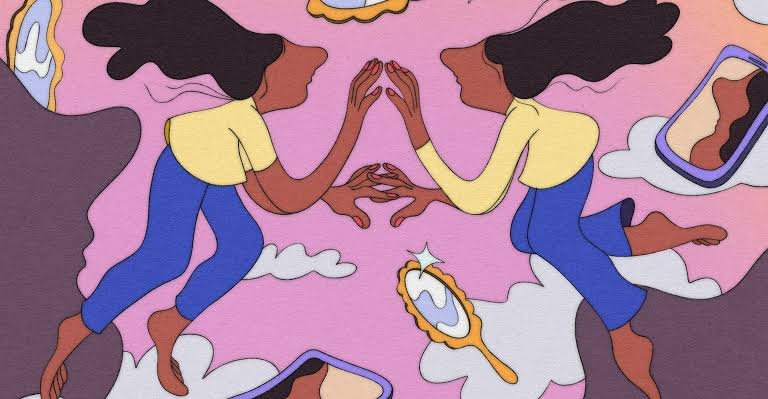
Sheathed are the universe and the world beyond, as the faded stars glitter in the moonlight. The white satin souls are draped in musky colours to radiate something they do not own, to reflect uninhibited energy, and to speak false truths. From sunrise to sunset, from the light to the dark recesses, everything in this world carries a secret, veiled, hidden face to conceal its true self under the rock of a fake identity approved by the world. Humans, analogously, fear nothing more than being revealed as they truly are.
Authenticity rarely transpires in the society we inhabit. It means being one’s true self — without wearing a mask, without offering explanations for one’s nature, and without fearing hatred or social rejection in the open.
Instead, we live in a bounded space where we feel compelled to become something we are not. We choose to live as others wish us to live, choosing to speak, see, and hear in the most socially approved fashion of our surroundings. That compulsion shapes our lives within a bubble of an imaginary self, dimming the transparent inner core we bear and obscuring our own definitions of good, bad, or worse.
The Distortion of True Selfhood
The concept of authenticity lies dormant because people hesitate to admit they are not what they pose to be. This instinct is understandable: whenever we meet another individual, we instinctively mould ourselves into who we believe they would like us to be — thrashing our own boundaries in the process. Over time, this erosion eats away at our identity, leaving us confused and lost because that persona is fundamentally not who we are. Yet no matter how far we run from our roots, we eventually circle back to the same core.
In the contemporary era, society frequently perceives authenticity as something bold or bleak, giving rise to two distinct streams:
Egoistic Bluntness: One group uses “authenticity” as a shield for outspoken hostility and bluntness, holding up a mirror to others under the guise of being “authentic” and “true.”
Conformist Masking: The second group — fearful of expressing their inner self — feels underconfident in a room full of polished actors, deciding it is safer to abandon their true grounding and wear a costume that everyone adores.
The fundamental issue in both cases is a misunderstanding of what authenticity entails. Authenticity is not self-indulgence, narcissism, or an aggressive battle to be fought. It is a quiet, steady connection to your morals, values, honesty, and ethics. It shapes character and nature. If examined deeply, authenticity is what reveals itself during our hardest moments — for while persona can be maintained during good times, true character is tested in adversity.
Seeking Validation in an Unreal World
Our central struggle is that we live to impress and seek validation from people who carry little substance of their own — individuals who urge us to become displayable, mannequin-like figures in a world full of life. This remains our core vulnerability: we fail to love ourselves for who we are, cherishing ourselves only through the reflected approval in someone else’s eyes. It is exceedingly rare to find individuals who remain genuinely themselves regardless of changing circumstances or external approval, yet that steadfastness is precisely what yields enduring peace.
To live like a star in the sky when you were meant to be the moon results in a life spent in quiet despair — constantly striving to fit into artificial standards, praising the wrong ideals, and opposing genuine truth.
This culture of pretense seeps like a fever into the youth, shaping the direction of coming generations. It prompts crucial questions:
What defines our character and integrity when steadfastness is required?
How can we cultivate genuine goodness if nothing we project is real?
How can we stand against injustice if we refuse to embrace our own truth?
What values do we pass on in an era where pretense is paramount?
Sartre, Diversity, and the Imperative for Transparency
In his existential and moral philosophy, Jean-Paul Sartre posits that the human soul possesses fundamental freedom. An individual is not born loaded with predetermined moral traits when opening their eyes to the world; rather, it is through perspective, choices, and self-exploration that character and destiny are forged.
We are all inherently different, carrying embedded diversity. We cannot all be identical, nor can we force ourselves into rigid moulds merely to fit into an artificial social structure. We represent different colours on a palette, meant to shine distinctly. Yet the reality remains that many are buried deeply within patronising showcases, forgetting their own baseline existence.
It is high time we reflect upon these delicate qualities that construct or dismantle our character. We must cultivate transparency and encouragement for those who refuse to hide behind social masks. We need to openly discuss and promote authenticity as a vital requirement for our social and moral structure — for individual choices initiate the broader cultural shift toward real, transparent lives.