



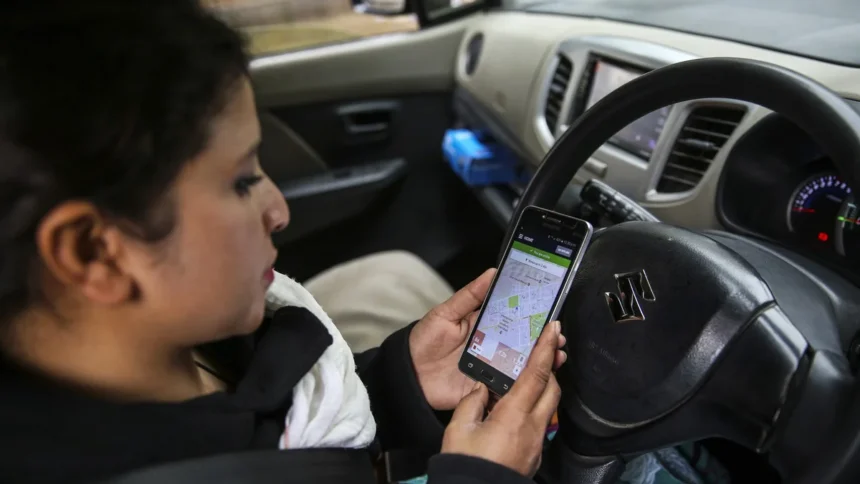
A lady driver in a pink shalwar kameez stands outside the customer’s gate in a side street of Lahore, verifies the order on her mobile, and knocks. There is no one in the house who doesn’t look forward to seeing a rider. They’re amazed for a moment that the rider is a woman. The surprise, however, is fleeting, almost reflexive, and more a reflection on the gig economy in Pakistan than any news story about ’empowerment’. But in practical terms, women have been taking up this job for the past few years, yet it hasn’t been entered on equal terms, and there’s a story between them.
Today, the phrase “a quiet revolution” is used to describe the new trend among Pakistanis of doing business on apps like food delivery, e-commerce on Instagram or Daraz, and ride-hailing. Which is correct. However, each woman on a bike or behind the display of a seller is being perceived as a symbol of progress — one that is in fact rather complex, an economic and social negotiation that women have to wade through every day with their own families, algorithms, strangers on the street, and platforms that were never designed with women in mind.
An Opening, Not a Flood
The scope of change is real but limited. The latest available labour force figures for Pakistan indicate that gig work accounts for a small share of overall employment, and even among gig workers, women engage in a narrower range of gig activities than men. Men are overrepresented in teaching, selling goods, taxi driving, and delivery jobs. All these are dominated by men. Nevertheless, many platforms have increased women’s income opportunities, primarily in non-threatening positions where a woman’s visibility or lone presence in public spaces is not a direct challenge to her presence.
That’s a very special group of women — the ones who make up the rideable drivers, the motorbike drivers in the market traffic, the ones who make a difference by being visible in the world. They’re not just gig workers. They are gig workers who have violated some threshold that’s still considered acceptable at best and tolerable at worst in Pakistani society. A few of them simplify their calculations: a delivery job pays much more than any informal work, such as tutoring or tailoring, and it pays regularly.
In Lahore, one rider learned to ride a motorbike from her husband and started doing odd jobs for a few thousand rupees a month, but since she joined a ride-hailing and delivery service, her family could afford to buy more food and let her pick up her children from school when she chose. Platforms like it love to display her story in ads, particularly on International Women’s Day. They are real. These are not the only ones, either.
The Permission Economy
It’s a softer, less obvious, less-paid negotiation that often needs to be completed before a woman can log into a delivery app — one that has to be done with a father, husband, brother, or in-laws who say this kind of work is fine. Gig work isn’t unique in this sense; Pakistani women have faced mobility challenges in the past, but the stakes are heightened when such challenges are made public and easily tracked through gig work. All customers can see a rider’s face. A driver’s location is pinged throughout a city. The online retailer who wants her products to sell well is rightly told that showing her own face will build more trust than a stock photo — which is precisely what many families are concerned about when it comes to visibility.
Permission from the family is not always permanent. It can be revoked upon just one uncomfortable encounter, a comment from a nosy neighbour, or a viral video that makes visible women feel collectively less safe. For those women who run home businesses on Instagram or Facebook, it’s the same negotiation in a different form: the permission to post their face, to be seen in a video, to respond to customers late at night. Many believe they can solve it by routing business calls through a brother’s or husband’s number, or by simply reducing the online presence that drives sales, to maintain a little more control — playing it safe and forgoing growth.
Safety Is Not a Side Issue
Safety for women in public gigs is not an afterthought, but a factor that influences almost every decision they make, such as what orders to take, what streets to ride down, and when to log off. Riders have reported that customers abandon orders as soon as they see the delivery person is a female rider, while platforms fail to provide options to opt out of unfamiliar or unsafe locations, despite the need to protect them. The net effect is that women are expected to work the same hours and routes as men and do the flexible work that is openly advertised to them, while women have to calculate constant risks that men do not.
What happens with online exposure is different, but it follows the same dynamic. Digital Rights Foundation data has revealed that a majority of online harassment complaints come from women, and that harassment of women operating businesses or personal brands online consists primarily of hate comments, blackmail attempts, and threats. The death of a young, popular TikTok star in 2025, who was repeatedly targeted by an online harasser, served as a stark reminder that online visibility can have devastating real-world impacts for women in Pakistan. While being an online seller isn’t the same as being an influencer, both are more alike than most platforms care to acknowledge. Anyone with high engagement is likely someone whose face, voice, and lifestyle are on display, and that is the exact group targeted by harassment.
On paper, there is legal recourse. Pakistan’s cybercrime law classifies online harassment as a criminal offence, but pursuing it requires going in person to an office and providing identification, which itself deters women attempting to avoid the very exposure and family conflict that filing a complaint would bring.
Economic Actors, Not Tales
It’s understandable that we’re told to be inspired by these women as outliers, but that framing understates what is actually happening. These are not mere tales of rebellion. They are working women making rational economic choices in an economy that provides them with real income, flexible hours, and freedom from traditional employment restrictions. At the same time, they are being asked to bear costs that are not priced on the market and are rarely covered by platforms: the cost of safety, the cost of social friction, the cost of endless family negotiations, and the cost of lost opportunities.
This framing is important because it changes what fixing the problem actually requires. It is not about more feel-good advertising around an 8 March campaign or another quote from a rider in a pink uniform. Fairwork’s research on Pakistan’s platform economy suggests something more fundamental: women are not less ambitious than men, but platforms fail to build gender-specific protections — such as tailored working hours, safer route assignments, and effective complaint mechanisms — thereby letting these workers down. Several workers who signed up during the initial recruitment drives have since walked away from the industry altogether, citing the disappearance of safety incentives once the initial marketing frenzy passed.
What Would Be Required to Stay in the Game?
A realistic and honest portrayal of women in Pakistan’s gig economy would put them on equal footing with men as workers, along with all the structural issues that it brings. That translates to platforms constructing safety and route features that are not driven by algorithms insensitive to gender risk. It means payment methods and support mechanisms that are not based on the assumption of unrestricted movement or needing a male relative to route business calls through. Ultimately, it requires recognising the harassment women experience on the street or on Instagram as a direct cost of doing business, rather than an unfortunate risk that individual women must shoulder alone.
Until then, the woman who parks her bike outside a Lahore gate, or the seller who posts her third photo of the day after finally securing her father’s reluctant permission, will continue to do what they are doing. Working. Earning. Living in public in an economy that is not fully designed for them. It is a quiet, profound shift. But this shift has not yet been matched by an economy or a society built to support it.
This piece captures the reality so well —beyond the headlines. Women in Pakistan’s gig economy aren’t just symbols of ‘progress.’ They are economic actors making deliberate, courageous choices every day while navigating safety, family dynamics, and platforms not built for them. Real support means designing policies, routes, and protections around their lived experience, not just celebrating them once a year.
This piece captures the reality so well —beyond the headlines. Women in Pakistan’s gig economy aren’t just symbols of ‘progress.’ They are economic actors making deliberate, courageous choices every day while navigating safety, family dynamics, and platforms not built for them. Real support means designing policies, routes, and protections around their lived experience, not just celebrating them once a year.