





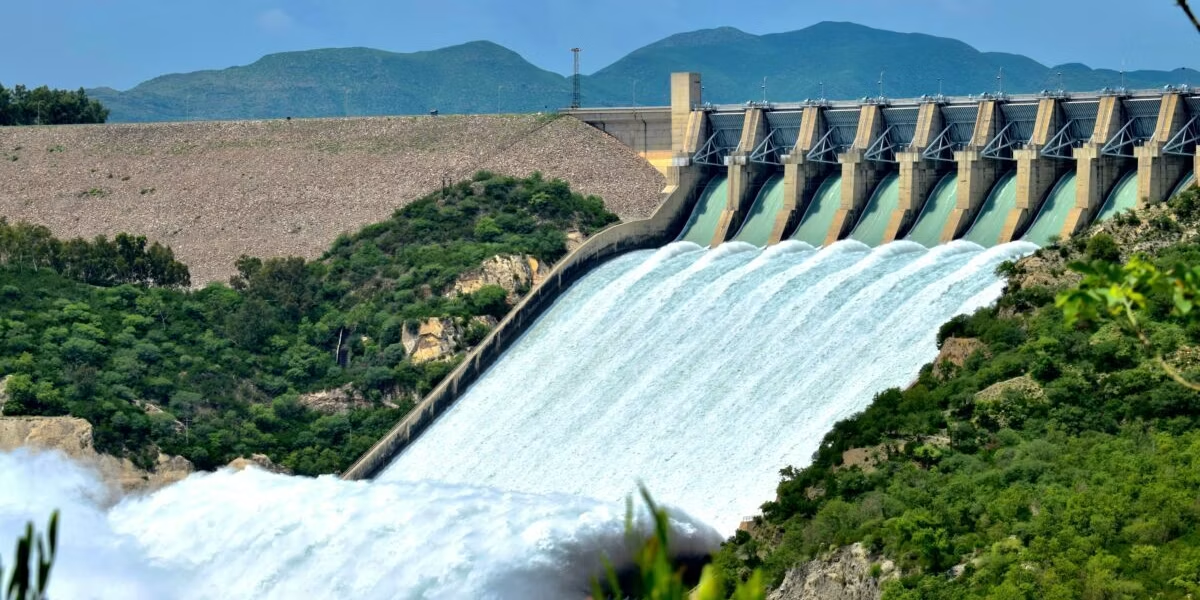
While the world may view water issues as an environmental crisis, the water landscape in South Asia and Central Asia shows something entirely strange and more lethal: THE WATER WARS. Water is slowly becoming a flashpoint for power, security, and survival in Asia. From the Indus to the Brahmaputra and from the Amu Darya to the Syr Darya, water scarcity and climate change are increasingly becoming the primary reasons to treat water as a strategic tool. Hence, Asia is clearly heading toward water wars, with profound mistrust over shared rivers, turning them into instruments of geopolitical bargaining.
South Asia gives the clearest illustration of the very dilemma. The rivers of the Indus, Ganges, and Brahmaputra are, though, home to billions but, at the same time, are entangled with national security. Although the INDUS WATER TREATY (1960) clarified the usage rights and river allocations to both India and Pakistan, the very achievement is now under severe stress. After the recent India-Pakistan War 2025, India placed the treaty in abeyance, while Pakistan rejected the move and warned against the diversion of the rivers. The water dispute has, therefore, moved beyond the technical arguments over dams. Water has been weaponised, turning a shared resource into a full-blown bilateral crisis.
Similarly, the Brahmaputra River has become the new frontier for water wars between Asia’s two largest economies, China and India. It begins in Tibet in China and ends at the Jamuna in Bangladesh, making its way across various parts of India. When China began construction of a mega dam project on the river in 2025, the Three Gorges Dam, India expressed concerns about downstream impacts and called for transparency, while Beijing maintains that the project will not affect downstream water levels. The key issue is not whether the dam will literally shrink the Brahmaputra; rather, limited basin-wide data-sharing and consultation can turn uncertainty into strategic suspicion.
Central Asia also faces a parallel dilemma on the Amu Darya and Syr Darya. Upstream states in this region aim to seek hydropower, while downstream states rely heavily on irrigation. In the same way, the Qosh Tepa Canal in Afghanistan gives a new dimension to the hydropolitics in Central Asia. This reveals a disturbing truth of hydropolitics: a project designed to benefit one state may lead to a permanent water-security crisis for another.
Above all, the most vulnerable communities exposed to the threats of hydropolitics are not governments, but farmers, pastoralists and rural households. When river flows are diverted, crop timings change, harvests fail, and the groundwater table is disturbed, leading to food insecurity and forced migration. A dam may be a symbol of national power on the map, but for a farmer downstream, one decisive question lingers in his mind: will the water arrive when the crops need it?
Hence, to avoid future existential crises, South Asia and Central Asia need a shift from river-by-river bargaining to wider basin hydro-diplomacy. Countries should establish data-sharing mechanisms, joint flood forecasting, and binding regulations on water-related construction projects. Existing treaties should also be modified to incorporate climate vulnerabilities, groundwater table fluctuations, and ecological flows.
Most importantly, water must be treated as a shared resource benefiting all, through confidence-building mechanisms rather than a weapon of geopolitical competition. Asian rivers have the potential to become corridors of peace because no country alone can control an entire basin. Hence, the water war of the 21st century will not be won by the state that captures more water but by the states capable of managing shared water before water scarcity turns mutual mistrust into an escalated conflict.