





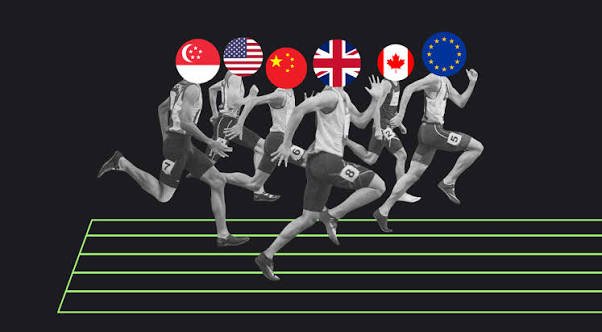
When nuclear weapons emerged, all powerful nations had one thing in mind: hoard as many as you can because our rivals could be doing the same. The hunger for power and the fragile idea of being left behind drove nations to prove their economic and innovative strength. As AI has entered, not only as a piece of technology, but also as a new mode of production and a necessary aspect to gaining dominance globally, so too leaders have set their eyes on developing and implementing it, often at the cost of adequate governance required to stay within ethical boundaries.
As once came the capitalist class on the ruling pillar of the future, so has AI appeared as the embodiment of a new class, one associated with tech giants. The presence of the CEOs of OpenAI and Claude in meetings with government officials clearly supports this claim. The aim here is to capitalise on this technology because having advanced AI equipment would be a staple marker for a country being a superpower, at most. However, in this rush, countries are being led to poor practices in terms of forming any ethical or safety standards around it. Not only does major data get fed into the system to sophisticate the output, but other confidential information is becoming part of the larger stream and at an ever-present risk of security breach.
An article in the Financial Times quoted Dario Amodei of Anthropic with the following:
“If all companies in democratic countries stopped or slowed development, by mutual agreement or regulatory decree, then authoritarian countries would simply keep going.”
Almost too precious to ignore, this highlights the idea behind the rapid evolution and strengthening of AI as similar to an ‘arms race’ which gives solace to leaders against a paranoia developed through rival countries.
The US and China understand that a government intervention in AI is a necessary corollary to gaining strength. Both their governments are actively participating in building AI infrastructure and becoming shareholders. Even as Andy Burnham recently took office as the PM of Britain, he emphasised the need to deepen the UK’s reach in research and development around the technology. Specifically, he noted the need to reduce reliance on foreign data centres e.g. the US, and build its own AI models as a response to the US government export control on Mythos, the highly sophisticated model produced by Anthropic, while simultaneously regulating its risks to jobs and national security.
Not only for economic gains in capitalisation, AI’s use in military and defence would likely play a vital role in forming stronger geopolitical strategic links. Particularly in the case of the Five Eyes, an intelligence alliance between Anglo-Saxon countries to exchange signals intelligence, cryptanalysis, and decryption, where its member country, the UK’s AI Security Institute, would act as the source of international leverage in sharing risk intel.
While this almost blind salivation towards the benefit of AI draws powerful leaders, they surely must be knowledgeable enough to know the limitations of the technology as well, especially where those nuances may prove fatal. In a study by Kreutz and Jahankhani, they explored 40 AI security challenges of which most did not, or either partially, follow the current ISO standards. AI is bound to hallucinate and generate incorrect information. In a serious issue of life and death, e.g., war, hasty decision-making through AI could prove disastrous. Although the world is developing risk management frameworks like the European Union’s AI Act and the National Institute of Standards and Technology’s AI Risk Management Framework (NIST AI Act), there is still little transparency provided by governments in their military use or their plans to integrate it in the future.
Surely AI is a major breakthrough in reaping huge benefits both economically and militarily, yet its proliferation is much riskier than the atomic bomb in that it is constantly degenerating the world around us. The most I’ve seen people do is ‘like’ or ‘reshare’ an infuriating post or reel talking about the dangers for life, from surveillance to the burning of historical books. A lasting protection from it is something I don’t know. But can we stop AI? No. Can we regulate it? Yes.