





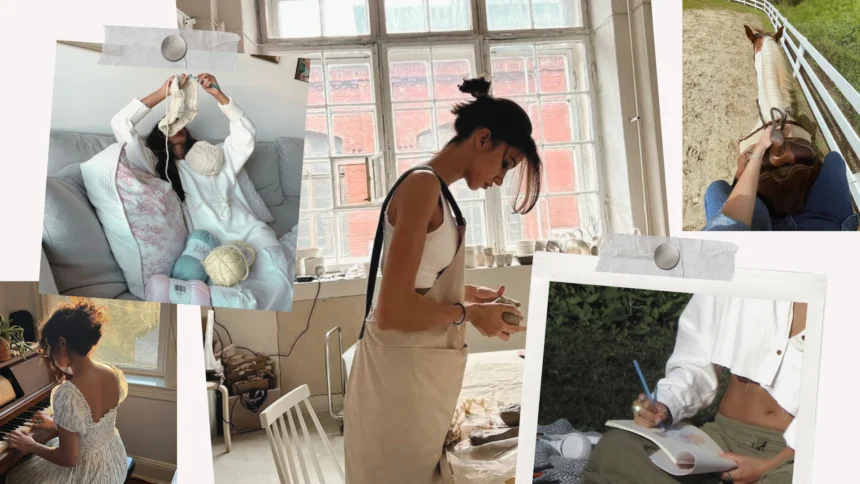
Adults have started playing again. After lockdown gave us a chance to rethink how we spend our free time, social media has become swarmed with new activities and niche communities. From BookTok’s takeover to themed food board dinner nights, the hashtag #hobbies has over 761.8K videos on TikTok. This impact has also scaled up to the economic level: Statista reports that the Global Toys, Hobby, and DIY retail volume stands at a towering 703bn USD. This raises the crucial question: why are adults turning to hobbies?
In a post-industrial economy that has reconstructed human beings into productive machinery, hobbies become a sanctuary where we can finally take a breath. The World Health Organisation reports, “long working hours led to 745,000 deaths from stroke and ischemic heart disease in 2016, a 29 per cent increase since 2000”. With excessive workload and demand to be beyond humanly efficient, mental health takes the collateral damage. Hobbies, therefore, are not merely leisure and entertainment; they can be life-saving. A study titled “Exploring the Impact of Hobbies on Mental Health and Well-Being: A Scoping Review” concludes, “engaging in hobbies offers a break from daily stressors and fosters a sense of purpose and fulfilment, ultimately enhancing the quality of life”. The adult hobby boom is a response to a culture that idealises burnout and exhaustion; people find refuge in focused activities, whether that be pottery or simply reading a book.
Digital fatigue is also a catalyst in the adult hobby boom. Overstimulated by passive doomscrolling and constant notifications, people seek activities that require intentional engagement, whether that be physical or intellectual. The cognitive load theory explains that extraneous load, any form of digital stimulation, drains our mental processing. Comparatively, hobbies offer sustained focus, a sense of progress, and the satisfaction of making or mastering something. A study finds that “engagement in hobbies halved the risk of older adults following a trajectory of ‘persistently low cognitive function.” The difference is evident: whilst digital overconsumption exhausts us, hobbies give the brain meaningful effort that it’s designed to thrive on.
The surge in adults participating in more hobbies also unveils a deeper reality: the loneliness epidemic. During the COVID-19 pandemic, “the rates of social isolation and loneliness…were estimated to be 31.2% and 28.6%, respectively, which were higher than those before the pandemic”, according to the World Health Organisation. Social distancing rules created intense social isolation, causing many adults to crave in-person connections, and hobbies offer that exactly. Board games, sports, or any collective hobby invites you to connect with like-minded people, creating a sense of belonging and community. It is proven that “collective belonging addresses needs for meaning” and “identity”, alleviating feelings of loneliness and low self-esteem.
Hobbies, however, may be repurposed to build personal branding and a certain self-image. In order to find belonging, people may turn to activities that present themselves to fit into desired aesthetics. The term “performative male” is the perfect embodiment of this, and it has conquered for-you-pages. It’s used to describe men who adopt certain hobbies, like reading, fashion and even drinking matcha to attract women. In this case, hobbies can also serve as accessories to display specific characteristics in order to create social connections.
Whatever the reason be for the adult hobby boom, it’s refreshing to witness a world falling in love with curiosity and adventure again. As worries rise about our addiction to the isolating digital world and hyper-productivity, seeing adults take the time to learn a new craft or find a moment to relax shows the world is moving in a positive direction. If people are finding ways to reconnect with themselves and with each other, then it’s a change worth celebrating.