





When modern citizens of sovereign states contemplate their current land of residence with every tender feeling, they may naturally be left in a loop of confusion. Immigrants who question their identity on a daily basis, ethnic communities who acknowledge their privilege, children of the land forced into displacement, and many others all experience this uncertainty. Among these diverse dwellers exist citizens of third-world nations, ones like myself.
These individuals adopt an unwanted lens of hopelessness when they think about their homeland, yet they garner a certain level of rage when they realise all the ways their nation has been wronged throughout history. This rage is multifaceted, directed not only at the corrupt, the betrayers, the hegemons, and colonisers of history, but also at their own people for letting it happen. Though rage is a powerful emotion, it arises mainly from love and sympathy for what is one’s own — a statement I can assent to, having been born and raised in Pakistan.
Pakistan, a state with its hybrid regime and billions in debt, has an existence that is no less than pure bewilderment. Bearing the scars of colonialism and the traces of dictatorship, the nation often appears almost immune to meaningful progress. The people, so used to being aghast at their own country’s happenings, feel no surprise when bad news makes headlines, yet they remain guiltily in love with the nation itself.
As a Pakistani resident, what can possibly make me one of those miserably in love with their homeland? The fellow people, the warmth, or the poetic landscape with immense national pride attached to it. Pakistanis do take pride in their heavenly regions, each ounce of them stored in formidable mountain ranges, green plains, and sublime waters. However, this rare source of pride now seems to collide with fear as a global phenomenon has started to manifest itself profoundly in an already wounded nation. The issue of climate change, which should have been addressed long ago, now ushers in a new calamity every day, as Pakistan is listed among the nation’s most vulnerable to the consequences of climate change.
A few months ago, the news of a family of ten being swept away one by one by a torrential flood in the Swat River near Mingora made national headlines. The horror of this tragedy, as death trailed a family on holiday, caused great distress across the nation. Questions arose as to why the authorities were not present and why governance remained so poor that the last drop of hope in this country seemed to empty itself out. However, the disappointment expected from the authorities and a governance system in ruins shall not be the main argument of this piece. Rather, what lays the next brick in this observation are the major floods that followed soon afterwards.
As Dawn reports, “unprecedented flash floods left behind a trail of wreckage in Buner, Swat, Shangla, Mansehra and beyond. A week before that Muzaffarabad bore the brunt of monsoon rains. Almost a month back, 37 villages across GB were declared calamity-hit.” (Amin, 2025).
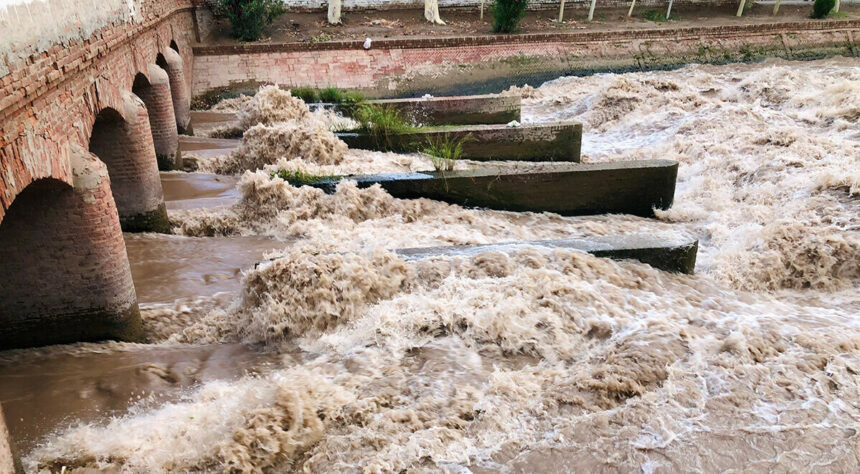
The floods were recurring, with heavy rainfall becoming a constant. Karachi, too, stood drenched in cataclysmic waters. As reported by Reuters, “The death toll from flooding in Pakistan since the start of the monsoon season in late June now stands at 802, half of them in this month alone.” (Shehzad and N. Das, 2025). The scenes were almost a repetition of the 2022 floods, which left more than 1,000 casualties.
Where sorrow rises every day, which part of the governing bodies should be held most accountable? The policymakers, who seem to lack effectiveness and constantly display short-sightedness? Or the individuals in power, who seem to practice corruption and seek publicity on a religious basis? The government’s incompetence in addressing these matters stands as a root cause of the issue. However, another significant, yet ironically ignored, issue at the global level is climate marginalisation. The climate crisis sees no borders, yet the powerful remain unhinged while the vulnerable face catastrophe. This truth has long been observable in the remnants of colonial law as well as in transboundary climate injustice — two phenomena central to the global fight against injustice, the former of which is highlighted in this excerpt.
Pakistan and Colonial Law: The Canal and Drainage Act of 1873
The Indian subcontinent under British colonial rule saw the passage of the Canal and Drainage Act in 1873. In 1947, Pakistan inherited its legal and structural framework, which was later updated through further irrigation legislation, such as the Punjab Irrigation and Drainage Act of 1873 (as amended in 2023). British officials publicly justified canals as protective works designed to mitigate drought and stabilise agriculture, yet their design, financing, and operation reveal a consistent emphasis on revenue extraction and the promotion of commercial agriculture (Pandey and Sonal, 2025). These remnants of colonial law contributed to the nation’s climate vulnerability and became part of the broader phenomenon of deep and enduring imperial influence on the country’s existence.
The Act provides a hierarchical legislative framework for authoritative water control, limiting public use of water and, in true imperialistic essence, restricting local adaptation to water-related problems. The comprehensive Act hindered the development of modern climate-responsive policies, the consequences of which are observable in present-day climate change challenges. One particular example is the prioritisation of cash crops through the Canal and Drainage Act.
A cash crop is agricultural produce grown primarily for profit rather than for local consumption. The Canal Colonies established under the Act provide evidence of this prioritisation of market growth, as official documents labelled them “settlements for the cultivation of wheat and corn”. Moreover, the Act introduced the traditional warabandi method, a rotational water schedule based on the requirements of intensive wheat-growing cycles rather than traditional, water-resistant crops such as millets, pulses, and sorghum, which were better adapted to the local climate.
The warabandi schedule was fixed according to crop seasons rather than real-time rainfall or soil moisture, thereby reducing effective flood-adaptive measures and contributing to governmental incompetence. Warabandi also marginalised effective pre-Partition community-managed systems of Sindh and Punjab, such as the kuhl and phud systems. This manifested as a long-term setback through the loss of indigenous knowledge and adaptive practices.
The Act also abolished doras (natural river spill channels) and inundation canals, which had traditionally been used to prevent flooding, and replaced them with perennial canals, thereby heightening the possibility of floods. Water that had previously dispersed gradually was instead forced into confined channels at dangerous velocity.
This Act and its legal structure introduced a rigid, authoritative water-control system, whereas the nation’s governing bodies have failed to implement flexible, decentralised methods of water management to address the flood crisis. The Act also ignored the ecological requirements of the land in which it was implemented and failed to account for the country’s heavy reliance on the Indus River, a factor that would later influence the Indus Waters Treaty of 1960. All these points, alongside many others, reinforce why the decolonisation of the country’s institutional structures remains urgent, yet continues to be ignored by the authorities.
Apart from the Indian context, it is evident globally that colonisation stole from people and their lands, causing lasting deprivation. However, it remains equally urgent for formerly colonised nations to recognise these legacies and free themselves from enduring imperial influences. Only then can genuine empowerment be achieved.
BEAUTIFULLY WRITTEN by an exceptional writer. Loved every bit of it . Keep em coming 🤍
A truly thought provoking and insightful read!! Amazing work by a mega talented writer❤️.