





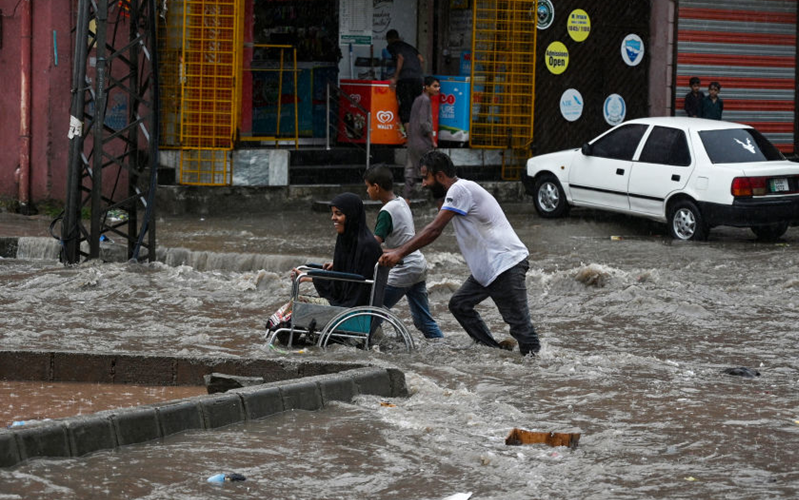
Every extreme weather event, whether a hurricane, flood, or wildfire, carries a price tag. They bring an overdue bill, carrying a massive economic catastrophe with them, costing trillions to several nations, particularly the poor ones. Such events don’t send an invoice. But the economy always does.
Each disaster remains as a headline for weeks, but then fades. What doesn’t fade are the bills; to the governments, majorly, to the farmers and the affected families left to rebuild from scratch. For a long period, the economic cost of climate change was treated as a future problem.
That illusion, however, is now over. The intense damage is here; it is measurable and accelerating. The question is no longer whether we can afford to act. It’s whether we can afford not to act and perish together as victims of both climate change and climate economics.
The economics of climate change discloses a trillion-dollar reality. Extreme weather events have cost the world over 2 trillion dollars in the past decade, affecting over 1.6 million people worldwide. In the last two years alone, global economic damages reached 451 billion dollars, a 19 per cent increase compared to the previous eight years of the decade, as reported by the International Chamber of Commerce [1]. Furthermore, a NOAA Climate survey finds that in the United States, losses from weather disasters have averaged $ 140 billion over the last decade, with 2017 the costliest year on record [2]. The figures are not mere numbers — they are a trigger warning indicating an inevitable economic disaster in the near future amid climate change.
Moreover, these figures are not coming to a halt; they are rather accelerating. According to the World Economic Forum, typical cyclone costs rose sharply from under 10 billion dollars in 1984-1994 to over 80 billion dollars in 2014-2024, and the severe storm costs increased more than tenfold over the same period. WEF further mentions that, if the current trend continues, the world could face 145 billion dollars in losses in 2026 alone, a 6 per cent rise on 2025 figures [3]. Hence, climate change economic projections loudly chant that extreme weather events don’t just cost lives; they also impose comparable economic costs.
Scientific research no longer allows us to call the extreme weather event simple bad luck. Studies suggest that anthropogenic greenhouse gas emissions have amplified the likelihood and severity of specific disasters. According to landmark studies published in Nature Communications, 143 billion dollars per year in extreme weather costs are directly attributable to climate change, resulting from human activities that have increased the intensity of weather events [4]. Along with the human toll, these events bring indirect losses such as supply chain disruptions, regional unemployment, climate migration, and cross-border financial spillovers that ripple far beyond the original disaster zone.
The sobering part of climate economics is that the costs are distributed unequally across the globe; developing nations pay the heaviest price. The acute impact on developing countries is highlighted by an analysis of the ICC, which shows that a single extreme weather event can impose costs exceeding a country’s entire annual GDP [5]. Moreover, the Centre for Strategic and International Studies projects that climate change will thrust 122 million people into poverty by 2030. In the shadow of current global warming, food security scores for low-income countries are projected to decline by 42 per cent, compared with just 6 per cent for wealthier nations [6]. Hence, the most vulnerable are those with the least contribution to atmospheric emissions — the Global South.
Economic damages being felt today are just the beginning. What lies ahead is more alarming. Research by the Green Central Bank shows that past warming of just 1.2°C has already resulted in a global income loss of 2 per cent, due to above-normal temperatures recorded between 1960 and 2014. Whereas future projections show something more destructive. The Network for Greening the Financial System has developed scenarios in which global GDP losses reach 30 per cent by 2100 under current policies, with a worst-case of up to 50 per cent [7]. Thus, climate change under the current faulty policies could deliver nothing but large-scale damage, permanent and global.
Hence, climate change is no longer a distant threat; it has arrived, and it is most likely here to stay. And it is sending bills that governments and ordinary people are already struggling to pay. This alarming scenario calls for immediate action by both wealthier and developing nations, within their respective capabilities. A single dollar invested in clean energy, flood defences, and climate-resilient infrastructure today would save many in disaster recovery in the future. Today, immediate and collective action is the smarter and cheaper choice. The window to make better decisions is always open. Do we have the will to act before the next disaster knocks on the door?