





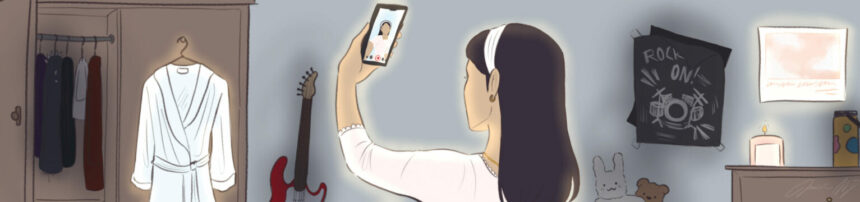
The six-inch device, your constant companion, the love of your life, your identity maker and your social currency, the beloved son of capitalism and darling dearest of globalisation: your mobile phone. But stop, you use your mobile phone for work, right? And just “minor scrolling”. But when you want a sound for your next 15-second reel, you look for what is trending; you want to buy an outfit. What are others wearing? You want to find a hobby? Sure, there you have the emerging trend of padel and golf carting even when you cannot afford it, but hey, that is what the media demands, yes, justified. And those are just a few examples. From reading YA novels to buying Kashmiri churian, we are just following a “trend”, and yes, that is harmless, but wait, who are you now? Who are you without your feed? Who are you when you only wear what others do? Who are you when you only drink a 1000-rupee coffee which your feed asks you to? Who are you if you don’t follow every AI-generated trend and already curated CapCut templates? Are you yourself or only what your feed demands of you? The answer is harsh, but so is the truth.
Our identity is at the crossroads of “Instagram trends” and “TikTok reach.” Doomscrolling and the cyber wave of globalisation have made it statistically impossible to just be ‘yourself’ when you easily could be someone else because we all know the price of sticking to our own likings. When was the last time any of us read a book because we just “wanted to”? When was the last time you watched a movie when the internet declared it ‘Rotten Tomatoes’? This approach of having euthenics and indigenous patterns in such an environment as we exist in gives it the face of “pick-me behaviour” and “cancel culture”. When having subjective opinions and personal taste is just labelled as the ‘urge to stand out,’ one can only perform for the media.
A human’s identity is formed by self-recognition. An intricate process which is influenced by both internal and external factors. One’s identity is a result of cultural, social, psychological, religious, and familial influences and, to some extent, biases. A sense of belonging, a sense of dissonance, likings and dislikings, approval and rejection set the stage for development, but the media’s polarisation has made this meticulous process a daydream. When you are fed words long before you learn how to speak, taught choices and tastes based on algorithms and views, your whole existence becomes a question mark. When you cannot eat without the media, cannot shop without the media, cannot have a hobby without the media, and cannot choose colleges and preferences without the bandwagoning, you are no longer a mere user of social media; you are its performer, and the audience is the self you left behind only.
To find yourself in such a dystopian environment is not only a journey; it is an act of rebellion. When 9 out of 10 Instagram videos ask you to wear the same dress, demand that you listen to the same music, force you to read the same novel and make it mandatory for you to align with the same political views, you begin to lose yourself in the spiral of being included in and the urge to fit in. This desire to be among the majority and avoid confrontation has been present in human psychology for the longest time. Humans found it easier to be just someone else rather than trying to know who they were because the latter demands effort and the former demands imitation. It is easier to copy the strokes the other artist scribbled; it is distressing to find a painting of your own. Following trends is not the harm here; how it slowly takes you away from your own self is the cost you are paying here.
So again, who are you without your feed? A human experiencing or an actor performing?