





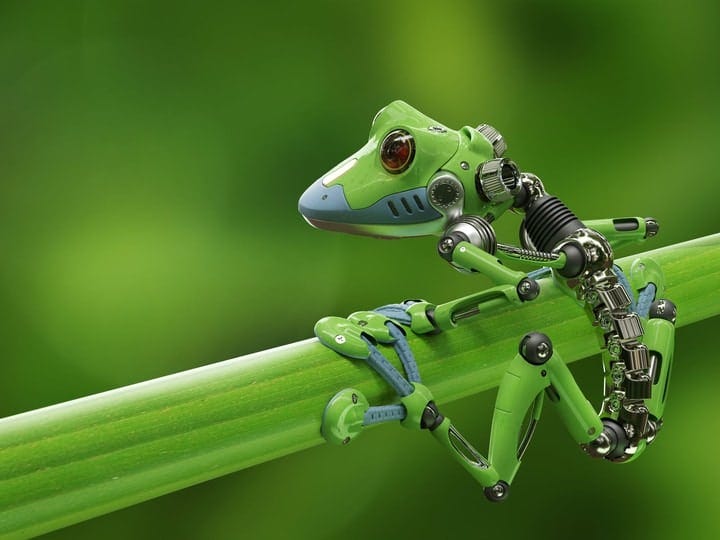
A question that often arises in my mind is: Is everything new in the world a copy of something old?
According to the Cambridge Dictionary, “Biomimicry is the practice of making technological and industrial designs copy natural processes.” Man has always been a curious being; he observes nature, researches it, and if he finds something valuable in it, he copies it to solve his problems. The world’s first mimicry of nature mentioned in the Quran is when Qabil buried Habil in the land by learning the process of burying from a crow. Man learnt how to swim and catch fishes from beasts; he made clothes from leaves and discovered countless solutions to countless problems inspired by the environment. In the beginning, man only knew that he was copying nature, but as time passed, copying became biomimicry.
History
In 444-507 BCE, Lu Ban invented an umbrella inspired by a giant lily leaf. Leonardo da Vinci, also known as a father of biomimicry, properly introduced it as a separate study. He sketched a flying machine by analysing the anatomy of birds and their flight in detail during the 1480s. After that, many personalities invented amazing technologies like a helicopter inspired by the rotation of a hummingbird’s wings. A revolutionary invention of Velcro by George de Mestral was copied by a stubborn burr, sticking to his dog and clothes. Shinkansen bullet trains in Japan are a result of the kingfisher’s fast-flying structure. With the rapid modernisation, engineers are searching for designs of nature that can collaborate with modern technology, as they think that nature has already solved the problems that man has been trying to solve for years.
Inventions Inspired by Nature
- Shinkansen bullet train
A Japanese train with a speed of up to 320 km/h was inaugurated on 1st October in 1964. Before there was a problem of bomb blast-like sounds passing through tunnels. Scientists started researching how to decrease sound. One of them noticed a kingfisher bird diving into water silently and catching fish without any noise or disturbance in the water. On analysis of its anatomy, he came to know a mind-blowing fact: that a thin and long beak of a kingfisher connected with its head in a bullet-like shape helps to reduce friction in water, and step-by-step exposure to water makes less noise as compared with rapid exposure directly on its flat face. As the old trains had flat rectangular-like shapes facing more pressure and resistance, they used to make more noise. The regeneration of trains in a bullet-like shape totally changed the experience of travelling in history. We can see how nature has already been designed so perfectly that a deep observation of it can solve the huge problems of mankind.
- Velcro (a hook-and-loop design of nature)
Once George de Mestral went on a hike along with his dog. By passing through a bushy area he got burdock burrs stuck on his clothes and the skin of his dog. He came back home and analysed the sticky burr structure under a microscope. He observed tiny hooks at the end of spikes of flowers. Then he came to know that the fur of his dog worked as a set of loops that got attached with the hooks of burrs. Although it was a disastrous experience, it gave him a new idea to build something valuable that can work as a binder to hold objects stuck together. Now an accidental discovery has become a common necessity of life. Velcro is vastly used in clothing, shoes, hair accessories, kitchen utensils, and holding wires and carpets in place.
- Sharkskin on planes and ships
Shark skin-inspired riblet material helps reduce drag force on planes and ships. Engineers faced the problem of extreme drag force on planes that increased the fuel usage. A sea creature that helped them finish this problem was a shark. Nature has made it so that it smoothly and quickly swims in water. It has sandpaper-like skin that consists of V-shaped scales. These scales not only fasten the speed but also reduce the cost of fuel. Moreover, they also have the ability to prevent bacteria like E. coli. Its structure resists the colonisation of bacteria that stops the spreading of infections. Hospitals use it on the surfaces that are touched the most a day and prevent infectious diseases from spreading. Nature has the secrets of cost-effective and power-saving architecture with resistive behaviour against outside attacks, and shark skin is the best example of it.
- Termite mound
Termites, little bugs, can teach a man the hidden architectural tricks through their mounds. Scientists studied mountain-like structures in properly drained areas of Europe, Africa, and Asia. It was revealed that those were the castles of millions of termites made in years. The main materials used to build that nest were sand, termite saliva and dung. Its structure was complex, consisting of uncountable tunnels that help proper ventilation and gas passage. Its porous surface keeps its interior at constant temperatures day and night. A chimney on the top of the mound has a different wind passage than the surface-level openings. It helps the easy passage of respiratory gases. So a structure made by tiny bodies teaches the great lessons of architecture. Humans used these mounds to make a model of a building that remains cool in summers and warm in winters.
How nature wins
Nature is designed so perfectly that when a man focuses on its objects, he learns new things every time. Even the tiniest creature of it is built for purpose and gives ideas to improve life. Things made by nature are biodegradable and environmentally friendly. It not only creates less waste but also helps save energy. If studied deeply, we can say that the future will be more modern with projects like stronger and lighter materials for cars and bulletproof vests inspired by spider silk. Also, a reptile-shaped army of robots climbing walls with better adhesion is also a possibility. Nature always wins over man’s creation because the creator is the majestic evolver. He has always asked man to travel and observe nature, and those who can’t see his signs are not unlucky but blind indeed. In the Quran, Al-Aziz says:
“Say, [O Muhammad], travel through the land and observe how He began creation. Then Allah will produce the final creation. Indeed, Allah, over all things, is competent.”
A very interesting and informative article. I really enjoyed reading it especially the examples of the kingfisher-inspired bullet train and Velcro. It is amazing how many solutions already exist in nature if we take the time to observe and learn from it.
Thank you for sharing such valuable knowledge in a simple and engaging way. May Allah bless the writer and the entire team with continued success and give them the ability to keep producing such beneficial content. Looking forward to reading more articles like this in the future. Ameen. Best Of Luck Beta Hifza❣️