



Accessibility in poetry is often seen with a disapproving eye, with simple, punchy lines being equated to a dumbing down of a complex art form. Especially for literary experts and devoted readers, a confessional 6-liner about self-healing on Instagram stokes disdain. But for millions of others just going about their day, a small verse can sneak in a moment of reflection.
Like this line written on a mural in Lahore.
“Log kya kahenge?
Log hum hi to hain, hum kya kahenge?”
(What would people say?
We are the people; what will we say?)
It reminds people how relevant poetry can be to their daily reality. So instead of resisting it, perhaps we should be appreciating it for what it is: a public invitation into an otherwise esoteric joy.
Public forms of expression have co-existed with “high” art throughout history. The walls of Pompeii in ancient Rome, upon excavation, were discovered to have thousands of examples of graffiti, many of which contained poetry. Such writing was so common that an epigram on one wall read, “I’m amazed, O wall, that you have not fallen in ruins, you who support the tediousness of so many writers.” In Sufi culture, works of the renowned poet Bulleh Shah moved far beyond the page. His famous verses were written on his shrine in calligraphy, memorised by generations, and are sung every year at his Urs festival by qawwals. The desire to live alongside creative expression has always been there. Social media and street art have just made it louder.
Today, street poetry initiatives can be found globally. In London, the ‘Poems on the Underground’ project displays poems inside the city’s underground carriages for millions of commuters daily. Passengers, who are otherwise inundated by screens and advertising content, can look up to find something that moves them. Many are introduced to works they had not read before. In a routine commute, it creates a moment to pause and think. Inspired by the concept, similar projects cropped up in Paris, Beijing, Shanghai, and Moscow.
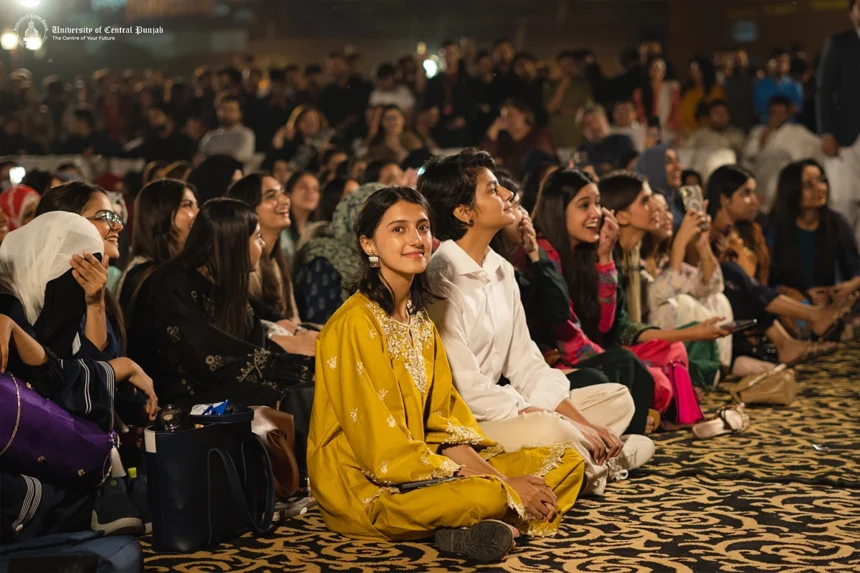
In New York as well, a ‘Poetry in Motion’ programme is run by the Transit Authority for its subway riders. In Pakistan, mushaira events allow budding writers to perform their work and give all literature lovers the opportunity to attend. Poetic quotes also appear on murals painted by artist groups like the Fearless Collective in various cities. Such outlets don’t just elicit introspection; they also reflect collective sentiment. For locals, it is a connective experience to see shared values or grievances displayed publicly. For outsiders, it is a look into the social makeup of a community.
In the world of social media as well, poetry has adapted itself to modern times. It consists of short, simple and emotionally charged lines, commonly known as “Instapoetry.” Perfect products for a generation that scrolls. One of the most famous writers who popularised the form is Rupi Kaur whose first collection titled “Milk and Honey” became a massive success and sold millions of copies globally. Her content was the centrepiece, but Kaur also ensured that she created an integrated experience for her followers through her spoken-word performances and Instagram posts that showed snippets of her work. To capture an audience, it’s not just about the accessibility of the material but also how it is packaged. Does all this sacrifice depth? Yes. But within the constraints of today’s attention span, it pushes just enough poetic exploration as non-readers are willing to sit with it. It is an incremental win. If Instapoetry were absent, the connection to poetry in general would be much more limited.
At the same time, the brevity which democratises verses also imposes a cost. When a few lines are used to convey an entire emotion, they have none of the nuance of a longer piece. For instance, the emotional quotes on social media about longing like “I miss you in ways I can’t explain” are shareable. But they cannot come close to the intricate realisations about love through life’s suffering that Faiz Ahmed Faiz expresses in his famous poem “Mujhse Pehli Si Mohabbat.” As Faiz’s world falls apart, witnessing violence all around, he exclaims, “Aur bhi dukh hain zamane men mohabbat ke siva” (There are other sorrows in the world, apart from the anguish of love). When contradictions and ambiguities like these are absent, it flattens the reality of what we feel. It stops poetry from doing what it’s supposed to — describing the complexity of human experience.
Despite its flaws, public poetry serves an important role in society. It is not about choosing between Yeats and a sentimental reel. It is realising that if more people read, more people are likely to explore other literature as well. Being moved by a verse on a mural or a piece in an open mic is not the end goal; it’s a starting point. And it might make someone step into a bookshop that they haven’t been to in years.