





A writer writes not only to pour down the thoughts rushing in his mind onto the paper. But somewhere the purpose of writing is to let the people know and read what he thinks and writes.
Every writing is meant to be read.
Penning down the ideas or crafting them in a story is not the sole reason to write. A piece of writing is also meant for an audience to whom that idea resonates.
What will happen if a writer writes something but no one can read it for a century? Will a writer write a story if he gets to know that his work will be kept secret for a hundred years and no one can read it?
In a forest near Oslo, Norway, a thousand trees are planted, which are gradually growing. These trees will turn into an anthology of books after a hundred years.
In 2014, “The Future Library”, an artwork by famous Scottish artist Katie Paterson, became the talk of art and literary circles for its non-traditional and unique concept. Under this artwork, 1000 trees were planted in a forest near Oslo, Norway, not to restore nature but to supply paper after 100 years for an anthology of books.
Paterson’s artwork considers our place on earth in the context of geological time and change. And this artwork is also one of them.
“The future library is a living, breathing, organic artwork, unfolding over one hundred years. It will live and breathe through the material growth of trees. The unwritten words, year by year, activated and materialised” (Paterson).
This artwork is a connection between humans and nature. As it connects humans with nature and humans with humans across time. It started from the people alive today and is meant for the people living 100 years from now. This artwork introduces us to new dimensions of thinking and decision-making. Today, we make decisions meant only for us living now. The future library artwork questions the present tendency to think in short bursts of time, helping us to think beyond the boundaries of time.
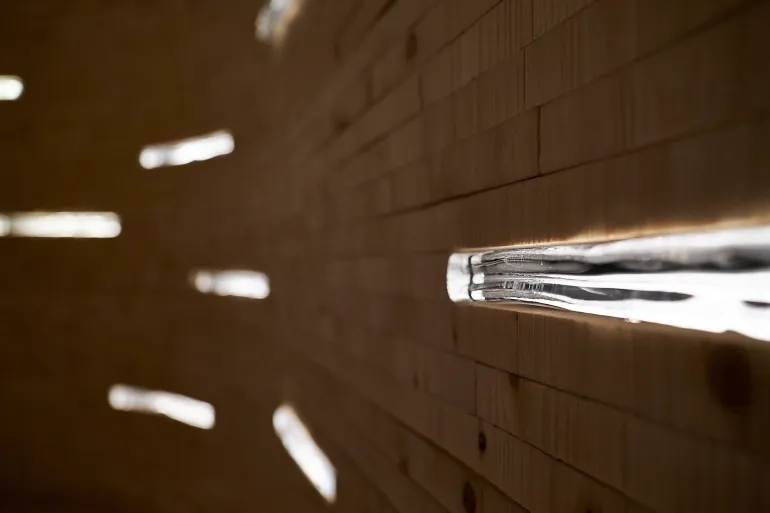
For this artwork, every year one internationally acknowledged artist is approached to contribute with their writing. From 2014 to 2026, many famous writers have contributed to this project with their writings; some of them are Margaret Atwood, Elif Shafak, David Mitchell, Han Kang and Judith Schalansky. The writers hand over their manuscript in a special ceremony held in the same forest. The manuscripts are held in trust in a specially designed wooden room called “The Silent Room” situated on the top floor of a public library, Deichman Bjorvika. This room has one hundred drawers, one for each writer’s manuscript, with his/her name engraved on it. All the writings stored there would be published in the year 2114 in a single special anthology of books.
It sounds so fascinating to think about this idea, to write for people beyond your time. The piece of writing, created today, is meant to be read in the year 2114. This artwork is a rarity in itself.
The manuscripts are being submitted, the forest is being preserved, and the trees are growing day by day to produce a work in the hope of finding a receptive reader in an unknown future.
MASHAALLAH, I’m happy to read this piece of writing. What a powerful idea!
Writing for a future you’ll never meet is a such a beautiful act of hope.