





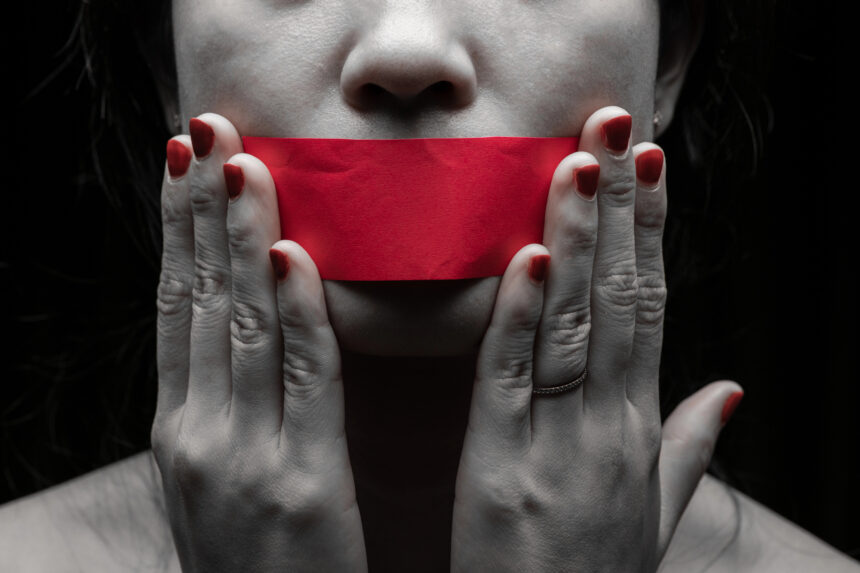
The silence found around the topic of abuse is not accidental. It is of immense importance for us to grasp how such silences in society are produced through structural conditions that allow them to be maintained as well as enforced effectively. The reason abuse exists across societies is not only because it exists, but more significantly, because it is not spoken of. People often tend to mistake the absence of testimony as the absence of harm itself, and they not only assume this but also begin to propagate this belief with much conviction. But this absence of harm, this silence, is not mere emptiness. It is structural, for it is built through instilling fear, which is then sustained by shame and later justified through a language that parades itself as protective.
In many contexts, silence becomes a form of social order, especially within tightly bound families and community systems. At the individual level, however, silence is often internalised, and that is the real trauma a society must learn to heal from. Survivors of abuse often hesitate to speak about it because they anticipate the worst possible consequences. It is usually not because they lack awareness of harm itself. Research on trauma and disclosure shows that victims commonly experience self-doubt, guilt, and fear of disbelief, all of which discourage reporting. The act of speaking out is not simply an act of telling the truth. It is a significant risk, one that can lead to isolation or reputational damage.
Such hesitation is reinforced by the social environment as well, because families that are often positioned as sites of care and protection can also function as mechanisms of great suppression. People often prioritise preserving their reputation over wanting swift justice. The way abuse is reformed is often in the form of a misunderstanding or as a private matter that is portrayed as mutual conflict. In this context, silence is not just imposed externally, but instead it is negotiated internally within relationships themselves, where the involved individuals are usually reluctant to disrupt their existing circumstances.
The logic of silence extends way beyond the family and into the sphere of a community.
What can be said and what must be concealed is frequently regulated by social norms. In societies where things like honor and respectability are held on a pedestal, the disclosure of abuse is considered threatening, for it is seen as causing collective damage. As a result, the victims of abuse themselves are often implicitly or explicitly encouraged to endure what they have undergone for the sake of preserving the so-called “honour.” Thus, this silence becomes a form of social compliance and something that absolutely hinders the victim’s pursuit of justice.
Such a dynamic is not limited to any singular cultural context, and the studies conducted across multiple regions show that stigmatisation and victim-blaming play a central role in suppressing disclosure. Every time a victim discloses the violence committed against them, they are questioned for their truthfulness and held partially responsible for the abuse that they have experienced. The burden of proof, then, is shifted onto the victim, which makes taking refuge in silence feel safer for them rather than speaking out.
The bigger problem still is the way institutional structures often fail to disrupt this pattern, and while it is true that legal systems may exist, the access to them, realistically, is extremely uneven. The processes of reporting abuse are complex and can even culminate in being retraumatising for the victim. In some cases, and especially in the painfully slow systems, institutions replicate the same dynamics of disbelief and minimization often found within families and communities. When systems that are supposed to be reliable in terms of providing justice produce trauma and uncertainty, silence once again is reinforced.
Media representations add another layer to this, where only a very specific sort of abuse is considered real. Such sensationalized portrayals of abuse as being extreme and as fitting a recognisable narrative end up invalidating thousands of victims. This keeps everyday forms of harm remaining underrepresented, and such selective visibility is what shapes public perception of what is considered “real” abuse and what “counts” as abuse and leaves many experiences unacknowledged. The persistence of silence, therefore, cannot be reduced to mere individual reluctance toward disclosure, because it is actually embedded within a trellised network of psychological and institutional forces that shape social norms. Fear of consequences and the pressure to conform, paired with the lack of structural support, constantly sustains this ongoing machine of abuse. Thus, silence is not the mere absence of speech on the victim’s part but rather an outcome of all these intersecting pressures weighing down on them like impending doom.
Breaking this silence requires much more than simply encouraging individuals to speak up, since a shift in the conditions that make silence necessary is the only way the visibility of victims can become a possibility. This forces us to confront the fact that we must reduce stigma to create accessible and credible reporting systems that not only prioritise reputation but also help the victims believe that they are deserving of their perpetrator’s accountability. It also requires us to recognise that disclosure is never like a single moment of epiphany, but rather it is a deeply difficult process that is contingent upon trust, safety, and, above all, the possibility of being believed.
The culture around abuse then reveals a deeper contradiction that exists within our society. We must confront how the systems that are designed to protect us often end up concealing harm. Families protect themselves, and communities protect their image. Institutions protect their own legitimacy, and in each case, protection becomes a mechanism of suppression where ultimately, no one protects the victim. To confront this culture is to ask a very difficult question. What is being preserved when such silence is being maintained? As long as silence continues to function as a form of order, abuse will continue to remain a public structure, and a victim’s private tragedy will always remain unknown.