





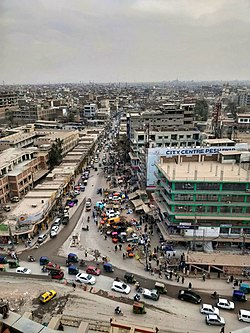
News Alert: Jeffrey Epstein in the jihad capital of the world, “Peshawar.”
Now that I have your absolute attention. Did you ever think that Peshawar might be more than just news about bombings and cross-border violence with Afghanistan, and that the province’s grotesque portrayal is cruel to its people?
Khyber Pakhtunkhwa, formerly known as the North West Frontier Province (NWFP), is ironic in that either its story has been told by a white man or by people who were never able to fully grasp the socio-cultural fabric, leading to the homogenisation of the province, which is in fact the most culturally and linguistically diverse province of Pakistan.
We can attribute the diversity of the province to its rich history and to the metropolis of the province, Peshawar. Peshawar has been a home to various civilisations. The most famous among them is the Gandhara civilisation, which has endured numerous invasions throughout history from the Achaemenid Persians to the British Empire.
No matter who passed from Khyber Pass, whether Persians, Greeks, Afghans, Sikhs, or traders from Central Asia, all of them left their unique and undeniable mark on Peshawar as the city in the ancient ages remained the hub of trade and cultural exchange, but not all traders who journeyed from foreign lands via Khyber Pass travelled further into India; some of them, charmed by the city, decided to settle in Peshawar.
However, all of these traders faced a common dilemma. None of them spoke each other’s languages, and the local inhabitants of the ancient Peshawar, who were primarily Hindus and Buddhists, spoke Prakrit. Therefore, through the amalgamation of cultures, Prakrit gradually evolved into a new language known as Hindko. Hence, the people who speak Hindko throughout the province are widely known and recognised by their cities rather than by their native tongue, so the native inhabitants of KPK who speak Hindko in Peshawar, Kohat, Hazara, and Abbottabad are called Peshawari, Kohati, and Hazerwaal, respectively.
It is interesting to note that the native Pathans from the surrounding villages and tribes adjacent to Peshawar also have distinct dialects of Pashto, which vary from town to town and village to village.
Though the Peshawaris and Pathans speak completely different languages, the similarities between the two are quite apparent in terms of mannerisms and architecture. Both Peshawaris and Pathans would travel the lengths and depths of mountains and oceans to fulfil the needs and wishes of the guests to make them feel at home (a common gesture of courtesy). Similarly, both of them love houses with high ceilings and a courtyard known as ‘sahn’ or ‘baramda’, along with a garden, and we cannot forget their love for fully carpeted houses, so do remove your shoes before entering the house.
You might be wondering what the rift is between them if they are so similar, how their cultures are different and why it is relevant now.
Even if the history of the frontier looks overwhelming at first, its people and their issues are quite simple and similar; both Peshawaris and Pathans want to be seen, heard, and respected. However, their frustration stems from fear. For much of history, contributions were overlooked, and stories of their survival, resilience, and endurance were twisted by colonisers and politicised by the politicians to serve their own vested interests. Due to the above-mentioned factors, both Peshawaris and Pathans fear the erasure of their cultures and languages. To top it off, the unequal access to opportunities and economic resources has exacerbated tensions in KPK.
In recent years, a wave of ethnocentrism has emerged in the province, which has forced Peshawaris and Pathans into forming circles of seclusion from each other, highlighting the cultural differences which have created a ridge and closed channels of communication. If we closely view the events leading to the partition of the subcontinent and the creation of Pakistan, specifically in Peshawar. We can clearly dissect the differences in the ideology of Peshawaris and Pathans and the respective roles they played to acquire independence from the British Raj.
When the whispers of independence reached Peshawar, two different ideologies and approaches emerged. On one hand, Pathans gathered under the banner of Khan Abdul Ghaffar Khan (Bacha Khan), while on the other hand, Peshawaris decided to side with the All-India Muslim League and, with relentless effort, created the Muslim League’s office in Peshawar in 1912 and supported the Muslim League in every capacity. After realising the importance of a separate Muslim homeland, Pathans joined the call for the Muslim League.
One example of this is illustrated in the formation of “Khyber Union London”, which was formed by Pathan students, providing a platform for Muslim students of the Frontier to express their demand for a Muslim homeland, and so, with great fervency, “Khyber Union Peshawar” held its first and open debate on the creation of Pakistan, hosted in Islamia College. This debate reverberated throughout the subcontinent, as it was the first debate to be held in an educational institute to discuss and advocate for the establishment of Pakistan. Even with the initial divergent political ideologies of Peshawaris and Pathans, over time, numerous Pathans became active members of the Muslim League. The efforts of both groups towards a common goal are quite transparent.
However, years later, the seeds of discord were sown by the various political parties in the province to leverage maximum votes and to gain popularity at the expense of the identity of the dominant groups residing in the province. An ethnically diverse province deserves a name reflecting the diversity of its inhabitants. Hence, deliberate homogenisation breeds nothing but dissent and chaos. The change of name of the province from NWFP to KPK paved the way for this chaos. Pathans hailed the decision, as it meant recognition of their culture in the country. On the contrary, Peshawaris and Hazarewals viewed the name change as an attack on their identity and culture, which led to widespread protests. Mainly because the Hindko community is the dominant community of the province and not a minority limited to a single city.
People say history repeats itself. Ironically, it repeats itself for the worse, and we refuse to learn from it. On 15 January 2026, Pashto was introduced as a compulsory subject across the province. But why was this courtesy only extended to Pashto by the government, and why was the same courtesy not extended to other widely spoken languages of the province, such as Hindko, Saraiki, and Khowar? The directives of the KPK’s government regarding the induction of local languages into schools’ curriculum could have been inclusive if the cabinet had appropriate representation of the respective cultures. Nevertheless, the lack of representation of dominant cultures has resulted in one-sided policies in the province, which have marginalised other languages and cultures, leading to a curriculum that does not reflect the true diversity of the region.
The infamous Qissa Khwani Bazaar of Peshawar did not get its name because of one ethnicity. The Bazaar is the living testament of Peshawar’s cultural and linguistic diversity. Every nook and corner of the city has countless stories of Peshawaris, as many as Pathans. In fact, in some areas, more than Pathans.
Just like Peshawar is the heart and soul of KPK. Similarly, Peshawaris and the Hindko community are the soul of the province. Therefore, the contributions of Peshawaris and Pathans should be celebrated together; both communities should be given equal representation at all levels of government and should not be divided on the lines of hatred for the benefit of a few. If we continue down the road of ethnocentrism, soon the frontier province will be torn to shreds, and the fire won’t only turn KPK to ash but will engulf the entire country in its flames sooner or later.
Thus, instead of focusing on a few cultural differences, we should focus more on the collective efforts of our ancestors. This would open new avenues of healthy discourse in educational institutions, which could eventually become drivers of change, leading to culturally inclusive policies. Pathans are the echoing voice of the mountains, while the Peshawaris are the beating heart of KPK, and so neither should be suppressed nor erased.