





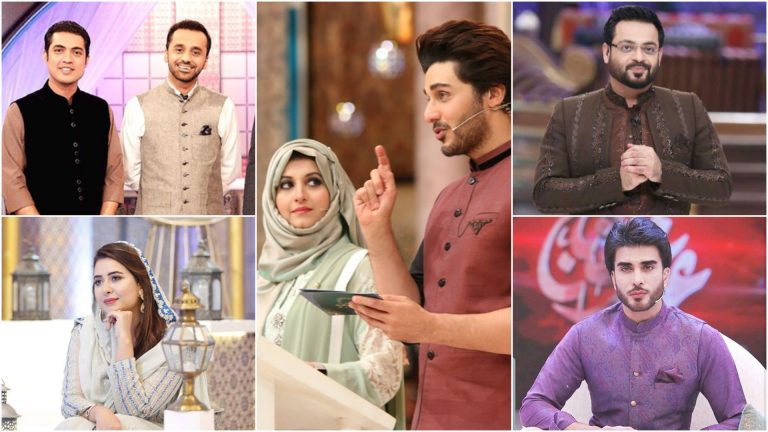
Ramadan transmissions consume the attention and time slots of all major television networks during the 29-30 day period of the Holy Month. The premise of these shows centres on various activities and gestures that Pakistani society associates with this month: this includes a segment where verses from the Holy Book, the Quran, are recited, with translation, to ingrain the implied meanings in the audience’s minds. Then these shows proceed to depict various activities, such as the preparation of special dishes for Iftar, the distribution of gifts to the audience if they give correct answers to general knowledge questions, a segment where the host is interacting with kids and another one that is dedicated to charity.
Often these segments can be identified with the background music that plays after the show progresses further from the point where it halted before the interval came about. The background music that welcomes the charity segment is one that is daunting, disturbing and uncomfortable, as it seems to mitigate the emotions of not only the audience but also those demanding the charity, as their story is promoted as tragic, depressing and heartbreaking.
For someone who might be dealing with their own set of personal problems, such a description of this segment would dissuade them from watching it due to the emotional burden it would impose on them. If the same segment is treated like any other segment, the potential impact that could be created could exceed the impact that stakeholders try to generate by transforming a ‘Ramadan Transmission’ into a dramatic spectacle.
In order to understand these shows and why they have been able to garner a strong audience for themselves in Pakistan, despite having several flaws, it is imperative to contextualise them in regard to Pakistani society. It is known to everyone that Pakistan, formally known as the Islamic Republic of Pakistan, was a nation founded on the basis of the religion that the majority of its population was affiliated with. Therefore, religion naturally began to permeate every aspect of life. Inherently, there was nothing wrong with this, as religion allowed people to develop a clearer path that would be defined by the utilisation of correct morals and principles. However, over the years, the destination that this path was supposed to lead us to has become blurry because most individuals are not honest about the morals and principles that they boastfully own up to in front of the world.
Often, these morals and principles are used to establish a certain image for oneself. In Pakistan, ‘religion has become a currency’, one that they are consistently trying to derive benefits from. Perhaps because, to them, it seems like a wiser decision to monopolise such a currency instead of the usual one. However, such assumptions stem from ideas stakeholders have of the audience and its preferences, to a point where they have figured the audience out and hence can trick them.
Though foolishly, these companies themselves give away to the audience the real motives behind such shows. For example, last year, ARY Digital’s Facebook page uploaded a post announcing that their Ramzan transmission by the name of Shan-e-Ramadan 2 amassed the highest number of GRPs (Gross Rating Points) on the first day of Ramadan.
While it can be asserted that this number is not in the channel’s control, as people are willingly watching the show, it is also true that the fact that the official social media page of the channel is uploading such statistics showcases that these numbers carry incremental value for show producers. Thus, making one question the intention behind these shows — is the intention to foster religious awareness and a sense of community in people, or to turn this month into a business, something other industries in the country, such as fashion and food ones, have already done?
When questioning these transmissions, another facet of the endeavours carried out by these channels during the month of Ramadan is the ‘Ramadan Special TV Shows’, ones that have been in hot water for the past couple of years, as many believe that the premise of these shows is often not related to either the month of Ramadan or the values associated with the month.
Many of these shows could be aired on television on regular days as well. While this concern is valid, ever since the popularity achieved by shows such as ‘Suno Chanda’, which aired in 2018, various producers have cemented their creative seeds in this specific genre of TV shows.
It is up to the public’s opinion whether these shows are being produced to foster a sense of community and livelihood during this auspicious month, or if their primary goal is to earn more profit than they typically would. Such queries are completely valid. Yet, it is important to consider that in Pakistani society, any form of entertainment not explicitly promoting ‘religious ideas’ is often viewed as contributing to the degeneration of values and ethics. While other ventures that, though explicitly promoting religious ideas, end up making this promotion their primary centre of attention throughout this month. Thus, coercing us as audiences to reassess the content we consume, as the more we respond to something, the more it will be reproduced.