





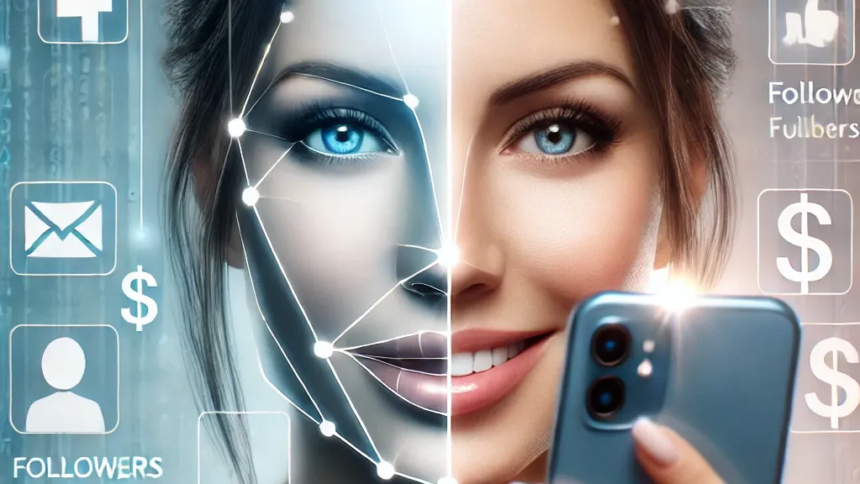
‘Hey guys! Welcome back to my channel. Today I am going to give you my honest opinions, show you my true self, the exclusive behind the scenes, and a realistic day in the life of a content creator because I want to be real and unfiltered with you guys!’
Somewhere along these lines are the famous words of almost every influencer before they go on to excessively edit their videos, add beauty filters, delete sections according to social media censorship guidelines and then present a finished product for the masses to consume.
Can a person with an online platform truly be a hundred per cent authentic? They put on makeup before filming, fuss over the lighting, experiment with new angles, engage their audience in their speech and actions and add fun effects in the video so as not to bore their audience. In order to sustain viewership, every influencer goes through the process of trying to make their content more palatable. Which isn’t necessarily a bad thing. Trying to excel at your job by bringing your best self forward isn’t so wrong now, is it?
However, this is where these creators face the ultimate dilemma. The viewers don’t want a customised personality; they want to see their true self to be able to relate to the influencers and say things like ‘that is SUCH a mood.’ In this period of lack of socialisation, people seek human connection online, and many of them through these online personalities. A job that is as inherently performative as an influencer’s is demanded to be anything but that.
‘I feel like I’m on a video call with my best friend every time I put on one of her videos.’
‘I relate to him so much because he’s going through the same problems I am.’
‘I’ve been watching her videos for years now. I feel like such a proud mom to see how far she has come.’
And God forbid if someone is caught faking or embellishing their personality for the camera, then they are immediately shunned and ostracised.
‘I knew there was something off about him.’
‘I had a gut feeling about her; you know, there’s no way someone’s life was like that.’
And so on. Influencers are put on a pedestal but are also expected to see eye to eye with their viewers; they are always supposed to express their true opinions, but cannot say anything negative about anyone or anything because that’s unethical, and is it really that deep? They should show their real lives, but it can’t be boring because who has that kind of attention span anymore? They should be unique people to differentiate them from other creators, but their opinions can’t go against the mainstream view of things, never, in contradiction to the viewers.
It’s like a never-ending game of see-saw where you have to make everyone happy all the time. Any kind of performance is considered bad, but what people don’t realise is that humans are inherently performative creatures. Whether it’s a TikToker with a million followers or your regular salary man, some degree of performance is almost always there. The same way a TikToker says nice things about an author they don’t really like, a salary man puts on a bright smile for the boss they hate and delivers a cheery ‘good morning!’ to them. An Instagrammer with a 20-step morning routine is not that different from a housewives’ association that constantly tries to one-up each other with their homemade lasagna recipes. Performance also comes in subtler forms, such as one’s fashion sense and style, the jokes people make to amuse others, and agreeing to attend a suffocating social event simply because all your friends will be there too.
So, can it not be argued that performance is not inherently bad? At least to some degree. Humans have been putting up performances for centuries because we want to be liked by other humans. We are social beings and are constantly trying to ‘fit in’ or ‘stand out’ in relation to other people. We seek societal acceptance and subsequently crave praise for our conformity. This phenomenon is only intensified with influencers, as they have a larger audience, more people to approve of them and more standards to reach. It would not be an exaggeration to believe that every online creator is performative to some extent and that no one is completely vulnerable on camera.
In fact, the entire fiasco of periodically trying to prove oneself as authentic is a performance in and of itself. Constantly reiterating that you are being real and unfiltered is telling the viewers what they want to hear and an attempt to appear acceptable to the masses.
It is hypocritical to ask influencers to constantly prove their authenticity when we, ourselves as humans, are performative in everyday life. And it is a stretch to believe that all types of performances are bad, because we have been conducting ourselves this way for centuries to form a coherent society and non-hostile social circles. And it is naive to believe that people on the screen can and are always open about their vulnerabilities, all for the world to see and comment on.