





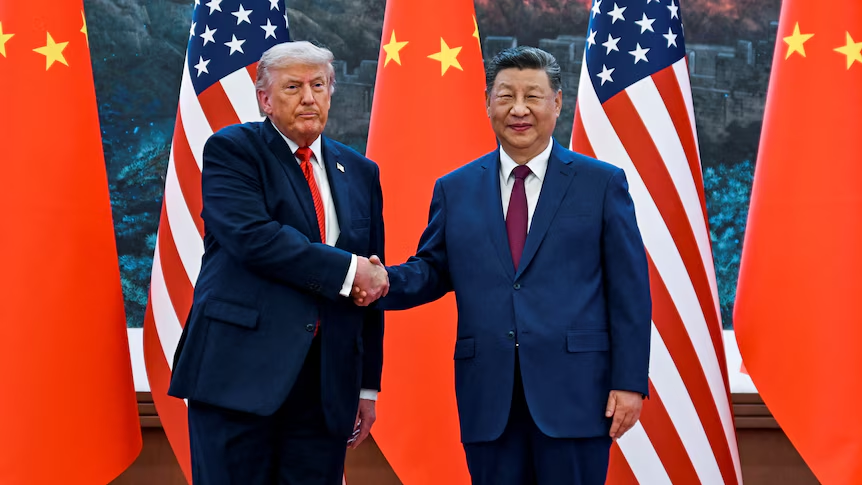
Trump arrived for a high-stakes summit with Chinese leader Xi Jinping. On Wednesday, accompanied by several CEOs and a high-profile business delegation spanning agriculture, aviation, electric vehicles, and artificial intelligence (AI) chips, he landed in Beijing.
When Air Force One touched down in Beijing on Wednesday night, this moment drew most attention when Tesla CEO Elon Musk stepped off the plane ahead of senior officials, including Pete Hegseth, Marco Rubio, and Greer, a sign of the crucial economic agenda that lay ahead. Musk and U.S. chipmaker Nvidia’s boss Jensen Huang stayed close to Trump during the welcome ceremony and were prominent during the banquet. Huang’s appearance was notable because he was not originally in the delegation, but when he joined the trip it fueled speculation that AI and access to chips was a bigger part of the talks. As electric vehicles, AI, and semiconductors become key battlegrounds in the U.S.–China relationship, this visit has had a highly positive effect on the conflict between China and the United States, which started in 2018 when the President increased tariffs. As trade was near the top of the agenda despite recent tensions over the Iran war, businesses hoped for key deals as well as an extension of the tariff truce that is due to expire in November.
The visit was defined by warm rhetoric and symbolism. Trump was wooed with a packed itinerary that included an honor guard, a state banquet, and an invitation to the exclusive compound where China’s Communist Party leaders live and work.
The U.S. President seemed impressed and invited Xi to the White House in September. He said the talks had been “very successful”, while Xi called them “historic and landmark”. Chinese Foreign Minister Wang Yi confirmed on Friday that Xi would visit the White House in the autumn.
While aboard Air Force One, President Trump said to reporters that China had agreed to buy 200 Boeing jets and an additional 750 planes, the aerospace giant confirmed the deal. Trump also gave good news to U.S. farmers that China would buy billions of dollars of soybeans also, but no source from China has confirmed any deal.
If the Boeing orders are finalized, this will be the plane maker’s first major Chinese deal in nearly a decade. It was largely shut out of the world’s second-biggest aviation market because of trade tensions between Beijing and Washington. Chinese Foreign Ministry spokesman Guo Jiakun only said that the “essence of China–U.S. economic and trade relations is mutual win–win cooperation”. He added that both sides would work to implement the “important consensus” reached by the two leaders and bring greater stability to bilateral trade ties and the global economy. But still, questions over the trade truce agreed in October 2025 are there, when Washington suspended steep tariff increases on Chinese goods while Beijing eased back from restricting rare-earth exports.
President Trump told reporters on Air Force One that he and Xi did not discuss tariffs at all. However, the White House said both leaders agreed to establish a “Board of Trade” to manage the relationship without having to reopen tariff negotiations. U.S. Treasury Secretary Scott Bessent, who was leading trade talks for Washington, said in a pre-recorded interview to a Channel that “he expected progress on a mechanism to support future investment.”
Taiwanese President Lai Ching‑te has previously stated that Taiwan does not need to declare formal independence because it already sees itself as a sovereign nation. The U.S. President told the press, “I am not looking to have somebody go independent,” on Friday at the end of his two‑day summit with his Chinese counterpart Xi Jinping in Beijing.
The U.S. has long supported Taiwan, including being bound by law to provide it with a means of self‑defense, but frequently has had to square this alliance with maintaining a diplomatic relationship with China, such as accepting China as a member of the United Nations Security Council instead of Taiwan. Trump earlier said he had “made no commitment either way” about the self‑governing island, which China claims as part of its territory and has not ruled out taking by force. Washington’s established position is that it does not support Taiwanese independence, with continued ties with Beijing being contingent on its acceptance that there is only one Chinese government. Although Beijing has been vocal in its dislike of Taiwan’s president, whom it has previously described as a “troublemaker” and a “destroyer of cross‑strait peace”, many Taiwanese consider themselves to be part of a separate nation, though most are in favor of maintaining the status quo, in which Taiwan neither declares independence from China nor unites with it. But a Taiwan as an independent state, with a little shelter of U.S. support, is far better for American privileges, to safeguard the strait of Taiwan, known as the Formosa Strait, a 110‑mile‑wide water body that separates mainland China from the island of Taiwan and Far East countries.
President Trump, in an interview with Fox News, stated that U.S. policy on the matter had not changed: “You know, we are supposed to travel 9,500 miles (15,289 km) to fight a war. I am not looking for that. I want them to cool down. I want China to cool down.” Both countries should stay where they are; that is my proposal, because Taiwan is very faithful to the U.S. up till now and will never leave, if their friends are on the hands of aggressives.
Like Arab friends, to save them and save the Muslims of Iran from the merciless regime of Iran, when things are very clear that President Trump has saved the world from World War III without any doubt. As Iran was urging China to take its part in the strait and showing its willingness to charge Iranian or Chinese currency, but it does not work. To stop war, the U.S. only requires a change of regime and the handover of enriched uranium to America.
As this escalation has proved, Iran first triggered fire as well on all Muslim Arabian states, all of them, and if Iran is allowed to be a nuclear‑weapon country, it will not hesitate to consume them with its items. Iran did not respect even Pakistan, a Muslim country, which can give peace with all respect to Iran. But they ignore it and are still ignoring it. The leadership of Iran keeps regime‑taking enriched uranium as salvation, either they want to develop weapons or use it as insurgents’ weapons against Arabian states or the U.S., so Iran’s behavior is suspicious, which pressed them to dismantle nuclear‑weapon materials from Iran.
I have several times given examples of countries like Japan, which surrendered themselves to the United States only to save their country from nuclear consumption and their citizens, but today they are one of the greatest nations, with all respect.
President Trump went to China without invitation; that is why he was not greeted at the airport. But he and his team were highly respected, with esteemed diplomatic honors and words accepted. Many trade packs and sales were offered to China, and Xi, China’s Prime Minister, was invited to Washington. This was accepted. The result is very clear: China will never be part of a fallen regime. At the end, in the words of an American, Fr. Thomas, if God has saved many lives of the world, he will continue to do so.