





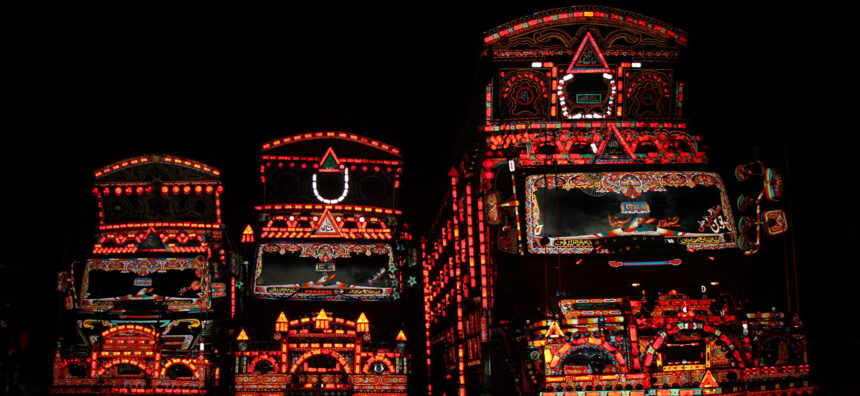
From the local routes of trade to the international art galleries, truck art has paved its way. On the surface, this feels like an amazing achievement, but in reality, it is clearly not. Truck art is not merely some designs, motifs, and colour combinations to admire, but these designs hold stories.
Truck art is connected to the drivers’ emotions in indescribable ways. For some drivers, their trucks are like “brides,” and they spend their lives and earnings making them glamorous. For others, it’s their “identity and pride,” which represents them, and there are so many other factors to unveil.
Truck art is not some randomly placed motif but the well-curated love of its drivers and artists, which is either represented by the landscapes, poetry, or the finely placed bells and charms. These pictures of mosques, Sufi saints, eyes, eagles, aeroplanes, or movie stars are either the dreams, admiration or escape of the drivers, or they are efforts to ward off evil and provide protection for their journeys. The poetry on these trucks is not phrases that rhyme, but it’s the driver’s way to humorously express respect, love, emotions or harsh realities of their lives. Even the extravagant lights inside the trucks and their reflections are not useless; drivers often use them to communicate with those on adjacent paths.
These moving tales are now seen just as an attractive artwork. It is the artwork whose artists devote their lives to mastering it and retaining it yet are never known to the world. The artwork whose curators are just figures moving in the art pieces, but don’t forget, with a lot of pride because it’s not just a vehicle but their whole life explained and expressed. Cultural exchange due to globalisation and Western adoption has made us look at the lives, devotions and efforts of the truck drivers and the artists as merely some interesting designs and colours.
Who is the artist? Who is the mastermind behind this artefact? These questions remain out of focus. They are ignored and not credited for their work. The evils of fast fashion have commercialised truck art, which used to belong solely to its artist and the curator solely. Now it’s over almost everything, be it a dress or a phone case, without knowing who the artist of that design is. For the world, this art is merely Pakistani art, but it is not; this is the art of the artisans who have mastered it over the years, who remain in the shadow, the craftsmen of Rawalpindi, Peshawar and Karachi.
The essence of identity, uniqueness and relativity of the drivers and their trucks has been overpowered by repetition, recognition and the desire to be admired. Now on the roads we see predictable motifs and designs. The excitement we used to get as kids after looking at the bright colours and motifs has now faded and no longer holds any uniqueness to attract the attention of people.