





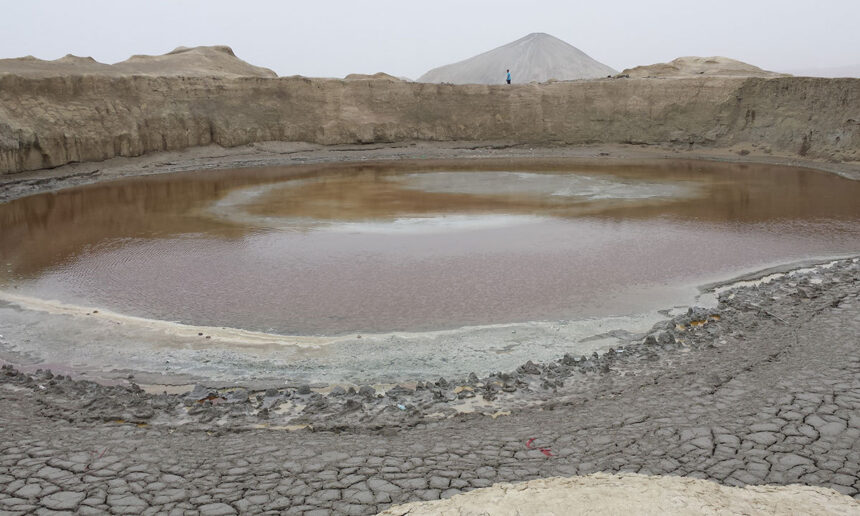
Pakistan is a country of high mountains, ancient civilisations, and cities, but somewhere in the barren deserts of Balochistan lies a phenomenon that Pakistanis have never heard of: the Hingol Mud Volcanoes.
They are not volcanoes of fire and flame. They huff, sneeze, and move their cold mud, carving out featureless terrain like lava. Some spring and fall in a matter of days, while other mud volcanoes stand like guardians of olden times on the Makran shore, hiding geological mysteries of millions of years. The Hingol Mud Volcanoes, also known as Chandragup, Khandewari, or Jabl-e-Gurri, are a surreal Pakistani region where myth, science, and history converge.
A Landscape That’s Alive
Pakistanis are lucky to have one of the largest and most active mud volcano networks on their coast, as mud volcanoes are rare worldwide. Mud volcanoes, unlike fiery volcanoes, are formed when underground gases, such as methane, exert pressure on water and fine sediments, creating bubbles in the water and resulting in conical-shaped mounds of cold, clay-like mud.
They may be hillocks or giant mountains. An example is the Chandragup volcano, with a height exceeding 300 feet, but the surface is cracked like the skin of a large animal. The earth shakes a little with escaping gases, and a new bubble upsets the pool at the top every few minutes.
Legends Written in Dust and Gas
Myths and stories keep flowing around the volcanoes. There have been a bunch of local Balochi tribes near the area, cultivating stories that are passed down from generation to generation. These stories are what add the extra life to the land. Some people suppose that the mud volcanoes are slumbering giants and their shaking is caused by animals which lie deep in the ground. Others say that there is healing power in the mud at the top.
Travellers are even said to have been relieved when the volcanic mud was rubbed on the body or sore parts, or on the wounds of the body, and there is even another myth about the interference of the divinity: When the volcano collapses or entirely changes its appearance, it is the restoration of the fate or the cleansing of the land around the volcano. Whether one accepts such stories or not, it puts an aura of magic on an already otherworldly landscape.
A Coastline of Wonders
The Hingol National Park, covering the mud volcanoes, is also an attraction. It is the largest national park in Pakistan, an enormous desert, mountainous terrain, flowing rivers and windswept coastline with a size of over 6,000 square kilometres.
The most surreal landscapes in Pakistan would be found in the middle of the most familiar natural artworks, like Princess of Hope: It is a high and elegant sculpture of rock, and the Buzi Pass: A theatrical highway which is cut in huge cliffs. All this has been due to the centuries of erosion of the winds and the tectonic and geological forces which made the mud volcanoes.
When Islands Rise and Fall
The mud volcanoes do not exist on dry land. Under the Makran coast, there are underwater mud volcanoes, which are covered by the waves. Once pressure accumulates, the seafloor may break, allowing mud, gas, and rocks to explode upwards. This occurred a few times in the history of Pakistan.
- One of the most massive earthquakes generated an island, which lasted several months in 1945.
- Another small island emerged in 1999 and broke apart. In 2010, fishermen were witnessing a mound come out of the sea as an upsurge of a giant.
- The famous Zalzala Jazeera (“Earthquake Island”) appeared in 2013 after a fatal earthquake in Awaran.
People flocked to view it — and the island was gone in two years. These temporary islands keep scientists in mind that the area is geologically active, unpredictable, and contains untold forces.
A Natural Treasure Worth Protecting
The mud volcanoes in Pakistan are not well-known, though they are rare and possess cultural value all over the world. Most of the Pakistanis have never encountered them despite them being some of the most distinctive geological sites in Asia. Under good care, the region would transform into:
- One of the most famous geological research zones in the world.
- One of the important ecotourism sites.
- Cultural harmony on the Hinglaj pilgrimage site.
- A representative of the concealed Pakistani nature.
However, they may be damaged either by thoughtless tourism, uncontrolled exploration, or due to a mere lack of care.
The Hingol Mud Volcanoes serve as a mighty reminder of the agitation of the energy in the earth. They narrate about the past and future of Pakistan through geological, cultural, and mythological narratives. And they give us a glimpse of the world in which the planet creeps very lightly beneath our feet and carves out the land unheard. These mud volcanoes are lurking in the desert winds of Balochistan, patient, mysterious, and alive, challenging the world to find out their secret strength.