





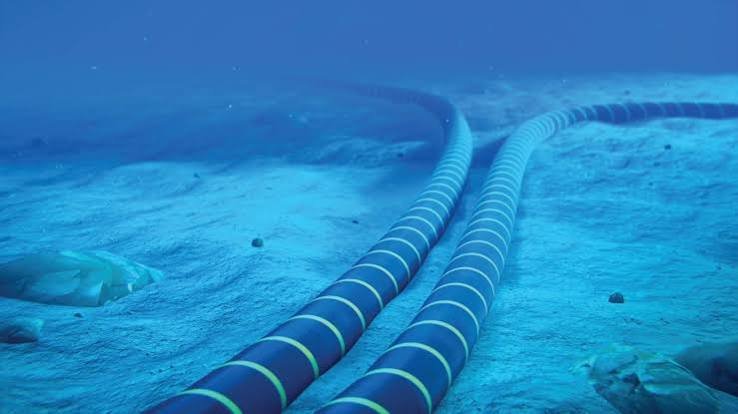
The role of underwater cables has transformed from a necessity in telecommunications to a crucial geopolitical resource of the 21st century. Roughly 99 percent of the global telecommunications pass through a system consisting of more than 500 existing or planned undersea fiber-optic cables. This network enables many crucial activities, including cloud computing, military communications, and millions worth of any financial deals made every day. While international security strategies have typically revolved around defense of borders with the help of armed forces, the world’s main forces of competition remain unnoticed under the oceans.
Originally constructed by international telecommunications companies to share capital risk, submarine cables are now increasingly controlled by American technology firms. Forced by the massive demand for bandwidth from cloud systems and generative AI, hyperscalers such as Google, Meta, Microsoft, and Amazon run or take control of more than fifty percent of the undersea bandwidth in the world. The corporations avoid conventional transport routes that are politically risky to create private data pathways. For example, Meta’s Project Waterworth, which stretches for 50,000 kilometers, leverages high-bandwidth 24 pairs of fiber-optic cables to dive as deep as 7,000 meters, engaging in activities that bypass naval bottlenecks like the Red Sea, the Baltic Sea, and the South China Sea.
In the same way, The Umoja project by Google will provide a big new connection on the ocean floor which makes it possible to connect Africa to Australia. Unlike similar installations which are usually built through Europe or the Middle East, this is a new direct connection. The cable, before entering the ocean, passes through the seven countries of Africa including Kenya, Rwanda, Democratic Republic of Congo, Zambia, Zimbabwe and South Africa. The reason it is built this way is that most of the internet traffic today passes through a few busy routes in the north. In case of a problem with a rocket cable, the internet may not be accessible in large areas around the Red Sea. Umoja avoids these dangerous areas because it opens a direct connection in the south. Thus, two objectives are met at once. First of all, many people in Africa will get high-quality internet. Secondly, the cable can be used as a backup option in case northern routes get blocked by some disaster.
This corporate consolidation is inextricably linked to the growing competitive standoff between the United States and China. The hypothesis of “weaponized interdependence” implies that all physical components of the Internet should be viewed as potential targets for interstate coercion. Washington tried to persuade its allies not to work with Chinese companies like HMN Tech, which is building infrastructure such as the 15,000 km PEACE cable to expand China’s Digital Silk Road in the Global South. As retaliation, Beijing has weaponized its regulatory powers in the South China Sea to delay infrastructural projects supported by the West.
Permit approvals for seabed exploration have changed from a process of just a few days to now dragging on for months or facing outright rejection. This has delayed the multi-partner Singapore-Japan Cable 2 (SJC2) project for more than a year. Because of the desire to avoid Chinese jurisdiction, major projects such as Google and Meta’s Apricot and Echo cables had to move around Indonesia, leading to much longer routes and costly shallow-water armor.
The enormous susceptibility of the undersea cable infrastructure has brought in the use of the cables in grey-zone warfare, as reckless parties take advantage of this weakness to cause serious disruptions while escaping detection. Since cables are often snared by commercial vessels, any planned acts of sabotage can always be claimed to be unintentional. Incidents that raised some questions about the actions of Russian or Chinese ships like the New New Polar Bear in 2023 or Yi Peng 3 in 2024 have involved commercial vessels using tons of anchors to cut crucial telecommunication and energy connections. In the same way, the Chinese commercial ships cut domestic cables connecting Taiwan’s Matsu Islands during 2023, and the Penghu Islands in 2025, thereby testing Taiwan’s resilience in digital terms.
At the same time, the mechanisms of underwater spying have changed radically. In the days of the Cold War, intelligence organizations employed hazardous wiretaps on the seabed, such as the American Navy’s Operation Ivy Bells, executed in 1971. Nowadays, physical soldering on contemporary fibers at great depths poses significant difficulties and reaches the level of detection. Instead, modern intelligence operations are more focused on the onshore landing stations where these cables come up to the surface.
Ultimately, the competition for global domination has moved from land borders to the icy bottom of the sea. As giants of technology and countries race to build private routes through zones controlled by enemies, the mapping of the Internet will be altered forever. In times when digital sovereignty guarantees economic survival, the ability to control, record, and cut off the crucial glass threads gives enormous strategic advantage; it becomes clear that the silent wars of the future will be fought at the bottom of the ocean.