





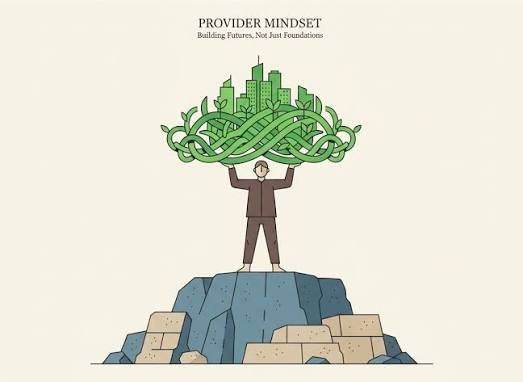
Some identities are chosen. Others are inherited.
One of those inherited roles is the “provider” which is silently inherited by means of culture, expectations of the family and gender norms. It sounds noble. Stable. Responsible. And behind that heading can lie a silent crisis: What happens when your value is pegged to what you do rather than who you are?
The role of the provider has been traditionally very gendered. In most societies, a man is raised on one unwritten formula: masculinity is provision. Earn. Protect. Sustain. Since childhood, boys are exposed to hidden messages – “Be strong. “Don’t depend on anyone.” One day you will be taking care of your family. Monetary victory not only becomes an aim but also a demonstration of identity.
Now this is where the crisis starts.
Losing a job is not only an economic loss but also an existential one. A professional failure does not merely hurt the ego; it challenges manhood. Emotional vulnerability is threatening because the provider must be stable. In the event of his falling down, who supports everything?
But the stress is no longer a preserve of men.
Women, particularly in contemporary urban settings, are progressively moving into the provider roles as prime earners or co-earners. They are not yet all updated in the eyes of society. A woman, as a provider, still might be expected to nurture and manage the home and do emotional work. She is both a caregiver and a breadwinner, with no right to drop either role.
In the case of men, the crisis is that they will only be considered valuable when they produce financially.
In the case of women, it may be that they have to give birth and retain their traditional feminine nature.
The question, in both instances, is the same, namely, whether by discontinuing my provisions I shall still be worthy.
The crisis of identity among providers tends to emerge silently. It manifests itself as burnout tarnishing a career. It is manifested in relationships where love is transactional, i.e., where love appears conditional on stability. It hangs in silence in cases where one wishes to express fatigue but believes they cannot afford to do so.
In terms of cultural dimensions, most households continue to define success in material terms. The house, the car, and the tuition fees paid on time are all visible signs of good provision. Mental health, shared vulnerability and emotional presence hardly get such applause.
An attentive father is the one who offers safety.
Setting boundaries by a mother creates strength.
Sharing responsibility with a partner brings about balance.
The provider role is made stiff, which makes the crisis even worse. In men, this inflexibility may be in the way of emotional expression. Research on masculinity has traditionally observed that classic gender expectations of men do not support help-seeking behaviour. Male sexes might find it difficult to confess stress, as it would mean being weak. The result? Unspoken anxiety, repressed emotions and seclusion.
In the case of women, especially in a two-earner or single-parent family, the crisis can be characterised by guilt. When she puts career development first, she risks being branded as detached. By taking a professional step back, she will put herself at risk of financial instability. The intrapersonal tug of war exists.
The provider role is a dramaturgy—one that is sustained at an individual’s expense.
The point of irony is that it is not the role itself that is the problem. Giving is an effective, passionate gesture. The issue is when identity is reduced to one of its functions. Human beings are multidimensional. We are philosophers, emotional, inventors, spouses, and friends. By making ourselves economical, we become small men.
A generational change is also taking place. Young couples are more interested in a partnership model and not a strict provider-dependent model. Debates on joint finances, emotional labour, and mental wellness are underway. Nevertheless, there is a cultural resonance of traditional roles.
To escape the provider identity crisis does not mean being able to lose responsibility. It implies the broadening of the concept of value.
Value does not revolve around income groups.
Power does not mean a lack of weakness.
Family leadership is not based on the paycheck alone.
The actual change starts when caregiving becomes a mutual affair rather than a heavy load, when families reward emotional labour as much as economic labour, and when personalities permit themselves to be nurtured as much as they nurture.
Even providers require help.
The crisis is mitigated as identity becomes not what I earn but who I am and what I provide. It distinguishes between being and doing.
Ultimately, the fittest model is not necessarily one who bears the burden by himself. It is concerning how the weight is distributed economically, emotionally, and socially.
The identity of the provider does not necessarily need to be a prison. It may be a role which is adaptable, changing and human.
And other times, the greatest thing a provider can offer is to acknowledge that he or she does not have to do it all by himself or herself.