





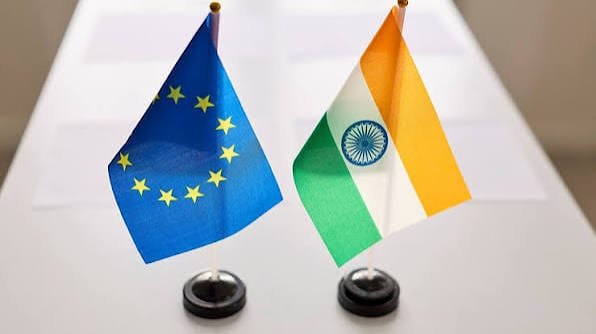
With New Delhi securing zero-tariff access to Europe, Islamabad faces a potential $10 billion trade deficit unless it aggressively rewrites its economic strategy.
The economic landscape of South Asia is shifting rapidly. India and the European Union recently concluded negotiations on a Bilateral Trade and Investment Agreement (BTIA). This pact is a game-changer: it will phase out or drastically slash import duties on more than 90 per cent of traded goods. For New Delhi, the timing is optimal, providing a strategic buffer that protects its domestic manufacturing base from unpredictable trade disputes with the United States. More importantly, it opens a direct, highly profitable route for Indian textile conglomerates, commercial agricultural groups, and heavy industries to scale up their presence across Europe.
For Pakistan, however, this deal presents an acute structural challenge. The cost of doing business domestically has climbed to historic highs, leaving local producers lagging far behind regional competitors like India and Bangladesh. Local factories are already reeling from a painful cycle of fuel price spikes, soaring electricity bills, and the sudden withdrawal of government industrial subsidies. To compound matters, this shock arrives at a time when the 27-nation European bloc purchases roughly 30 per cent of all Pakistani exports, making Europe our single largest source of foreign exchange.
The Erosion of GSP+ Preferences
Up until now, Pakistani and Bangladeshi exporters managed to remain competitive in European markets by leaning heavily on preferential trade frameworks such as the EU’s Generalized Scheme of Preferences Plus (GSP+) and Least Developed Country (LDC) provisions. These agreements allowed local shipments to enter European retail markets under minimal tariffs, which effectively masked Pakistan’s exceptionally high domestic production overheads.
The new India-EU agreement completely upends this dynamic. Previously, Indian apparel faced a restrictive 12.8 per cent tariff, while processed agricultural products were taxed at up to 26 per cent. Under the new pact, those figures drop to absolute zero. Almost overnight, Indian suppliers are securing the exact fiscal advantages that Pakistan spent years fighting to obtain. The crucial difference is that India can back those zero tariffs up with substantially cheaper raw materials, lower energy bills, and robust state-sponsored incentives.
Pakistani suppliers now face an uphill battle they cannot win under current economic conditions. European corporate buyers are commercial entities first; they will inevitably shift their procurement toward more affordable, high-volume Indian alternatives that match or exceed local quality standards. This shift threatens to push Pakistani export volumes over the edge.
Macroeconomic Fallout and Deficit Risks
If Pakistan loses a major share of these European orders, the macroeconomic shock will be devastating. Economists estimate it could wipe out roughly $10 billion in annual trade revenue. A cash drain of that magnitude will rapidly widen the current account deficit, collapse the value of the rupee, and deplete remaining foreign currency reserves. Such a shock transcends a routine financial hiccup, risking a structural crisis so severe that standard International Monetary Fund (IMF) bailouts and rolling loans may prove insufficient to stabilise public finances.
Fortunately, a narrow window for action remains. The India-EU trade deal is scheduled to take full effect by 2027, giving Pakistani policymakers and corporate leaders a multi-year cushion to reinvent the national export strategy and diversify into alternative markets.
Strategic Alternatives and the American Opportunity
The United States represents the most immediate alternative market. Due to ongoing trade tensions between Washington and New Delhi, Indian goods face heavy penal duties when entering the US market. This friction has created a substantial supply gap. While aggressive exporters like Vietnam are moving rapidly to claim that space, American consumer demand is sufficiently vast to accommodate new partners.
Pakistan must seize this opportunity immediately by negotiating specialised, sector-specific trade protocols with Washington and aggressively marketing domestic manufacturing facilities as stable, reliable long-term supply chain partners.
Time is running out, and the government must operate on an emergency footing. We must deploy proactive diplomatic campaigns to protect our current GSP+ status with European regulators. Simultaneously, we must secure permanent market shares across the United States, East Africa, and the Middle East to soften the blow.
Failing to pivot immediately will trigger a dangerous domino effect across the national economy, threatening millions of industrial jobs and derailing any prospect of sustainable economic recovery. The policy choices enacted over the next few years will determine whether Pakistan adapts to this new global order or sinks into permanent structural paralysis.
References
- European Commission Trade Directorate. (2026). Bilateral Agreements Registry.
- State Bank of Pakistan. (2026). Economic Review and Export Performance Data.
- International Trade Centre. (2026). South Asian Tariff and Competitiveness Analysis.