





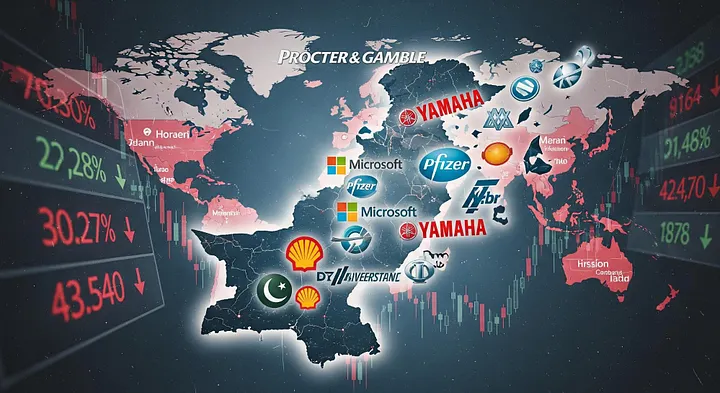
The Pakistan-Western world relationship has been based on the strategic bargain over decades. Security ties, economic assistance, and alignment continued to sustain the relationship even during moments of tension. However, in recent years, a subtle yet significant change has begun to occur.
The West is gradually receding.
This is no melodramatic split-up, including screamers and diplomatic break-ups. Rather, it is happening quietly, through reduced investments, a burdensome strategic focus, and a gradual diversion of attention. What once appeared to be a strategic geopolitical alliance is now starting to appear as a faraway friend.
The turning point, in most aspects, was the post-war period in Afghanistan and the termination of the war in Afghanistan. Pakistan spent the last 20 years playing a significant role in the Western security policy. The fact that it was located in a strategic geographical location made it an invaluable ally to supply lines, intelligence collaboration, and domestic diplomacy. When the war was over, that strategic urgency was gone almost overnight.
Unless Afghanistan held the relationship together, Western capitals started reworking their priorities.
To the policymakers in the United States and the United Kingdom, Pakistan is no longer central to their foreign policy agenda. The focus has changed on the bigger geopolitical contests — specifically the conflicts with China and the war in Europe since the Russian invasion of Ukraine. Pakistan has also slowly fallen behind in that reshuffling.
This change is apparent in economics as well as in diplomacy.
Foreign direct investment in Pakistan by the West has been decelerated significantly in the last ten years. Political instability, currency fluctuations, and uncertainty in regulations have seen multinational corporations that previously considered the country an emerging market become wary. Rather than growing, most Western companies have simply shrunk their presence or decided to freeze new investment.
The same thing is reflected in the patterns of aid.
Other organisations, such as the World Bank and the International Monetary Fund, are still involved, but their activities are more geared towards stabilising the crisis than entering into a long-term development partnership. Loans and a bailout package are going on, but the overall Western discourse on Pakistan has changed its focus to opportunity management rather than risk management.
The debate in policymaking has shifted.
Whereas previously Western diplomats used to talk about Pakistan as a strategic partner, currently the terms of stability, risk, and economic reformation are much more likely to be used. The previous decade’s passion has mostly disappeared as Pakistan no longer has discussions about being a gateway to Central Asia or a market that is expanding rapidly.
Meanwhile, the geopolitical orientation of Pakistan has changed.
In recent years, Islamabad has been strengthening economic ties with China, especially through the China-Pakistan Economic Corridor, which is one of the marquee infrastructure projects with the Belt and Road Initiative in Beijing. The economic landscape in Pakistan has been changed by highways, energy projects, and the development of ports related to the corridor; however, the same has also changed its strategic orientation, albeit in a subtle way.
In the eyes of the Western policymakers, this alignment makes it difficult to engage.
With the increasing competition with China, the Western governments gradually perceive geopolitical relationships in terms of strategic rivalry. Sometimes the countries that are strongly attached to Chinese infrastructure and finance have to walk a fine line in foreign relations.
Pakistan is right in the middle of the tension.
But the evacuation itself is not entirely geopolitical. It is also psychological.
The media coverage of the Western media on Pakistan has diminished continuously. After being a topic of international news on many occasions (through the terrorism issues, nuclear politics, or the war in Afghanistan), the country is now getting sporadic coverage. When it does feature in international news, it is usually a crisis in the economy or a political uprising and not an opportunity.
In international politics, attention serves as a form of influence.
When nations are taken off the strategy radar of the major nations, then they tend to have a more silent form of disengagement. Diplomacy is not so heated. Investment committees turn to other places. Think tanks change the focus of their research.
Pakistan has gradually been falling in that less noticeable category.
Nevertheless, it will be a mistake to refer to the situation as mere abandonment. The Western governments have continued to have a diplomatic relationship, trade relationship, and security dialogue with Pakistan. The nation is significant because it is a nuclear nation, has more than 240 million people, and is located in a geographical area between South Asia, Central Asia, and the Middle East.
The level of engagement is what is changing.
Pakistan is increasingly being redefined as a regional player and has periodic global relevance rather than being considered a key strategic partner. The association still exists, but the sense of urgency that characterised it has disappeared.
This change also poses challenges as well as opportunities to Pakistan.
On the one hand, fewer investment flows, less advocacy by diplomats, and even weaker integration into Western-led economic systems are probable because of reduced Western attention. Conversely, it can give room to Pakistan to expand its international collaborations instead of being overdependent on any bloc.
The present moment represents in many aspects a wider change in world politics.
The unipolar world, which emerged as a result of the Cold War, in which the Western influence was dominant in international bodies and alliances, gradually evolved into a fragmented system. The regional powers, the rising economies, and other financial networks are transforming the way nations are establishing relationships.
Pakistan is experiencing such a transition as it goes.
The great evacuation is then not such a dramatic exit but a gradual process of resetting. It is not that the western countries are abandoning Pakistan; they just have to approach it in a new way.
And in geopolitics, the silent ones are often more than the noisy ones.