





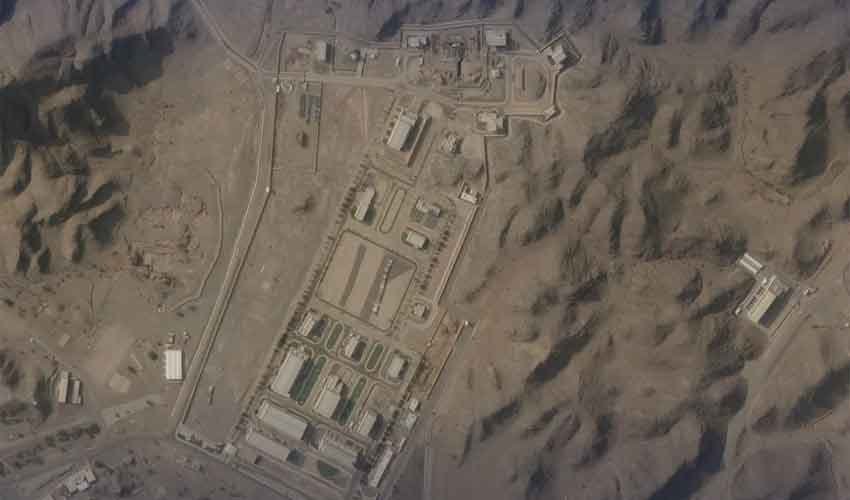
RIYADH: Saudi Arabia appears to be expanding a ballistic missile production facility to manufacture larger solid-fuel missiles capable of travelling farther or carrying heavier payloads, according to a study by two US researchers who examined commercial satellite imagery spanning more than a year.
The expansion could strengthen Saudi Arabia’s ability to deter potential attacks by Iran and increase its military self-reliance. However, it could also intensify a regional missile arms race and fuel opposition in the US Congress to a proposed US-Saudi civilian nuclear agreement over proliferation concerns.
Satellite images captured by US-based Planet Labs between April 2025 and September 2026 show developments at the al-Duwadimi complex, located about 200 kilometres west of Riyadh.
Researchers Sam Lair and Michael Duitsman of the Foreign Policy Research Institute (FPRI) said the images revealed a new building believed to contain casting pits, where solid-fuel ingredients are poured into missile motor casings and left to harden.
According to their assessment, the structure is at least twice the size of the facility believed to house the complex’s existing casting pits. Protective walls surrounding the building appear designed to shield nearby structures from accidental explosions.
The researchers also identified a second new building that could be used to store fuel ingredients or completed missile components.
Their analysis suggests the expanded infrastructure may support the production of larger missiles with greater range or payload capacity.
Solid-fuel missiles are favoured by militaries because they can be stored for extended periods and launched more quickly than liquid-fuel systems.
Researchers and experts from the London-based International Institute for Strategic Studies (IISS) and the CNA research organisation told Reuters that Saudi Arabia’s missile arsenal and the characteristics of the facility point to possible Chinese technology.
Saudi Arabia secretly acquired around 40 liquid-fuel DF-3 ballistic missiles from China in 1987, according to a declassified 1991 CIA estimate. The kingdom publicly displayed two of the missiles for the first time during a military parade in April 2014.
The FPRI researchers have also identified what they believe to be wreckage from a Chinese-designed DF-15 missile fired by Saudi Arabia in Yemen, based on photographs and videos circulated on social media.
Lair suggested Saudi Arabia might now be producing the solid-fuel DF-15, while the facility’s expansion could be intended for manufacturing the longer-range DF-21 or a similar missile.
Riyadh is believed to have turned to Beijing because Washington has long restricted exports of longer-range missile systems.
The Saudi and Chinese governments, the CIA and the White House did not provide comments in response to requests for information, according to Reuters.