




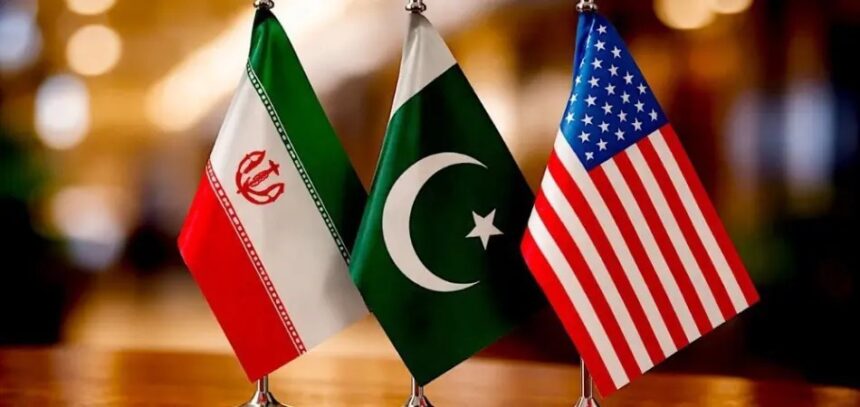
Pakistan has emerged as the primary and unexpected mediator between the United States and Iran.
As a Muslim country with long-standing good relations with Iran and sharing a roughly 900-kilometer border, Pakistan is seen as a trusted conduit for Tehran.
It has no US military bases on its soil, which helps it act as a “brotherly” liaison with Iran while maintaining working relations with Washington.
Pakistan’s Army Chief, Field Marshal Asim Munir, is regarded as a tested and reliable arbiter by Saudi Arabia and other Arab countries, just as Pakistan’s civil service was trusted between the US and China in 1971.
Pakistan is now facilitating back-channel communications, relaying peace terms, and hosting high-level talks.
This diplomatic position is driven by the need to stabilize regional energy supplies and security while simultaneously cultivating strong ties with Washington, Riyadh, and Tehran.
– Pakistan’s Army Chief, General Syed Asim Munir, has been utilizing long-standing military connections to bridge the communication gap between Washington and Tehran.
– The Government of Pakistan has held direct discussions with Iran between high-level officials.
– Islamabad’s diplomatic push helped broker an initial two-week cessation of hostilities, which President Donald Trump extended following a personal request from Pakistan’s leadership, with Pakistan passing messages between US and Iranian leaders.
– The world has highly appreciated, even in US circles, that Pakistan has successfully hosted face-to-face delegations from both Washington and Tehran in Islamabad, including the highest-level face-to-face US-Iran negotiations in the city.
– This diplomacy also has economic urgency, as war severely threatens Pakistan’s economy by driving up consumer fuel and fertilizer prices and jeopardizing remittances from millions of Pakistani workers in the Gulf.
– Stable borders and a reopened Strait of Hormuz are crucial to Pakistan’s financial survival.
– The international community views Pakistan’s diplomacy as a major geopolitical achievement.
– Pakistan’s nomination of President Trump for the Nobel Peace Prize is also motivated by a desire for domestic image repair and political consolidation.
Does Iran want Pakistan’s presence as a peace mediator?
– Iran actively seeks and supports Pakistan’s presence and mediation in peace councils and negotiations.
– Having emerged as a credible, neutral mediator, Pakistan has hosted high-level, face-to-face ceasefire negotiations between Iran and the United States.
– Pakistan has given equal respect, security, and hospitality in the air, on the ground, and at arrival and departure.
– Both Tehran and Washington have formally accepted Pakistan as the chief mediator to broker a resolution, making Islamabad the neutral hub for the talks.
– Iran’s high-level delegations, including Foreign Minister Abbas Araghchi and senior parliamentary leaders, have repeatedly traveled to Pakistan to deliberate on peace proposals.
– Iranian President Masoud Pezeshkian has publicly praised Pakistan’s sincere role and efforts in promoting regional peace and stability.
– Iran has shown a strong desire to keep multiple regional countries involved in the dialogue, and Pakistan has been consulting with other powers like Saudi Arabia, Turkey, and Egypt to establish a cohesive regional consultative forum.
Why some Pakistani bloggers in other countries oppose Pakistan acting as a global peace mediator
Some Pakistani bloggers living abroad oppose Pakistan’s role as a global peace mediator. They tend to:
– Oppose the present regime of Pakistan and are often paid supporters of previous regimes.
– Question Pakistan’s diplomatic credibility, highlight domestic instability, and point to a lack of enforcement power.
– Argue that Islamabad often acts as a mere messenger rather than a neutral, decisive broker.
– Claim that shifting narratives and unfulfilled promises during delicate talks between the US and Iran have damaged Pakistan’s reputation as a reliable mediator.
– Assert that peace requires enforcement and structural authority.
– Say Pakistan, facing severe economic struggles and political polarization, lacks both the economic strength and geographical leverage to enforce lasting agreements.
– Accuse Pakistan’s efforts of sometimes being driven by a desire for geopolitical relevance or to appease Western powers, rather than for genuinely unbiased peacemaking.
These bloggers, supported by Pakistan’s neighbours, frequently raise the question of how a nation can broker peace abroad when it faces deep-seated political divisions and security challenges at home.
However, parts of the Pakistani diaspora support Pakistan’s diplomatic manoeuvring. They argue that its unique geographical and religious ties with conflicting powers such as Iran, Saudi Arabia, and the US make it one of the few countries able to maintain dialogue and prevent further escalation.
They see Pakistan’s limited but critical channels as a realistic way to keep communication open and support de-escalation.
Much of the escalation has involved the United States and Iran. Leaders from both sides have already approved and appreciated Pakistan’s hospitality and security on the ground and in the air, both at their arrival and departure.
It has been repeatedly stated that Pakistan’s Army Chief, Field Marshal General Asim Munir, together with the Government of Pakistan, is well placed to offer peace-seeking nations a golden opportunity.