





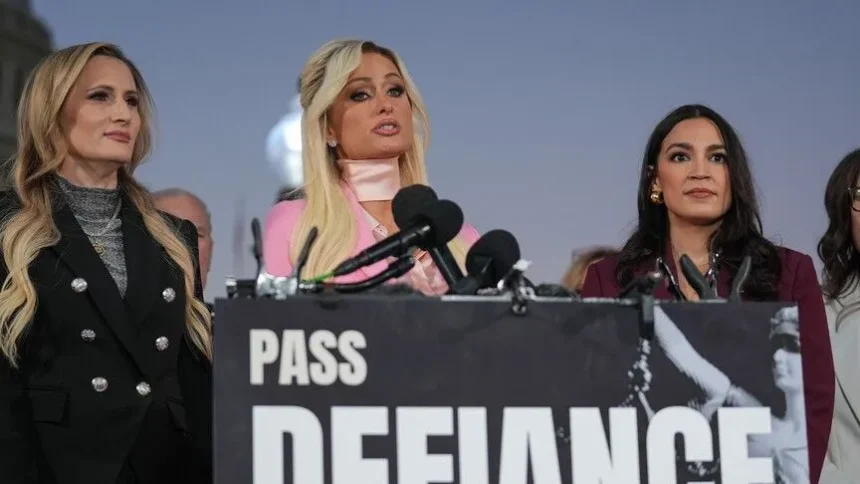
American media personality Paris Hilton and Democratic Representative Alexandria Ocasio-Cortez on Tuesday urged US lawmakers to pass legislation allowing victims of nonconsensual sexually explicit deepfakes to take legal action against those responsible for creating or distributing the material.
Speaking outside the US Capitol alongside Republican Representative Laurel Lee of Florida, the two called for an immediate House vote on the bipartisan DEFIANCE Act, which would establish federal civil remedies for victims of sexually explicit digital forgeries.
The legislation passed the Senate unanimously in January but has remained stalled in the House of Representatives for approximately 10 months despite support from lawmakers across party lines.
If enacted, the measure would allow individuals whose likenesses have been used in sexually explicit images or videos without their consent to file civil lawsuits and seek financial damages.
It would also enable victims to pursue profits generated through the creation or distribution of the nonconsensual material.
Hilton criticised existing legal protections, arguing that victims were being left vulnerable to exploitation and abuse as artificial intelligence made it increasingly easy to produce convincing fabricated content.
“The laws aren’t protecting us,” Hilton said, according to CBS News.
She revealed that more than 100,000 sexually explicit deepfakes depicting her were circulating online, highlighting the scale of the problem.
Hilton also expressed concern for young women and girls who lack the financial resources, public recognition or legal support available to high-profile individuals.
She warned that victims without such advantages could feel powerless when targeted by the creation and distribution of sexually explicit material without their consent.
Ocasio-Cortez questioned why the House leadership had failed to schedule a vote on legislation that had already secured unanimous approval in the Senate.
“Why hasn’t it been brought to the House floor for a vote?” she asked.
The New York Democrat emphasised the urgency of providing victims with legal avenues to hold perpetrators accountable.
Republican Representative Laurel Lee also highlighted the potentially devastating consequences of sexually explicit deepfakes, warning that victims could experience harassment, threats and lasting harm to their personal relationships, education and professional careers.
Sexually explicit deepfakes are digitally manipulated images or videos, often generated using artificial intelligence, that falsely depict individuals engaging in intimate acts that never occurred.
Advances in generative AI have made such material increasingly realistic, raising concerns about privacy, consent and the ability of victims to protect their reputations.
Supporters of the DEFIANCE Act argue that federal civil remedies are necessary to provide victims with a clearer means of seeking compensation and accountability.
Hilton directly appealed to House Speaker Mike Johnson, Majority Leader Steve Scalise and Judiciary Committee Chairman Jim Jordan to advance the legislation and bring it before the House for a vote.
Despite its unanimous passage in the Senate and bipartisan backing, the bill has yet to receive a final vote in the House.