





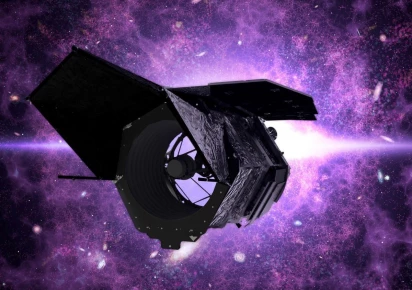
NASA is preparing to launch its next major space observatory, the Nancy Grace Roman Space Telescope, designed to investigate some of the universe’s biggest mysteries, including dark matter and dark energy.
The roughly $4 billion telescope is scheduled to launch on Sunday from NASA’s Kennedy Space Center in Florida aboard a SpaceX Falcon Heavy rocket. NASA officials say the mission is launching around nine months ahead of schedule.
Roman will build on the work of the Hubble Space Telescope and James Webb Space Telescope, both of which remain operational. Its instruments will allow scientists to examine the structure and evolution of the universe while also testing theories of gravity across enormous cosmic distances.
One of Roman’s major strengths will be its wide-field view, enabling it to survey large areas of the sky far more rapidly than previous major space telescopes.
Scientists hope these observations will shed new light on dark energy, the mysterious phenomenon associated with the accelerating expansion of the universe, and dark matter, which cannot be directly observed but is believed to account for much of its matter.
The telescope will also search for planets beyond the solar system, potentially identifying worlds that have been difficult to detect using existing observatories.
With its combination of panoramic observations and rapid survey capabilities, Roman is expected to provide scientists with an unprecedented view of the structure, composition and evolution of the cosmos.