





Iceberg theory, also known as the “theory of omission”, states that, like the tip of an iceberg, humans reveal only a small part of their true selves to others, while most of it remains hidden (like the submerged part of an iceberg). Ernest Hemingway, a famous American writer, integrated this theory into his writings, and 99% of his literary work is based on it. Know everything about your characters, he said, but write very little. For Hemingway, we should not hold the reader’s hand throughout the writing, let them explore the character themselves, and not spoon-feed them the plot. In his essay “The Art of the Short Story”, he summed up his theory in these words:
“A few things I have found to be true. If you leave out important things or events that you know about, the story is strengthened. If you leave or skip something because you do not know it, the story will be useless.”
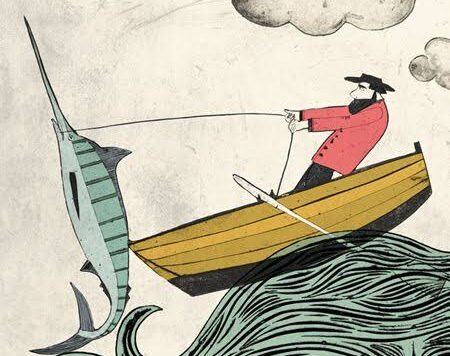
The Old Man and the Sea is the last great fictional work by him. This story revolves around an old fisherman, Santiago, who, after being unable to find any fish for eighty-four days, set sail early on the eighty-fifth day to fish in the Gulf Stream. On that day, he caught a fish, but it was heavy to haul in, and it began to tow his skiff farther out to sea. Santiago sailed with the fish for two nights and two mornings. Hemingway, in this story, highlights his character’s emotions, feelings, and thoughts through description, actions, and conversation rather than through direct statements.
The old man’s eyes
“Everything about him was old except his eyes, and they were the same colour as the sea and were cheerful and undefeated.”
It was not just about his eyes; it was about the strength, the courage and the bravery that the old man, Santiago, still holds at the age of 72. His eyes show the inner strength and resilience Santiago holds in himself.
The dreams of lions
“He only dreamed of places now and of the lines on the beach.”
Carl Jung, a Swiss psychiatrist and psychotherapist, viewed dreams as vital, spontaneous and symbolic messages from the unconscious. He believes that dreams do not disguise but reveal natural truth. In the Jungian perspective, the lion is generally considered a symbol of strength and primal authority. It can be inferred that the shore is the place where the old man lives, and the lion represents the courage and power the old man holds in himself.
The boy
“I wish the boy was here,”
A statement the old man repeated many times throughout the story. It shows the affection the old man had with the young boy, Manolin, whom Santiago had trained for fishing. It also shows that at an old age, no one wants to be alone. They want someone by their side to help them and be with them. To manage things for them.
The fish
“Fish, I’ll stay with you until I am dead.”
It shows the old man’s dedication to his work. For him, it was not just about fishing but about showing consistency and attention to the work. When the fish was caught in his trap, he didn’t know that it would be larger than his boat, and the fish, slowly and steadily with the hook in his mouth, sailed him far away in the ocean for two days and two nights. The old man just trusted the process; he didn’t give up. His consistency in his work and his courage against the sea and its creatures led him to stand tall in the face of adverse circumstances.
The Challenge
“He told the boy that I was a strange old man. Now he was proving it again. Each time was a new time, and he never thought about the past while doing it.”
The old man has no one else to compete with but himself. Throughout the tiring journey, with his hands cut by the fishing line and in a fight with a pack of sharks, he didn’t lose strength, didn’t stop, and continued to tackle things with bravery and hope. Because for Santiago, fishing kills him exactly as it keeps him alive.
In a nutshell, The Old Man and the Sea is not just a story set in the ocean, but it’s about what a man can do and what a man can endure. It’s about the feelings we can’t explain but express one way or another, the hidden emotions that are part of us, without us being aware of them. It’s about perseverance and human resilience in the face of life’s obstacles. But as Santiago said
“A man is not made for defeat. A man can be destroyed, not defeated.”