





Do you ever think how caves have shaped our perception of truth and reality throughout the creation of this world? At one place, where Plato’s allegory of the cave gives you the notion of ultimate reality outside the cave, simultaneously in Surah Kahf, Allah introduces it as an escape to preserve the truth and remain steadfast on your beliefs. Now taking you to the very start of the Islamic religious journey, the place from where it all started – the cave of Hira. Prophet Muhammad (PBUH) often used to go and seclude himself from the world in this cave to contemplate on the creation, when one day he was bestowed with the first revelation.
Although, there is one thing common in all the above-discussed scenarios and that is the plunge of isolation from the hustle and bustle of life to ponder on the necessary things to understand the world better. Despite this similarity, we yet have to uncover how these stories tell the truth in their own way.
Once, someone asked Rumi a question, “Isn’t it strange that you talk so much about silence?” He answered, “The radiant one inside me has never said a word.” Connecting this to the seclusion provided by caves we see, of how prime importance they are. The hollow, abandoned tunnel inside the earth giving you absolute answers to your curiosities is what caves offer. The opportunity of being with oneself rewards you with the light to see beyond the existing things. Where your mind runs apart from loops to go to the end in search of an opening. That is from where the actual quest begins, when you start understanding things, flaming the curiosity with even deeper intensity to know more and more.

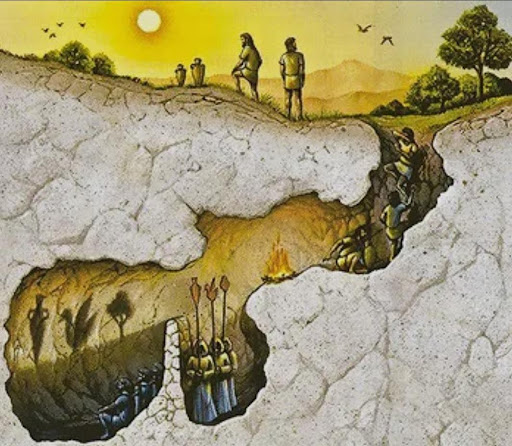
When you are exposed to things you know nothing about you start creating your own meanings for it. Whatever you see, you feel, you hear will be deciphered according to your thinking ability and the will to understand it. A core example of this act is given by Plato in his allegory of the cave where people are tied with chains and made to look at one wall they are faced towards. Plato says the shadows – the third form – shown on the wall are of the artists, and poets who are mere imitators and someone far away from truth who are not the creator of something. For the prisoners, it is like a puppet show where artists are mocked. If we look at this image from an alternate angle we will see that these shadows are not of artists but of the people with ruling power, the bureaucrats and the politicians who are showing us what they want us to see only, veiling the ultimate truth from us. We are those prisoners who are kept in darkness and taken advantage of our obliviousness. The truth remains outside the cave where there is light and objects – the second form.
Whereas, in Islamic theology caves offer you the truth. They are used as a symbol of protection from evil and the landmark of safety. As discussed in Surah Kahf, Allah shielded those who abandoned the worldly distractions and drew them closer to Him. He increased them in guidance and strengthened their hearts. Sufis adopt a similar pattern of segregation and withdraw themselves from the world, seeking divine protection and guidance. Shams Tabraiz was a dervish who operated beyond form and doctrine. He once said that if the Ka’aba were suddenly lifted up out of the world, we would see that each person is really bowing five times a day to every other person. On the other hand, the story of the first revelation of the Holy Book of Islam, the Quran, takes us to the cave of Hira, where Angel Jibreel commanded Prophet Muhammad
(PBUH) to “Read” (Iqra’), marking the beginning of prophethood. It was long after many years of sincere spiritual preparation that he was revealed to this. Cave of Hira has always been his escape and retreat for a deeper understanding of the world.
In short, no matter what cave story it is, they all take us to a single junction, the voyage of truth and reality. Every sane person who tries to stay aware of the happenings in his life and the world around him remains filled with curiosity, asking numerous questions about how the world actually works. The freed prisoner in the allegory of the cave is the one who made an attempt and used his mind to seek enlightenment and exposure to knowledge. It’s all about your intellectual level, how you choose to stay in this world.