





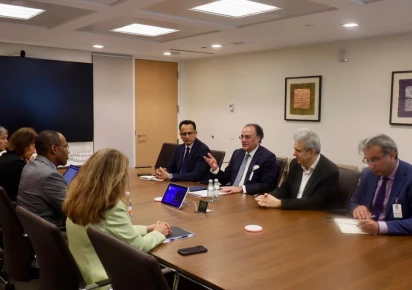
Finance Minister Muhammad Aurangzeb held a series of meetings with senior International Monetary Fund (IMF) officials to review Pakistan’s macroeconomic performance, progress under the Fund-supported programme and the government’s ongoing economic reform agenda, the Finance Ministry said on Thursday.
Pakistan is currently implementing a $7 billion IMF-supported programme, which has required higher taxes, fiscal restraint and structural reforms aimed at stabilising the economy. The country narrowly avoided a sovereign default in 2023 after securing a $3 billion IMF standby arrangement, followed by the approval of a $7 billion Extended Fund Facility (EFF).
Despite recent economic improvements, Pakistan’s foreign exchange reserves continue to depend heavily on IMF disbursements, bilateral financial support and the rollover of external deposits.
The country’s vulnerability was highlighted in April when it repaid approximately $3.5 billion to the United Arab Emirates, equivalent to about one-fifth of its reserves at the time, while Saudi Arabia extended $3 billion in fresh financial support. The State Bank of Pakistan has projected that reserves could rise to around $20 billion by the end of 2026, approaching their 2021 peak.
According to the Finance Ministry, Aurangzeb met First Deputy Managing Director Dan Katz, Deputy Managing Director Nigel Clarke, Middle East and Central Asia Department Director Jihad Azour, and IMF Mission Chief for Pakistan Iva Petrova.
During the meetings, the two sides reviewed Pakistan’s progress under the Extended Fund Facility (EFF) and the Resilience and Sustainability Facility (RSF), as well as the broader reform programme supported by the IMF.
Aurangzeb highlighted improvements in the country’s fiscal and external positions, including the achievement of revenue targets, stronger foreign exchange reserves, record remittance inflows and a healthier current account balance.
The discussions also covered key structural reforms, including tax and energy sector reforms, privatisation, tariff rationalisation, debt management, diversification of financing sources and Pakistan’s planned return to international capital markets.