





Israel’s parliamentary election remained too close to produce a clear governing majority on Wednesday, with neither Prime Minister Benjamin Netanyahu’s right-wing alliance nor opposition leader Gadi Eisenkot’s centrist bloc securing the support needed to control the Knesset. An unexpectedly strong performance by Arab parties, however, could give them a decisive role in determining the country’s next government.
With more than 85 per cent of votes counted, projections indicated that neither major political alliance was on course to secure the 61 seats required for a majority in Israel’s 120-member parliament.
Netanyahu nevertheless adopted a confident tone while addressing supporters at Likud headquarters in Jerusalem early Wednesday, celebrating his party’s position as the largest individual political force.
“We must establish a strong, right-wing, nationalist government,” he declared, urging rival political groups to support his efforts to form the next administration.
The prime minister also highlighted Israel’s military operations since the October 7 attacks three years earlier, presenting his government’s security record as a central argument for remaining in office.
His principal challenger, former military chief Gadi Eisenkot, was equally confident. Addressing supporters in Tel Aviv, Eisenkot claimed victory for what he described as “Israel’s Zionist national majority”.
Despite the competing declarations, the emerging parliamentary arithmetic suggested that coalition negotiations would be necessary before either leader could establish a government.
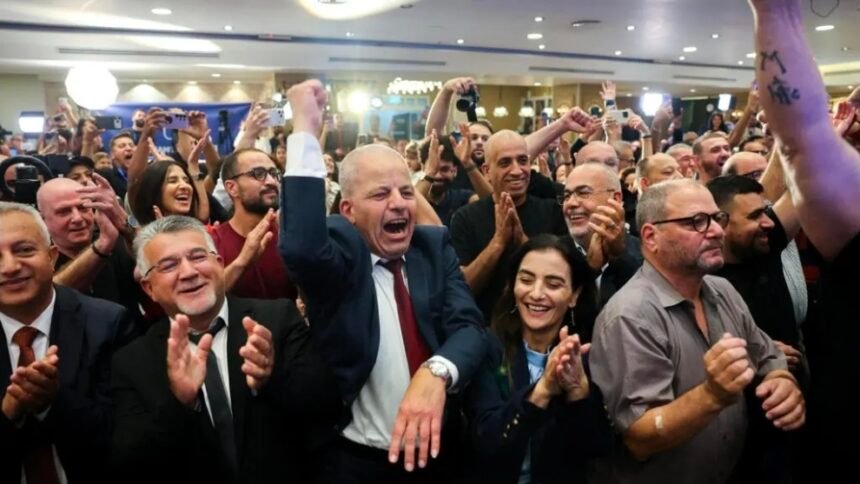
The election’s most significant development was the unexpectedly strong showing by the predominantly Arab Joint List alliance and Ra’am, also known as the United Arab List.
Together, the two parties were projected to secure approximately 19 parliamentary seats, potentially placing them in a pivotal position in negotiations over the formation of a governing coalition.
Their performance was supported by unusually high voter participation among Arab citizens of Israel, with turnout exceeding 77 per cent, its highest level in nearly three decades.
Arab citizens, most of whom are of Palestinian descent, account for approximately 21 per cent of Israel’s population but have historically recorded lower electoral participation than other sections of the electorate.
In the previous parliamentary election in 2022, Arab parties secured only 10 seats, making their projected gains particularly significant.
Ra’am leader Mansour Abbas welcomed the results as evidence of the community’s growing political influence.
“We’ll translate this electoral power into an influential political force,” Abbas declared. “We’re here – not on the sidelines.”
The outcome could substantially increase the bargaining power of Arab lawmakers, particularly if Eisenkot seeks their support to assemble a parliamentary majority.
However, any such arrangement would depend on negotiations between parties with differing political priorities and positions on Israel’s future direction.
As the remaining ballots were counted, the election appeared increasingly likely to produce a fragmented parliament, with the unexpectedly strong Arab representation emerging as a potentially decisive factor in the struggle to form the next government.