





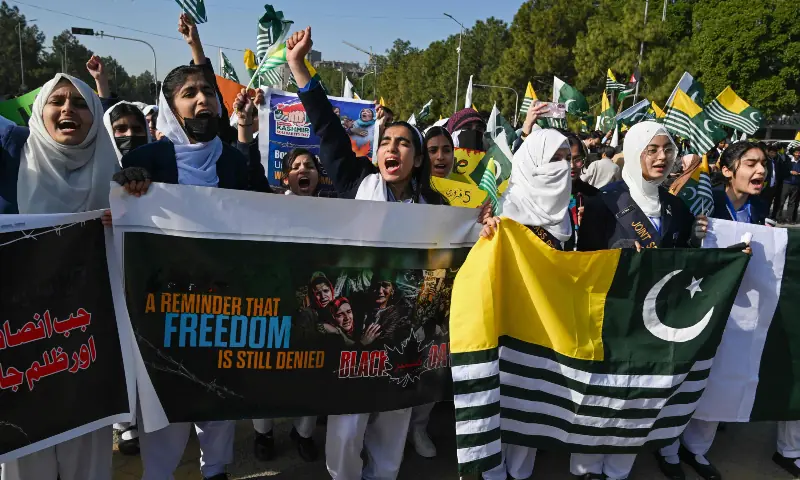
Pakistan’s top leadership on Tuesday reiterated its commitment to supporting the people of Indian-Illegaly Occupied Jammu and Kashmir (IIOJK) as the country observed Kashmir Black Day, marking 79 years since Indian troops arrived in Srinagar on October 27, 1947.
Prime Minister Shehbaz Sharif and President Asif Ali Zardari issued separate statements expressing solidarity with the Kashmiri people and calling for a peaceful resolution of the longstanding territorial dispute.
In his message, Prime Minister Shehbaz described the arrival of Indian forces in Srinagar as the beginning of a “tragic chapter” in the history of Jammu and Kashmir, whose consequences continued to affect the region nearly eight decades later.
He voiced serious concern over the prolonged detention of Kashmiri political leaders, activists and human rights defenders, highlighting the importance of protecting fundamental freedoms and political rights.
“Pakistan’s position on Jammu and Kashmir remains clear, consistent and principled,” the prime minister said.
He maintained that lasting peace and stability in South Asia would remain difficult to achieve without a just and peaceful settlement of the Kashmir dispute in accordance with relevant United Nations Security Council resolutions and the aspirations of the Kashmiri people.
Paying tribute to generations of Kashmiris, Shehbaz said countless men, women and children had made immense sacrifices in their struggle for their rights.
He said their sacrifices would continue to be remembered and honoured, reaffirming the solidarity of Pakistan’s government and people with Kashmiris.
President Asif Ali Zardari, in a statement issued by the Presidency, also drew attention to the conditions faced by residents of Indian-administered Jammu and Kashmir since October 27, 1947.
He said the region’s population had experienced decades of conflict, restrictions and denial of fundamental rights, stressing that the situation required continued international attention.
The president expressed concern over reports of human rights violations, arrests, restrictions on civil liberties and the extensive presence of security forces in the territory.
He said “continuing restrictions on fundamental freedoms, heightened militarisation, arrests and reports of human rights violations remained a matter of serious concern and underscored the need for sustained international attention”.
Kashmir Black Day is observed annually in Pakistan on October 27 to commemorate the arrival of Indian troops in Srinagar in 1947, an event that remains central to the competing historical narratives surrounding the Kashmir dispute.
Pakistan maintains that the future of Jammu and Kashmir should be determined in accordance with relevant United Nations resolutions and the wishes of its people, while India considers the territory an integral part of the country.
The dispute remains a longstanding source of tension between the two nuclear-armed neighbours, with Islamabad continuing to advocate international engagement and a negotiated settlement.