





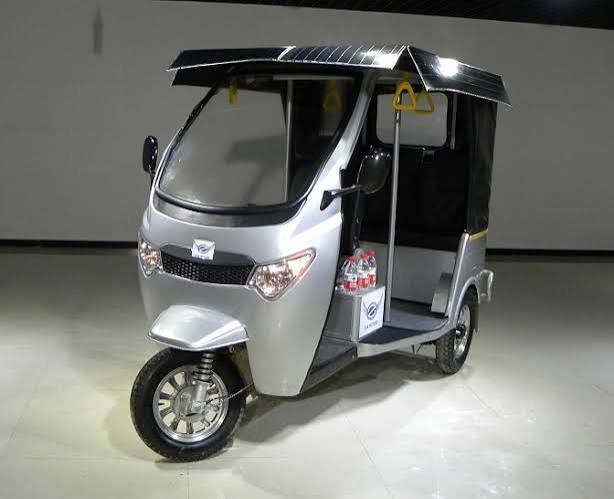
There are legislators, governance leaders, visionaries, innovators, and then comes Arshad mechanic, who has very boldly entered the aerospace sector as of last Wednesday. He made his entry decisively equipped with an electric rickshaw, three BISP 8171 cards (which he guarantees are “top-tier fuel”), and a government-issued laptop.
The executives continue to introduce EV reforms — which have proven to be transformative — complete with borrowed jargon, articulate speeches, and conceptual visuals of a more eco-friendly Pakistan. Arshad has decided to accelerate the ambition, arguing that there is no point in stopping at electrifying roads when it is possible to electrify and energise space.
Whilst screwing in a bolt that seems to have no functional role, he says, “Logon ki soch hi choti hai, kyunke ye EV scheme future ke liye hai is wajah se ye sirf gaariyon ke liye nahi hai, waisey bhi future zameen pe thori hona hai?”
He regards his workshop — which is sandwiched between a tyre repair shop and a local tea kiosk — as the operations centre for Pakistan’s first-ever electric rickshaw space program. There’s a decorative highlight as well: a slightly off-centre rickshaw with chipped paint, secured (optimistically) with wires, confidence, and tape.
On its right side, “Operation Chand – Active” is written in black paint, bold and in uneven lettering. The setup seems questionable at first look; as one pays more attention to it, it raises even more questions. The core modification of the vehicle is the government-issued laptop, which is fastened on its roof with tape and optimism.
“This isn’t any ordinary laptop,” Arshad asserts. “Ismein vision hai, policies hain aur plan hai. Aapko samajh nahi aayegi — ye ek poora navigation system hai.” Arshad states with unwavering confidence that the laptop takes in what he calls “developmental power” from state initiatives and converts it into momentum.
When inquired about the mechanics of this transformation, he mockingly waves his hand and says, “Bohat technical baat hai. Aap nahi samajh sakein gey.” The key innovation he claims, however, is present in the fuel system. “Bijli ne ghayab ho jana hai, petrol khatam ho jaye ga,” Arshad says, raising his shoulders. “Isi liye main ne socha woh cheez istemaal ki jaye jo kabhi khatam nahi hogi.”
And upon finishing this sentence, he very gently takes out three BISP 8171 cards from his folded wallet. “Yeh dekhein,” he says, holding up the cards like unique collectibles. “Government-funded propulsion. Sirf teen cards lagao, aur ek orbit free pao.”
Although the logic appears to be irrational, it is delivered with such firmness and certainty that for a short while, it almost seems believable — like most things do when communicated with assurance and fitting professional lingo.
The Reality of the Ground
Life continues as usual around him. A customer bargains and argues over the price of a puncture patch. The chaiwala can be heard complaining about inflating milk and sugar costs. The voltage fluctuates, and then all of a sudden the power goes out, before returning briefly just to make everyone aware of what they are missing out on.
Now, this is exactly where Arshad’s project becomes less comical and more oddly familiar. Because while statutory documents highlight national charging channels and flawless EV switchovers, the common citizen still mediates with a timetable of load-shedding that determines everything from work to sleep schedules.
Charging an electric vehicle in conditions like these feels more like a trial of perseverance than growth. Arshad, however, remains undaunted. “Load-shedding toh sirf idhar ki problem hai,” he clarifies. “Space mein full bijli aati hai, direct supply, koi feeder trip nahi hota wahan.”
His statements may be scientifically dubious, but they are realistic in emotion. Coming from a system where solutions often seem unreal and impractical, the concept of simply leaving the issue behind — by quite literally launching yourself into space — holds appeal.
Official Stance
When officials were informed about Arshad’s initiative, they were conditionally supportive. One of the representatives stated, “We encourage and appreciate innovative thinking at the base level, as it surely reflects the success of our regulations in motivating the public.”
When questioned about the possibility of any official support for the initiative, the answer came promptly: “We are doing the best we can and are extending our moral support already.”
Meanwhile, preparations remain in full swing back at the workshop. A damaged motorcycle helmet is used as astronaut gear; a plastic chair with only three of its legs intact is screwed into the rickshaw and apparently used as the command seat; and a short checklist containing items like “baad mein dekh liya jayega” and “adjust kar lein gey” helps to manage everything systematically.
The first phase is very simple according to Arshad: reach the moon. Phase two is even more clear-cut: Mission Mars. “Bas kuch aur schemes introduce ho jayein, aur ek extra laptop mil jaye toh Mars tak pahunchna bohat aasan hai,” Arshad states confidently.
The rickshaw, for the time being though, stays on the ground — not due to low motivation, but because of a power outage lasting the past eight hours. Arshad still waits patiently. In a place where announcements travel beyond reality and grand schemes surpass electrical speed, this initiative resembles government work more: exaggerated, preposterous, and unsettlingly true.