





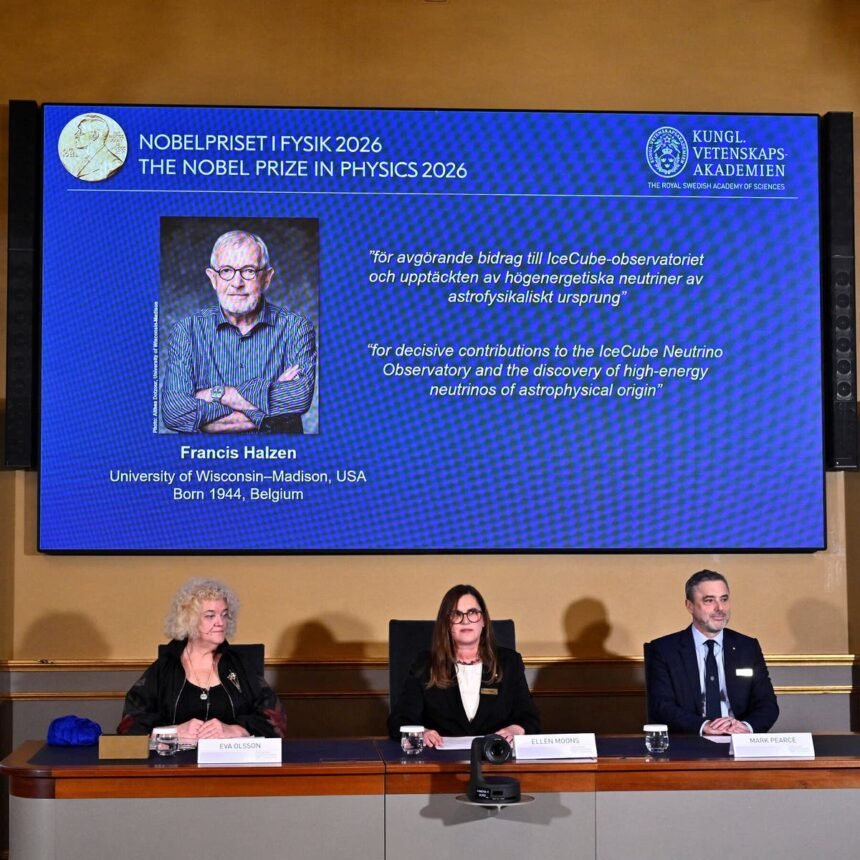
Belgian physicist Francis Halzen has won the Nobel Prize in Physics for his pioneering work with the IceCube Neutrino Observatory at the South Pole and the discovery of high-energy neutrinos originating beyond our solar system.
“This year’s prize is about ghostly messengers from space,” said Ellen Moons, secretary general of the Royal Swedish Academy of Sciences, while announcing the award on Tuesday.
The Nobel jury recognised Halzen “for decisive contributions to the IceCube Neutrino Observatory and the discovery of high-energy neutrinos of astrophysical origin.”
Buried deep within Antarctic ice, IceCube uses thousands of light sensors spread through roughly a cubic kilometre of ice to detect neutrinos — elusive subatomic particles that can carry information from some of the most energetic events in the universe.
The Royal Swedish Academy said Halzen’s “vision and scientific leadership” had been fundamental to developing the observatory.
“This Nobel Prize is about a giant ice cube positioned at the South Pole of our globe. The ice cube enables the detection of neutrinos,” Nobel Committee member Eva Olsson explained.
Halzen, 82, was born in Tienen, Belgium, and is a professor at the University of Wisconsin-Madison in the United States.
Reacting by telephone shortly after the announcement, Halzen said the award had come as a complete surprise.
“It was a great surprise, and I obviously didn’t expect it,” he said. “But it’s a great pleasure to hear about this prize.”