





Nostalgia is a feeling where you are in melancholy and delightfulness at the same time. In simpler words: you are happy and sad. The rarest remembered moments seem to bring out the strongest feelings of nostalgia.
It is not surprising, then, that nostalgia can become a coping mechanism. One wants to escape an unstable present and retreat into the delightful realm of a lived experience, where the pleasant parts become more prominent and the disturbing ones fade into the background.
We all try to escape from the present, don’t we? Readers disappear into their fictional worlds. And even if you are not a reader, you submerge yourself in the online world — the world of the internet. We spend hundreds of hours, if not thousands, curating a perfect persona for the world to see. We try to become the best versions of ourselves in ways that feel less painful and exhausting, sometimes completely replacing our real lives with digital ones.
Unfortunate as that is, politicians are aware of this. The right wing, especially, seems to have a lot to offer in the form of a “nostalgic past.” They chant about bringing back greatness and simplicity. But whose greatness? And for whom?
It is not difficult to find a scapegoat when things are difficult; we are all, rather instinctively, looking for one. But politicians take advantage of that instinct. They offer us a scapegoat who appears to carry the same wounds that we do, and then they make us perceive this scapegoat differently — inhumanly.
They ask, “What do you see?” We say, “Humans.” They say, “No, your eyes are corrupted.
They are the reason behind all the suffering in your life.”
And even with the right glasses on, we begin to doubt ourselves. We think, “Maybe it has been too long since I had my eyes checked. Maybe my glasses are not the right number for my eyes.” They make us doubt what we see. Pakistan’s political imagination is shaped by this.
It is not a revolutionary thing to say that Pakistan lacks a left wing. Some say it died in 1954 with the disbandment of the Communist Party of Pakistan. Here, the right wing is so dominant that one can barely name any left-wing parties at all.
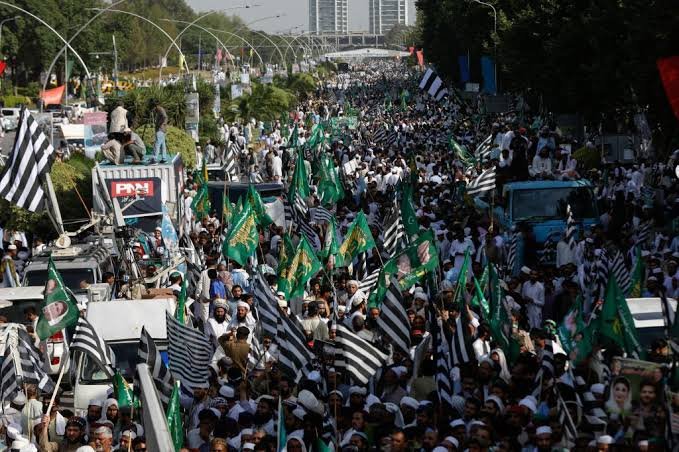
They all seem to offer their own versions of nostalgic history, which is not really ironic considering how many of them have been in politics for decades. The greatness they seem to be offering is often nothing more than a period in which they, or the people they represent, had the opportunity to present themselves as powerful sovereigns.
Some say, “We will create Riyasat-e-Madina!” Others chant, “Bhutto zinda hai!”
Current political parties are run by the children of the old generation — the people who themselves shaped the past. The whole political system is deeply influenced by the elite. They try to awaken nostalgic memories of the Bhuttos and the Sharifs, while some even get swept up in nostalgia for martial law.
But what exactly are they offering?
People often think of the best times as the years when they were teenagers or when they were very young. Every generation thinks their time was the best. The feeling we are looking for in the past may simply be the feeling of a time when we had no responsibilities, or at least fewer of them. We had a view of the world where we thought every dream was going to come true and everything was going to work out for us.
But then we became adults; we started to realise that the future might be bleak, difficult, painful, and uncertain. Unconsciously, we started remembering those days when we were free from this kind of thinking. However, just because we were not thinking that way does not mean the world did not exist that way. The past was not simpler — we just did not see or remember the complexity.
Politicians will remind you of the time when Zulfikar Ali Bhutto was in power. We forget that he emerged from the political landscape shaped by martial law. We forget his role in the events that eventually contributed to the division between West and East Pakistan. They evoke memories of the time when Nawaz Sharif was in power and CPEC was thriving, brushing off the corruption. We forget all of it. We erase the grim parts. We airbrush the details we do not like to remember.
My mother used to tell me a story about how she and her siblings would visit their maternal grandmother’s house, where they would watch movies together. But they had to be careful, because watching movies at night was something that was frowned upon. When I was younger and she used to tell me this story, I could not think past the nostalgic imagery.
As I grew older and began to understand more about the political history of Pakistan, I realised what period she had been describing. It was the era of Zia-ul-Haq — a time of intense state control over people’s religious and social behaviour, where even something as ordinary as watching a movie could become something that had to be hidden.
And that is what happens with memory. We recall the warmth of a house, the people sitting together, and the movies playing in the background. We recall the feeling. We remember the nostalgia, but we forget the political reality surrounding it. We erase the grim parts; we discard the details we do not like.
Pakistan’s political system is filled with parties that were formed decades ago. The mainstream parties are either inherited by the children of the people who founded them or, even when a new party is formed, it is often filled with the old faces of different parties. In this country, if a new party starts gaining recognition, it is rarely because the system itself has changed. There is usually something behind it — some new narrative, some new propaganda, some new promise. It is never that simple.
This is a country where people remain loyal to the children of the people who were ruling during their teenage years, or to the parties their parents used to follow. Political loyalty becomes something inherited, almost like a family tradition.
Perhaps it is time we start to realise that the past was grim. Yes, our pink Barbie doll phones, fidget spinners, and jhandiyas on the 14th of August were beautiful. Those moments and memories are beautiful. But you only have the pictures of those particular moments. If you were to live the whole memory again — to live that entire period of history again — you would realise how grim it actually was. We remember the moments, but we forget the circumstances that surrounded them.