





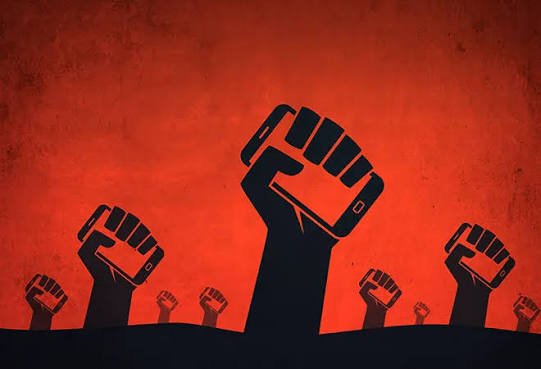
Press like, repost and maybe comment. The guilt subsides for a second; you can breathe knowing you’ve done something. But the thought at the back of your mind persists: “Am I actually making a difference?”
So you put it on your Instagram story. The world knows you’re on the right side of history, and surely that’s good enough. Now scroll past and laugh at a relatable meme. Thirty seconds pass, and we’ve already forgotten the face of the helpless child dying at the hands of the oppressor.
Before pointing fingers, I’ll be the first to say it: I’ve been there and still am there. It’s easier to hide behind the screen than stand vulnerable on the street. It’s easier to type a few words of support than raise your voice till your lungs ache.
No, it doesn’t negate any efforts to advance justice and speak out against wrongdoing. Yet, undoubtedly it takes immense courage to put your life, safety and everything on the line for the sake of truth and humanity.
In 2024, a post depicting the words “ALL EYES ON RAFAH” was shared by 47 million people. That number is indeed incredible and has brought light to atrocities being committed against the Palestinian people, but how many Rachel Corries are there? She was a 23-year-old activist who was brutally killed by Israeli bulldozers in 2003. Do we have the courage to stand before a bulldozer in order to defend another’s home from unlawful demolition?
Rachel is not the only example. So many have been arrested around the world for peaceful protest. Students have been denied their degrees for openly showing support for Palestine. Honest workers have been fired for speaking out against their employers’ unjust practices. Doctors have lost lives to save lives. Journalists have been killed just because they picked up a camera to show the horrific realities imposed upon Palestinians.
With social media, news catches fire fast and is extinguished just as fast. But these moments of real protest leave an imprint on your life – and, in most cases, cost you it as well.
The same goes for every other humanitarian issue. Kashmir has been suffering for many years, torn apart by power-hungry oppressors and used as a pawn to justify their political desires. But it takes incidents of violent state brutality to repeat for Kashmir’s name to be known by the algorithm again.
What horrifies me the most is that this society has no problem with mob culture and honour killings, but we hesitate to publicly protest when it comes to standing up for what is right. Azal Ali, an 18-month-old child, was raped and murdered, but who took to the streets? Yet, more than several people gathered to brutally beat and kill Mashal Khan on the streets in 2018 for false rumours.
Why does that difference exist?
It reminds me of the words of the Prophet Muhammad (peace and blessings be upon him): “Whosoever of you sees an evil, let him change it with his hand; and if he is not able to do so, then [let him change it] with his tongue; and if he is not able to do so, then with his heart — and that is the weakest of faith.”
Every action towards good matters, but standing up against injustice has layers. Clicktivism accelerates engagement with issues, but standing and raising your voice in congregation echoes far louder and oftentimes comes at a greater price.
Surely, for justice to flourish, there must be sacrifice. The question is: to what extent are you and I willing to sacrifice?