





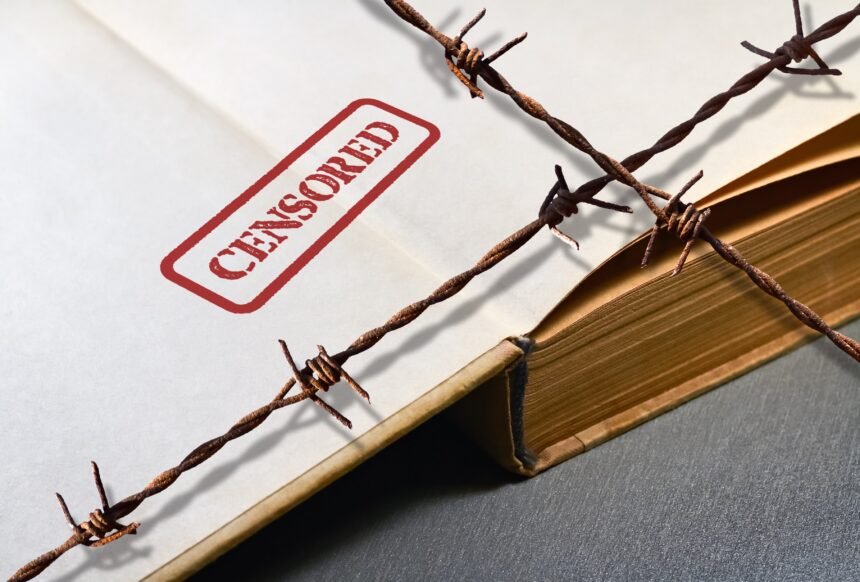
Think of a classic you love. The one you would suggest to others, whose favourite quotation you have underlined, and whose experience of reading is still engraved in your memory. Now ask yourself: are you sure you are quoting the writer, or quoting whoever decided what that writer was allowed to say?
Because chances are, the novel in your hands was never published the way it was written. A scene was cut. A character you loved for their kindness might have been written crueller in the original draft. A line was toned down before an editor even finished the first read-through. And more often than you would think, the writer did it themselves – not because a censor demanded it, but because they had seen what happened to writers who did not.
The Chilling Effect
Progressively, censoring writers has become something authorities no longer even need to do, because writers have started censoring their own original thoughts before ever writing them down. Legal and political risk alone is often enough to make someone rewrite, delay, or abandon a piece before anyone ever asks them to. PEN America gave this exact pattern a name in their 2013 report: the “Chilling Effect”.
The idea is that a chilling effect does not need to punish anyone to work; it only needs the possibility of punishment for writing against the standards of authority. No one actually has to be arrested, sued, or silenced; the writer just has to imagine that they could be, and fear does the rest. It is censorship that never technically happens because the threat of it has already done the job.
PEN’s numbers make this concrete: 85 per cent of surveyed writers said they were worried about government surveillance, and 73 per cent said they had never felt more anxious about privacy and press freedom. Nearly 800 writers were surveyed worldwide, and self-censorship among those living in democracies was found to approach levels reported by writers living under authoritarian regimes.
Which raises the real question: how does a society even arrive at this point? What exactly is building this fear inside writers, pushing them away from subjects that still shape the world we live in? According to the same report, writers specifically avoided topics like military affairs, the Middle East and North Africa, mass incarceration, drug policy, and criticism of the US government.
Historical Precedents of Dissent
Arguably, history has set clear examples for generations of writers. Consider Faiz Ahmed Faiz, who wrote rebellious pieces of literature. In 1951, he was arrested and imprisoned for four years in the Rawalpindi Conspiracy Case, accused alongside several army officers of plotting a coup against Liaquat Ali Khan’s government. He initially faced a possible death sentence before being sentenced to imprisonment instead. In jail, he wrote two full poetry collections; although his poetry might have seemed romantic on the surface, it always addressed the nation’s political state.
Even after Faiz’s death, his poetry itself was not entirely safe. One source close to his family notes that a single verse of “Hum Dekhenge” was permanently removed, even from Faiz’s own official “complete works” collection. This clearly shows that literature has been exploited in various ways. From Faiz to William Shakespeare, a writer’s originality often gets compromised at some point, which makes us reflect: if we are not consuming original work, we are not getting original interpretations of it either. Why, then, is it so vital for authorities to try and censor literature?
It is mainly because words and ideas can change the world, in both good and bad ways. Whatever we consume shapes what we become, and actively consuming content that is either desensitised or overly sanitised affects us directly. Moreover, we must consider that while freedom of expression is crucial, literature has invisible boundaries that, if crossed, carry consequences – sometimes deserved, sometimes not.
For instance, Iqbal Bano was hardly deserving of political backlash when she performed “Hum Dekhenge” at Lahore’s Alhamra Arts Council in the mid-1980s. Yet she was banned from performing in Pakistan afterwards, and military police reportedly raided the homes of audience members in the days that followed. Faiz Ahmed faced similar hostility when he was imprisoned for poetry that criticised power, not for inciting harm. Julius Streicher, on the other hand, was tried and executed at Nuremberg for a newspaper whose stated purpose was inciting the mass murder of Jews. One was punished for dissent; the other was punished for genocide. The difference between them represents the entire argument for where that invisible boundary should actually sit.
Manto and the Legacy of Uncompromised Truth
If there is one writer who understood this better than anyone, it is Saadat Hasan Manto. He was tried for obscenity six times across two countries, and every single time it was for stories that simply described things as they actually were: Partition violence, poverty, and the hypocrisy nobody wanted spoken out loud. He never once tried to write around it, even knowing what waited for him in court. When people called his work dirty, his answer was simple: if you find my stories dirty, then the society you live in is dirty. He was not making any of it up; he just was not willing to look away like everyone else.
He did not live to see himself proven right, however. He died poor, mostly written off by the literary establishment of his own time. It is only now, decades later, that the same stories once dragged into court are taught as some of the finest short fiction Urdu literature has ever produced.
And that is really the point we have been circling for decades. Manto is rare precisely because he is the exception. Most writers facing even one obscenity trial, let alone six, would have quietly started writing around the edges of what got them into trouble. That is the novel that censors itself: not banned, not edited by force, but gradually rewritten from the inside by a writer who has learned what the room can and cannot tolerate. And undoubtedly, some rooms simply cannot tolerate truth.
sooo impressive 📈 ✨ keep going
This was such an eye-opening read. The idea that censorship can become self-censorship is especially unsettling. Manto’s story makes the cost of refusing to compromise the truth impossible to ignore.
I remember as a kid every time I’d finish reading a book, id unconsciously adopt the personalities of its characters, especially those the writer presented as “correct”, but now all I can think about is how many books have been stripped of their original ideas, and how much of the literature we consume today are merely the remains of what the writer actually intended to say. Its devastating to think that something as original, political, and powerful as literature could threaten a corrupt system as well as those who benefit from it, creating fear around even thinking about the injustice they perpetuate