





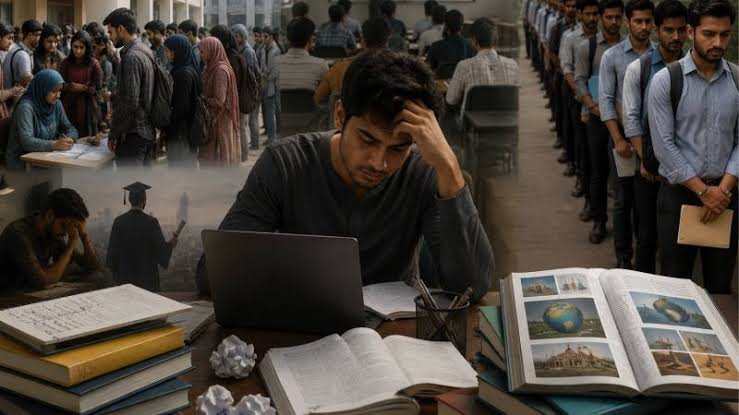
In today’s world of intense competition, merely obtaining a degree doesn’t guarantee stability and success. The reason is that our education system is more focused on good grades rather than practical skills. Cramming is encouraged, while creativity is not given importance. Only those students who can memorise well get good grades. As a result, we have learners, not critical thinkers.
The culture of cramming has damaged independent thinking. Students who earn good grades are often those who can memorise textbooks to the best of their ability. Many youngsters who have been toppers throughout their academic careers cannot work practically because they lack decision-making skills and have never used their brains to think beyond what is written in their textbooks. So, they end up jobless.
These flaws in the educational system contribute to unemployment. According to the Pakistan Institute of Development Economics (PIDE), over 31% of educated youth in Pakistan are unemployed. Even the fields that were traditionally considered secure no longer guarantee employment. According to PIDE, the unemployment rate among engineering graduates increased from 11% to 23% in just 2 years. These statistics show that degrees alone are not enough in today’s world.
The pressure from parents on students regarding career choices is also causing significant problems. In Pakistan, there is a belief that only doctors or engineers can be successful, or that these are the only professions that can guarantee financial stability. This mindset forces youngsters to study pre-medical or pre-engineering subjects at the intermediate level even when their personal interests lie in the arts, computers, or other fields. Ignoring their personal interests affects their performance, and such students mostly fail to secure admission in medical or engineering colleges. After that, they are left with very limited options. For example, a person with FSc pre-medical is not eligible for BS IT or BS AI in most universities. This is how a wrong decision affects their future, and most of them go through phases of stress and depression, harming their physical and mental health. There is a dire need for a change in the mindset of Pakistani parents so that students can freely choose their future.
Every person possesses unique and individual abilities. Not everyone is born to be a doctor or engineer. All professions are noble, and parents should not burden their children. Every student should have the right to decide his future for himself, according to his interests and passions. Parents should support them instead of forcing their will on them.
All these issues demand urgent educational reforms in Pakistan. Instead of rote learning, the education system should focus on creativity, critical thinking and practical skills. These educated individuals have to lead the country in the future, and without leadership skills, they cannot make a name for themselves in the world.
Degrees are not certificates of intelligence; they only show how well a person can memorise information. Having degrees in today’s Pakistan cannot guarantee a suitable job. Degrees are no more than a piece of paper without practical knowledge and the ability to live in the real world.
Education has the power to bring change. As Nelson Mandela said, “Education is the most powerful weapon which you can use to change the world.” If reforms are introduced, our education system can produce responsible individuals who can contribute to the betterment and well-being of society.